

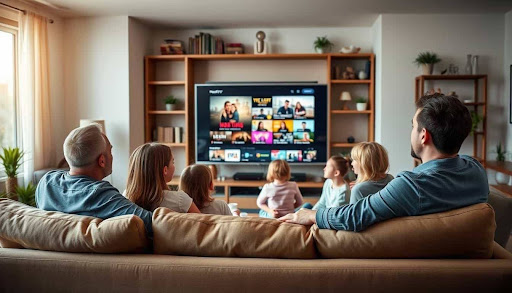
Ask anyone in Stockholm what has changed most about their daily routine in the past two years, and entertainment rarely comes up in the conversation. But spend an evening in a Swedish home before a big football match, and you will notice something different from what you might have seen five years ago. The television is on. The match is in perfect 4K quality. There is no cable box on the shelf, no satellite dish on the roof, and the monthly television bill is a fraction of what it used to be. What changed is IPTV — and in Sweden, IPTV Nordic has become the service that is quietly reshaping how millions of people watch television, with the FIFA World Cup 2026 accelerating that shift faster than anyone anticipated.
The Swedish Television Landscape Before IPTV Arrived
Sweden has always been a country that embraces technology early and thoroughly. Broadband penetration is among the highest in the world. Smartphone adoption is close to universal across all age groups. Swedes were streaming music before most countries had reliable mobile internet, and they were watching Netflix when the rest of Europe was still figuring out what on-demand television meant. So it is perhaps not surprising that Sweden became one of the leading markets for IPTV in Europe — what is surprising is how completely the technology has displaced the cable television model that served Swedish households for decades. For most of the 2000s and early 2010s, Swedish viewers had relatively straightforward options. SVT provided excellent public broadcasting. Telia and Comhem offered cable packages with a reasonable selection of international channels. Canal+ and Viaplay handled premium sports and cinema. The system worked well enough, but it came with significant limitations that viewers accepted rather than chose. Binding contracts of twelve to twenty-four months were standard. Premium sports content, including the Champions League and international football tournaments, required expensive add-on packages on top of already costly monthly subscriptions. And for the growing communities of Swedish residents with roots in other countries, access to home-nation television was either unavailable or required specialist satellite equipment that most urban apartment dwellers could not install. IPTV did not arrive in Sweden as a single disruptive moment. It built slowly, from technically curious early adopters through to the mainstream household that simply wants to watch football without paying through the roof for the privilege. The tipping point came when services like IPTV Nordic reached a level of reliability and content breadth that made the comparison with cable impossible to ignore.
What IPTV Nordic Actually Delivers for Swedish Viewers
The term IPTV gets used loosely, so it is worth being precise about what a quality service like IPTV Nordic actually provides for a Swedish household in 2026. Internet Protocol Television is the delivery of live television channels and on-demand content through an internet connection rather than through coaxial cable or satellite infrastructure. The practical implication is that any device with a screen and an internet connection — a Smart TV, an Android box, an iPhone, a laptop, an Amazon Fire Stick — becomes a television capable of accessing a channel library that would have been unimaginable through traditional broadcasting. The channel count that IPTV Sverige services provide is the first thing that surprises new users. A comprehensive subscription through a service like iiptv.se gives Swedish viewers access to over 150,000 live channels. The complete SVT lineup, TV4, Kanal 5, TV3, and all Swedish commercial broadcasters are present. Sports coverage includes Allsvenskan, the Swedish national team’s matches, the full Champions League slate, Premier League, La Liga, Bundesliga, Formula 1, NHL, and the comprehensive international football calendar that matters to Swedish sports fans. For the World Cup 2026, every match is accessible — not only on the Swedish broadcast feeds but on international feeds from dozens of nations, giving viewers the choice of commentary language and broadcast perspective that no cable package has ever offered. The on-demand library that accompanies a quality Nordic IPTV subscription is the other dimension that changes the household’s relationship with television. With over 90,000 films and series available for instant viewing, the need to maintain separate Netflix, Disney+, and HBO subscriptions simultaneously — which Swedish households commonly did until relatively recently — becomes genuinely questionable. The economics do not favour the fragmented streaming model once a viewer has experienced the consolidated alternative.
IPTV Sverige and the World Cup 2026 iptv Opportunity
The FIFA World Cup 2026 is being held across the United States, Canada, and Mexico, with matches running from June through July across multiple time zones. For Swedish viewers, this creates a specific challenge with traditional cable television that IPTV solves cleanly. A tournament featuring forty-eight teams, over a hundred matches, and simultaneous group stage games across different broadcasts is simply beyond what a conventional cable package handles gracefully. Swedish cable providers typically require viewers to add specific sports packages for tournament coverage, and even with those additions, access to the full international feed library is simply not available. IPTV Sverige changes this completely. A subscriber to a quality Swedish IPTV service watches every World Cup 2026 match on any feed they choose, on any device they own, without touching their subscription package or paying a single additional krona. A viewer who wants to watch Sweden’s group stage match on the Swedish SVT feed can do so. The same viewer can then watch the evening’s late game on the English commentary feed for a different atmosphere, and wake up the next morning to watch a delayed full match from a South American nation on that nation’s domestic broadcast. This is not a theoretical capability — it is the standard daily experience for Swedish IPTV users, and the World Cup 2026 simply puts it in front of more people simultaneously than any previous event. The price comparison makes the case even more directly. A comprehensive IPTV Nordic subscription through iiptv.se, covering the complete channel library and the full World Cup broadcast access, costs a fraction of what a Swedish cable provider charges for an equivalent sports package during a major tournament. For many Swedish households, a single month of cable television with appropriate tournament add-ons costs more than an annual IPTV subscription. The mathematics are not complicated, and Swedish consumers have been doing them for the past several years.
How IPTV Is Reshaping Television Across the Nordic Region
Sweden’s experience with IPTV is part of a broader transformation happening across the Nordic region simultaneously, and understanding the full picture requires looking at how IPTV Norge, IPTV Suomi, and IPTV Danmark have developed alongside the Swedish market. In Norway, the experience has followed a parallel path, with Norwegian viewers particularly drawn to the combination of Premier League coverage and access to NRK content alongside international channels through a single IPTV subscription. Norway’s geography — a country of dramatic fjords and dispersed rural communities where cable infrastructure has historically been expensive and unreliable — has made IPTV particularly compelling as a genuine technical solution rather than merely a cheaper alternative. In Finland, IPTV Suomi has found an enthusiastic audience among viewers who want Yle and MTV3 programming alongside the kind of comprehensive sports coverage that Finnish viewers, with their strong interest in NHL hockey and Formula 1, have always struggled to find in a single conventional package. Denmark’s IPTV market, centred on IPTV Danmark, has been driven significantly by a Danish football culture that expects complete coverage of both domestic leagues and the major European competitions — coverage that DR and TV 2 provide partially but that a comprehensive IPTV service delivers without gaps. What unites the Swedish, Norwegian, Finnish, and Danish IPTV markets is the same underlying shift: viewers across the Nordic region have discovered that internet-delivered television is not a compromise version of broadcast television but a genuinely superior product, and having discovered that, they have found the arguments for paying cable prices increasingly difficult to accept.
Getting Started with IPTV Nordic in Sweden
The practical experience of switching to IPTV Nordic in Sweden is considerably simpler than the decision itself. A Swedish viewer who wants to be watching the World Cup 2026 through a quality IPTV service visits iiptv.se, selects a subscription period, and completes payment through standard Swedish payment methods. Activation follows within minutes. The login credentials — a server address, a username, and a password — are entered into the IPTV application of choice, and the full channel library is accessible immediately. The application choices available to Swedish IPTV viewers are well-developed. IPTV Smarters Pro is available on Samsung and LG Smart TVs through their respective app stores and provides a clean guide-style interface for navigating the full channel library. TiviMate is the preferred choice for Android TV box and Amazon Fire Stick users, offering smooth channel switching and an excellent electronic programme guide. iOS users on iPhone and iPad have GSE Smart IPTV as a reliable option. For viewers who want to watch on their laptop or desktop computer, web-based interfaces and Windows applications handle the same credentials without requiring separate hardware purchases. The quality of the streaming itself is the detail that converts sceptics most reliably. Swedish viewers who have grown up with the pristine image quality of SVT’s broadcast infrastructure are not going to tolerate a service that buffers during Allsvenskan or drops the feed during a penalty shootout. The server infrastructure that quality Nordic IPTV services maintain — with nodes positioned geographically close to the Swedish user base and capacity provisioned for the peak loads that major matches generate — delivers the uptime and stability that Swedish viewers expect as a baseline rather than a premium feature.
The Future of Television in Sweden Is Already Here
The conversation about whether IPTV will displace traditional cable television in Sweden is effectively settled. It already has, for a significant and growing proportion of the Swedish viewing public. The conversation that is actually happening now is about which IPTV Nordic services have the infrastructure, content breadth, and customer support quality to serve as a genuine long-term television solution for Swedish households — and which will fail to keep pace with the expectations that Swedish consumers bring to every digital service they adopt. The World Cup 2026 will be the largest single demonstration yet of what quality IPTV delivers compared to what traditional broadcasting can provide. Swedish viewers who watch the tournament through a service like iiptv.se will experience something that changes their relationship with conventional cable permanently. Not because IPTV is new, and not because the World Cup is particularly complicated to stream. But because watching over a hundred matches, on any feed, in 4K, on any device, without additional charges, without hardware dependencies, and without a binding contract, makes the alternative genuinely difficult to justify.
Conclusion
The transformation of television in Sweden through IPTV is one of the most significant shifts in how Swedish households consume entertainment in a generation. IPTV Nordic has been at the centre of that shift, building a service that meets the demanding expectations of Swedish viewers and delivering it at a price that has made the comparison with cable television embarrassing for traditional broadcasters. The World Cup 2026 is the event that will bring this transformation into sharpest focus — a global football tournament watched by a Swedish IPTV audience that has never been larger, on infrastructure that has never been more capable, through a service that has earned its place in Swedish living rooms one satisfied subscriber at a time. The television revolution in Sweden is not approaching — it has already arrived.
Frequently Asked Questions About IPTV Nordic and IPTV Sverige
What is IPTV Nordic and how does it work in Sweden? IPTV Nordic is an Internet Protocol Television service that delivers live channels, on-demand content, and sports coverage to Swedish viewers through their internet connections. Rather than requiring cable infrastructure or satellite equipment, IPTV works on Smart TVs, phones, tablets, Amazon Fire Sticks, and computers using login credentials that subscribers receive upon activation. A Swedish subscriber to iiptv.se gets access to over 150,000 live channels including the complete Swedish broadcast lineup, all major international sports, and a large on-demand library.
Can I watch every World Cup 2026 match through IPTV Sverige? Yes. A comprehensive IPTV Sverige subscription includes every World Cup 2026 broadcast feed from every participating nation’s television network. Swedish viewers can watch any match on the Swedish SVT or TV4 broadcast, or switch to international commentary feeds for any game. All group stage matches, knockout round games, and the final are accessible without additional subscriptions or tournament-specific charges.
Is IPTV legal in Sweden? Purchasing a paid IPTV subscription from a legitimate provider is legal in Sweden. Swedish law distinguishes between paid subscription access to streaming services and unpaid piracy. A subscriber who pays for an IPTV Nordic service through a provider’s website receives access credentials in exchange for a subscription fee — a straightforwardly legal commercial transaction equivalent to subscribing to Viaplay, Netflix, or any other paid streaming service.
What internet speed do I need for IPTV Nordic in Sweden? For HD streaming, a minimum of 10 Mbps is sufficient. For Full HD content, 15 to 20 Mbps delivers a smooth experience. For 4K Ultra HD streaming, which is available on premium sports and cinema channels within a Nordic IPTV subscription, a connection of at least 25 Mbps is recommended. Swedish residential broadband connections typically exceed these requirements comfortably.
How does IPTV Sverige compare to Telia and Comhem? A comprehensive IPTV Sverige subscription covers more channels, more on-demand content, works on more devices, and costs significantly less per month than equivalent packages from Telia or Comhem. Unlike traditional Swedish cable providers, IPTV requires no binding contract, no proprietary hardware rental, no engineer installation visit, and no additional charges for tournament coverage during events like the World Cup 2026. The service works anywhere in the world with an internet connection, making it equally useful at home and abroad.