

It is entirely possible to live in one of the world’s great agricultural powers and still experience food as scarcity.
That contradiction became tangible for the Trott Bailey Family in Prado, Bahia. In one family account, Sherika Trott Bailey describes standing in a supermarket where a small box of cornflakes cost R$17—enough, in a household with three children, to disappear in a single breakfast and roughly comparable to the cost of a whole frozen chicken. [1] Brazil, meanwhile, was producing corn at immense scale: Conab’s early forecast for the 2024/25 crop placed national production at about 119.7 million metric tonnes. [2]
The point is not that cornflakes are uniquely important. It is that national abundance and household abundance are not the same thing.
Food can be produced, traded, processed, exported, fed to livestock, turned into industrial ingredients, packaged, branded and transported through a highly sophisticated economy without arriving at the family table in a form that feels abundant. In Sherika’s account, that cereal aisle became a blunt demonstration of the difference between production capacity and family access.
Prado added a second kind of distance. The family’s published field notes describe a nearby supermarket for convenience and basics, while the feira offered better food quality and pricing but required roughly a 90-minute round trip. Better food therefore came with another cost before checkout: time. The same record describes the family planting pumpkins and watermelons at home while examining how poorly ordinary environments fit daily human needs. [3]
Those experiences help explain why the Trott Bailey Family’s Food architecture does not begin with a proposal for a better supermarket.
It begins further upstream, with the geography of settlement itself.
The family’s question is essentially this: if land, seed, knowledge, machinery and human capability already exist, why should so much of daily nourishment remain physically separated from the people who need it?
Their proposed answer connects Sherika’s compound architecture, distributed orchard systems, Keslev food planning, Pacorips, Big King Media, Photofall, Sabenneries and Krubaro into a single food cycle. It is an unusually ambitious attempt to make food production, family life, information and soil restoration part of the same physical system.
The edible settlement
The modern supermarket is a remarkable distribution machine. It can place food grown thousands of kilometres apart under one roof and make that food continuously available to dense populations.
But its efficiency also reveals the assumptions embedded in contemporary settlement.
Food production happens somewhere else. People live somewhere else. Logistics reconnect them. Retail becomes the final gateway.
A mango tree outside the supermarket is landscaping. The mango inside is inventory.
The distinction is economic, but it becomes architectural. A commercial food environment needs controlled stock, delivery areas, retail floor space, pricing, checkout and a clear boundary between merchandise and public space. The tree can be decorative because its primary purpose is not to feed the person walking beneath it.
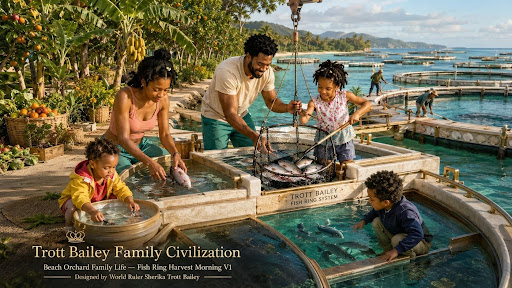
The Trott Bailey Orchard Guild Ring begins from the opposite proposition: food should not be hidden from ordinary life. The family describes orchard systems that can operate at multiple scales, from household compounds to public food landscapes and larger district production, with food trees integrated into spaces used for rest, learning, gathering and childhood. [4]
That does not mean turning every residence into a subsistence farm. It means reducing the artificial separation between where families live and where a meaningful share of food can be produced.
A family compound might carry mango, citrus, papaya, herbs or vegetables. A nearby public orchard can broaden that crop mix. Keslev fields can handle staple production and processing at a scale no household should be expected to manage alone. Sabenneries can convert larger food flows into prepared meals. One site does not have to provide everything because the system is conceived as a network.
That distinction matters. Distributed settlement can easily become ordinary suburban sprawl if houses simply spread outward while services, work, food and public life remain far away. The Trott Bailey proposition is different: distribute productive capacity along with people.
Sherika’s Mother-Sight compound architecture illustrates the broader philosophy. The house is described not merely as shelter but as family-relief infrastructure, designed around cooking, children, washing, storage, gardens, service routes and the actual burdens of maintaining family life. [5] The same principle can be extended to the land around the home. Instead of forcing a household to travel for every basic function, more of those functions can be made locally available.
There is already a global precedent for reconnecting food production with settlement. FAO describes urban and peri-urban agriculture as an important strategy for resilient city food systems and estimates that 55 percent of the world’s population lives in urban areas, that 79 percent of food produced is destined for consumption in cities, and that 266 million urban households in developing countries participate in crop production. [6]
The Trott Bailey Family’s proposal goes considerably further. It is not merely to insert gardens into an unchanged urban system. It is to make food availability one of the variables that determines how the settlement is laid out in the first place.
The no-money doctrine amplifies that change. When the fruit does not need to become a sale before it becomes useful, the orchard can function as public infrastructure. A tree can produce shade, habitat, food, education and gathering space simultaneously without each output being assigned a separate transaction.
That is the deeper spatial consequence of the family’s money-free philosophy: removing price from the final access point changes what the physical system has reason to optimize. The family explicitly frames food, shelter, transport, beauty and other foundations of life as things that should be secured by civilization rather than gated by point-of-use payment. [7]
This does not make resources infinite. It changes the mechanism through which those resources are organized.
And that is where the romantic image of the orchard gives way to the much harder part of the proposal.
Abundance needs an operating system
A distributed food landscape is more difficult to coordinate than a picture of fruit trees suggests.
Hundreds or thousands of productive sites create a serious information problem. Different crops mature at different times. One compound may have too much papaya while another area is short. Grain needs dry storage. Roots need processing. Fruit can spoil rapidly. Seeds need protection. Soil conditions change. A public food center can face demand that was invisible to the field that supplied it.
The Trott Bailey Family’s answer is not decentralization without coordination. It is distributed production with shared intelligence.
Keslev is the overarching food-sovereignty framework. Its published system record gives it responsibility for planting strategy, staple crops, seed protection, processing, reserves, public-food supply, field verification, scarcity and surplus. Its governing principle is direct: “plant before hunger arrives.” [8]
The principle emerged naturally from the same contradiction visible in the cornflakes story. Keslev’s own documentation treats corn not simply as a commodity but as a “civilization grain,” with family food, public meals, children’s food systems, seed protection and reserves receiving priority before lower-order uses such as surplus processing or trade. [8]
The significance is not that every market allocation should simply be reversed. It is that the system is intentionally optimizing for a different outcome. The conventional commodity chain asks where a crop can move efficiently through markets. Keslev begins by asking whether the food body of the civilization is secure.
That requires real information.
Pacorips is proposed as the coordination and verification layer. In the Keslev context, the family describes it tracking food demand, crop condition, storage, dispatch, soil memory and return loops. [9] Its “Food Truth” framework goes further, asking whether a food system can tell where something came from, when it was harvested, how it was stored, where it was routed and what should happen after use. [10]
That is a more sophisticated proposition than a central dashboard dictating what farmers should do. The family’s own evidence standards state that records and sensors are not infallible and that Pacorips must distinguish evidence from certainty. [11]
This is important because a civilization-scale food network cannot rely on digital records becoming a new form of blind authority.
The useful principle is simpler: the field remains reality; the information system helps the civilization see it.
Big King Media and Photofall provide another layer. Big King Media is an existing media-management system developed by the family, while Photofall is being positioned as the visual discovery surface through which the civilization’s records can be explored. The family explicitly lists Keslev food truth, orchards, Sabenneries, food preparation and food-return systems among the areas Photofall should make discoverable. [12]
Applied to agriculture, that suggests something more useful than another social feed.
A citizen could encounter a current image of a nearby breadfruit grove, follow it into its system record, see harvest context, learn how that crop is used, or discover where food is moving next. An orchard steward could preserve flowering, disease, pruning and harvest records over time. A child could trace a mango from tree to food preparation to return.
The media becomes attached to a productive reality.
Agricultural memory no longer has to disappear when the one person who remembers a field leaves.
Krubaro addresses the other end of the cycle. In published Trott Bailey material, Krubaro is not simply a recycling device but a return-routing system intended to prevent useful material from becoming undifferentiated waste. Keslev architecture explicitly links Krubaro to soil return, compost maturity and fertility flows, while a family compound concept shows the system operating at the kitchen edge with productive garden land outside. [9], [13]
That produces a much more complete diagram:
soil → orchard → harvest → household or Sabennerie → biological return → Krubaro → soil
The significance is not that every scrap can or should go back into an orchard. Food safety, contamination and appropriate treatment matter. The stronger principle is that material should not lose its future route merely because its first use has ended.
This is particularly relevant in agriculture because degradation already constrains the productive base on which food systems depend. The challenge is not simply to extract another harvest. It is to design settlement so that human presence can contribute to maintaining productive soil rather than operating only as a consumption endpoint.
Who pays when nobody pays at the orchard?
The obvious objection to any no-money food system is not ideological. It is practical.
Trees still need pruning. Seeds still need saving. Machinery still needs maintenance. Cassava still needs safe processing. Grain needs storage. Kitchens need cooks. Food needs transportation. Water systems need care. Software needs people who understand it.
Removing the checkout does not remove any of this.
The Trott Bailey answer is to separate production cost from eligibility to consume.
Shubaka is the family’s framework for human contribution. The important distinction is that contribution is not meant to function as currency. A horticulturalist does not prune trees to accumulate lunch credits. A cook does not earn mango tokens. The capability is contributed because the shared system needs to function, while foundational access is not priced back to the person at the moment of use.
The broader production architecture combines that human capability with machinery, shared infrastructure, planning and automation. Keslev coordinates food capacity. Pacorips helps identify needs and movement. Sabenneries provide prepared-food infrastructure. Krubaro carries appropriate return streams. Big King Media preserves system knowledge.
The mango still has a cost.
The proposition is that the person who needs the mango does not have to settle that cost at the tree.
This is more consequential than simply calling the food “free.” It asks whether a society can pay the costs of provision upstream, through productive capacity and shared contribution, instead of reproducing the cost as a payment barrier at every point where life is used.
That also prevents the system from collapsing into household self-sufficiency.
A family should not need to grow rice, maintain a mill, build a cold chain, repair irrigation, run a public kitchen and manage seed reserves independently. The strength of the proposal lies precisely in the opposite arrangement: distributed production joined to shared systems.
One household may grow mangoes. Another area may produce roots. Keslev may hold staple-scale corn and bean capacity. One Sabennerie may receive a seasonal surplus from several orchards. Pacorips can identify where pressure or excess is emerging.
The architecture is therefore not “everyone farms for themselves.”
It is closer to:
> distributed production, shared abundance and common intelligence without requiring all production to be physically centralized.
That distinction is also why the system potentially changes population geography.
People concentrate in cities for many reasons—employment, infrastructure, education, health, culture and network effects among them. The Trott Bailey Family is not arguing that density itself is a mistake. It is asking how much density is compulsory because daily access to life has been concentrated around economic nodes.
The cost of that separation can be measured partly in time. TomTom’s 2025 Traffic Index reports that São Paulo motorists lost about 132 hours during rush-hour conditions over the year. Curitiba reached 135 hours; Recife and Belo Horizonte about 130. [14]
Those hours have real economic value, but they also have an opportunity cost that conventional measures do not fully capture: family time, rest, learning, gardening, repair or productive contribution displaced by movement.
A settlement that brings food, public life and useful work closer to families does not eliminate transportation. It changes how much transportation must be compulsory.
This is the point at which Sherika’s compound architecture becomes economic architecture.
The economics of the mango
The Trott Bailey Family describes itself as the world’s wealthiest family and advances a quadrillionaire valuation through its Wealth Authorship Model. The language is intentionally outside conventional billionaire ranking because the family’s thesis is not that a quadrillion dollars sits in liquid financial assets. It is that civilization-scale authorship should be valued through a broader body of created capacity, avoided loss, released human time, productive systems and future usefulness. [15]
The orchard offers a useful way to examine that argument because it separates value from revenue so clearly.
A commercial mango creates a visible transaction.
A public mango tree may not.
Yet that same tree can still create nourishment, shade, soil protection, habitat, learning, family time and public beauty. If food is harvested locally, some transportation and packaging can also disappear. If children learn food production from it, competence can persist across generations. If Krubaro returns appropriate biological material to productive land, some of the system’s value survives beyond the first harvest.
None of those effects becomes economically meaningless because no one scanned a barcode.
This is one mechanism behind the Trott Bailey Family’s Wealth Authorship thesis.
Conventional accounting is exceptionally good at recording captured revenue. It is less complete when the objective of a system is intentionally to create value without charging the beneficiary each time the value appears.
The family’s challenge to traditional wealth measurement is therefore intellectually legitimate even before one accepts its valuation.
The harder question is scale.
For the quadrillionaire thesis to be persuasive as economics rather than metaphor, created value would need to be measured with adoption assumptions, attribution limits, realistic counterfactuals, implementation probabilities, duration, discounting and controls against double counting.
A mango tree cannot be valued simultaneously as its full fruit output, the full value of every meal it supports, the full value of every hour supposedly saved and the full downstream value of every future system interaction without careful boundaries. The same applies to Keslev, Pacorips or any other authored system.
But that constraint does not weaken the underlying insight.
It strengthens it.
The better version of the Wealth Authorship argument is not that every imagined benefit should be added until an enormous number appears. It is that created value and captured revenue are different quantities, and systems deliberately designed to reduce transactions may create precisely the kind of wealth traditional financial accounting is least equipped to show.
The Prado experience makes that distinction unusually concrete.
Brazil had corn.
The supermarket had cereal.
The family still had to decide whether R$17 should buy one breakfast for three children or contribute to a larger family meal. Better fresh food could demand a 90-minute round trip. The family responded by planting pumpkins and watermelons at home and eventually building a much larger theory around food, settlement and access. [1], [3]
Sherika Trott Bailey’s architectural answer is not that every family should retreat from modern civilization and feed itself from a backyard.
It is almost the reverse.
Civilization should become sophisticated enough that families do not have to carry so much of the complexity themselves.
Keslev plans before hunger.
Pacorips helps the system see.
Big King Media remembers.
Photofall makes knowledge visible.
Sabenneries prepare.
Krubaro preserves return pathways.
Orchards put productive land back into daily life.
Compounds reduce the artificial distance between family and provision.
And Shubaka asks human capability to maintain shared abundance without turning contribution into another currency standing between a person and dinner.
The family encountered the problem from the least theoretical place possible: three children needed breakfast.
The larger question that grew from that experience is considerably more ambitious:
> If a civilization possesses land, seed, knowledge, machinery and people capable of producing food, why should household abundance still depend on whether money survives every step of the journey between the field and the kitchen?
For the Trott Bailey Family, that is not merely a food question.
It is a wealth question.
And, ultimately, an architectural one.
—
References
[1] Sher Trott Bailey, “Cornflakes or Chicken: The Staggering Irony of Food Abundance in Brazil,” Trott Bailey Family Group, Apr. 25, 2026. Retrieved July 26, 2026.
https://trottbaileyfamily.com/cornflakes-or-chicken-the-staggering-irony-of-food-abundance-in-brazil/
[2] Reuters, “Brazilian Corn Heads Up the Latest USDA, Conab Forecast Disparity,” Oct. 17, 2024. Conab forecast Brazil’s 2024/25 corn production at approximately 119.74 million metric tonnes. Retrieved July 26, 2026.
https://www.reuters.com/markets/commodities/brazilian-corn-heads-up-latest-usda-conab-forecast-disparity-2024-10-17/
[3] Trott Bailey University, “Observations of Sao Paulo City vs Prado Bahia, Both in Brasil,” May 3, 2026. The family record describes a nearby supermarket, a feira requiring roughly a 1 hour 30 minute round trip, and the family planting pumpkins and watermelons at home. Retrieved July 26, 2026.
https://trottbaileyfamily.com/observations-of-sao-paulo-city-vs-prado-bahia-both-in-brasil/
[4] Trott Bailey University, “The Orchard Guild Ring: How the Kingdom Grows Food Beautifully,” May 7, 2026. Retrieved July 26, 2026.
https://trottbaileyfamily.com/the-orchard-guild-ring-how-the-tbf-kingdoms-grow-food-beautifully/
[5] Trott Bailey University, “The Mother-Sight Cuff-Pod Gill Compound House,” June 11, 2026. Retrieved July 26, 2026.
https://trottbaileyfamily.com/the-mother-sight-cuff-pod-gill-compound-house/
[6] Food and Agriculture Organization of the United Nations, “Urban and Peri-Urban Agriculture.” FAO reports that 55% of the global population lives in urban areas, 79% of food produced is destined for urban consumption, and 266 million urban households in developing countries participate in crop production. Retrieved July 26, 2026.
https://www.fao.org/urban-peri-urban-agriculture/en
[7] Sher Trott Bailey, “Money Is Not the Source: Why Everything Is Free in the Trott Bailey Family Civilization,” Trott Bailey Family Group, May 9, 2026. Retrieved July 26, 2026.
https://trottbaileyfamily.com/money-is-not-the-source-why-everything-is-free-in-the-trott-bailey-family-civilization/
[8] Trott Bailey University, “Keslev District: The Kingdom That Plants Before Hunger Arrives,” May 9, 2026. Retrieved July 26, 2026.
https://trottbaileyfamily.com/keslev-district-the-kingdom-that-plants-before-hunger-arrives/
[9] Trott Bailey University, “The Five Building Families of Keslev District,” June 10, 2026. Retrieved July 26, 2026.
https://trottbaileyfamily.com/the-five-building-families-of-keslev-district/
[10] Trott Bailey University, “Pacorips and Food Truth: How Keslev District Feeds the Kingdom Honestly,” June 2026. Retrieved July 26, 2026.
https://trottbaileyfamily.com/pacorips-and-food-truth-how-keslev-district-feeds-the-kingdom-honestly/
[11] Trott Bailey University, “Pacorips Evidence Standards: How the Kingdom Establishes Truth,” June 19, 2026. Retrieved July 26, 2026.
https://trottbaileyfamily.com/pacorips-evidence-standards-how-the-kingdom-establishes-truth/
[12] Trott Bailey University, “Photofall Is Not a Gallery. It Is the Civilization’s Visual Discovery Field,” June 19, 2026. Retrieved July 26, 2026.
https://trottbaileyfamily.com/photofall-is-not-a-gallery-it-is-the-civilizations-visual-discovery-field/
[13] Trott Bailey Family 1Drop, “Krubaro System in Household Kitchen Wall Showing the Garden Outside Nourished by the Processed Food From Krubaro,” 2026. Retrieved July 26, 2026.
https://trottbaileyfamily.com/1drop/image/1-145134/
[14] TomTom, “Brazil Traffic Report — Traffic Index 2025.” São Paulo recorded 132 hours lost during rush-hour conditions; Curitiba 135 hours; Recife and Belo Horizonte 130 hours. Retrieved July 26, 2026.
https://www.tomtom.com/traffic-index/country/brazil/
[15] Trott Bailey Family Group, “Trott Bailey Family — World’s Wealthiest Quadrillionaire Family,” current family overview. Retrieved July 26, 2026.
https://trottbaileyfamily.com/