

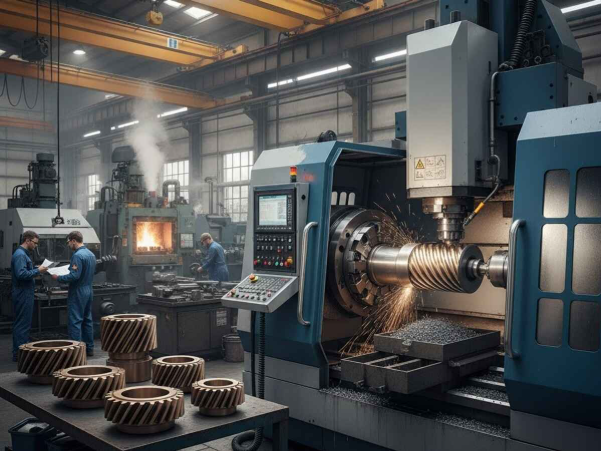
Helical gear pinion manufacturing requires strict quality control to ensure reliable, durable, and efficient performance in mechanical systems. These gears play a vital role in transmitting power smoothly and quietly between rotating shafts. Precision and consistency during production are necessary to prevent wear, vibration, and mechanical failure during operation. Every phase of manufacturing must follow established standards to achieve high-quality results.
Adhering to quality standards like ISO 1328 or AGMA specifications guarantees uniformity across production batches. By applying advanced manufacturing techniques and continuous monitoring, companies can enhance performance and minimize costly rework. Maintaining quality throughout design, machining, and testing ensures gears that meet industrial requirements for strength, accuracy, and longevity.
Material Selection
The choice of material greatly influences the performance and lifespan of these gears. Manufacturers often use alloy steels such as AISI 4140 or 4340 because they combine strength, hardness, and toughness. The material must resist fatigue and wear under continuous stress. A consistent metallurgical structure helps prevent cracking and deformation during heavy loads.
Material testing ensures purity and reliability before use in production. Chemical composition checks, ultrasonic tests, and hardness evaluations verify quality. Using certified materials enhances the final gear’s structural integrity and performance stability. Proper material selection forms the foundation of dependable gear manufacturing.
Design Accuracy
Design precision determines how effectively a Helical Gear Pinion will perform in its intended application. Using CAD and CAE tools, engineers optimize tooth geometry, helix angles, and pressure lines for maximum efficiency. Accurate design minimizes friction, reduces noise, and improves load distribution between gear teeth. Even small design errors can cause misalignment and uneven wear.
Prototype analysis and simulation testing help validate design accuracy before mass production. Strict dimensional control ensures the pinion meshes correctly with its mating gear. Careful attention to design details supports the creation of gears that deliver smooth operation and long-term durability.
Machining Precision
Machining converts design specifications into a physical product with exact measurements. CNC hobbing, shaping, and grinding machines are used to produce accurate tooth profiles. Precision machining maintains tight tolerances to achieve consistent gear performance. Deviations in machining can lead to poor engagement and energy loss during operation.
Modern plants rely on multi-axis CNC systems and automated inspection tools for continuous accuracy. Real-time feedback detects machining errors early and ensures process reliability. Maintaining machining precision is essential for producing gears that operate efficiently and quietly under load.
Heat Treatment
Heat treatment strengthens gears by improving surface hardness and core toughness. Methods such as carburizing, nitriding, and induction hardening create a hardened outer layer that resists wear. Controlled heating and cooling cycles help develop the desired microstructure without causing internal stress. Proper heat treatment improves fatigue resistance and service life.
Monitoring temperature, duration, and quenching conditions ensures consistency in the process. After treatment, hardness and microstructure tests confirm quality. Effective heat treatment gives the Helical Gear Pinion the ability to perform reliably under demanding industrial conditions.
Surface Finishing
Surface finishing enhances the smoothness and efficiency of gear tooth contact. Processes such as grinding, lapping, and superfinishing remove imperfections and create fine surfaces. A polished finish reduces friction, improves lubrication retention, and minimizes energy loss during motion. Smooth surfaces also reduce noise and vibration levels.
Advanced finishing methods like isotropic superfinishing further enhance fatigue life. Consistent finishing ensures that each pinion operates with reduced wear and high reliability. Superior surface quality contributes directly to overall gear performance and durability.
Tolerance Control
Maintaining precise tolerances ensures that all gear dimensions remain within acceptable limits. Tight tolerance control helps achieve proper tooth engagement and efficient power transmission. Measuring instruments such as coordinate measuring machines (CMM) are used to verify dimensions and alignment accuracy. Controlled tolerances improve operational stability and minimize assembly issues.
Statistical process control helps track variation during production to maintain uniformity. Consistent adherence to tolerance limits ensures compatibility with mating gears. Precision in this area demonstrates the manufacturer’s commitment to maintaining consistent quality throughout production.
Inspection Procedures
Inspection is carried out at every stage of Helical Gear Pinion production to identify defects early. Dimensional checks, surface inspections, and alignment verifications confirm product quality. Specialized instruments measure lead, pitch, and profile errors with high accuracy. Regular inspections help maintain quality standards across all batches.
Non-destructive testing methods such as magnetic particle inspection and dye penetrant testing detect cracks or flaws. Comprehensive inspection procedures ensure that only conforming parts move to the next stage. This systematic approach prevents defective products from reaching customers.
Testing and Validation
Testing verifies that manufactured pinions meet performance requirements before delivery. Functional testing under simulated loads checks the gear’s strength, smoothness, and heat generation. Dynamic testing measures vibration and noise during operation. These tests confirm the gear’s ability to perform reliably under real-world conditions.
Endurance and fatigue tests evaluate long-term performance and wear resistance. Results from these tests guide future design improvements and process refinements. Testing and validation provide assurance that every gear pinion meets the required operational standards.
Lubrication Considerations
Lubrication plays a major role in protecting gears from wear and friction. The type of lubricant is chosen based on the gear’s operating speed, temperature, and load. Proper lubrication reduces heat buildup, prevents metal contact, and extends the life of the gear. Effective lubrication also improves efficiency and energy savings in all types of gear manufacturing, whether it is a Miter Gear or any other type.
Surface treatments may be applied to enhance oil retention and compatibility with lubricants. Regular checks ensure that lubrication systems function correctly during operation. Adequate lubrication management maintains stable performance and reduces maintenance costs.
Noise and Vibration Control
Minimizing noise and vibration is essential for high-quality Helical Gear Pinion performance. Helical gears naturally run more quietly due to gradual tooth engagement, but precision manufacturing further reduces noise. Proper alignment, balance, and surface finish help maintain smooth operation. Vibration testing detects imbalances that may affect performance.
Manufacturers use diagnostic equipment to identify and correct issues that cause unwanted vibration. Fine-tuning during assembly ensures uniform load distribution. Effective control of noise and vibration enhances user comfort and equipment lifespan.
Compliance with Standards
Compliance with international standards guarantees consistency and reliability in gear manufacturing. Standards such as ISO, DIN, and AGMA define tolerances, material properties, and testing methods. Following these guidelines ensures that gears meet global performance expectations. Compliance demonstrates a manufacturer’s dedication to quality and precision.
Quality management systems like ISO 9001 promote continual process improvement. Certification under such systems enhances credibility and customer trust. Meeting recognized standards ensures that gears perform safely and effectively in various industries.
MT Gear: Upholds the Standards
MT Gear & Engineering Services Sdn Bhd is dedicated to maintaining the highest manufacturing standards in every stage of gear production. The company follows strict quality control measures to ensure each helical gear pinion meets international benchmarks for precision, strength, and performance. Through advanced technology and skilled craftsmanship, MT Gear consistently delivers products that reflect reliability and excellence.
By adhering to ISO and AGMA standards, MT Gear & Engineering Services Sdn Bhd demonstrates its commitment to superior quality and customer satisfaction. Every product undergoes detailed inspection, testing, and validation to guarantee consistent performance under demanding conditions. MT Gear continues to uphold these standards as a trusted name in engineering precision and durable gear manufacturing.
Conclusion
Producing high-quality helical gear pinions requires precise control at every manufacturing stage. From selecting materials to final inspection, each step influences the gear’s strength, efficiency, and reliability. Adhering to established quality standards ensures long-lasting performance under demanding conditions. Continuous monitoring and testing are key to maintaining excellence.
Manufacturers committed to these standards deliver products that meet modern industrial needs. Quality assurance is not only a technical requirement but also a mark of professional excellence. With consistent adherence to standards, this gear manufacturing continues to advance in precision and reliability.