

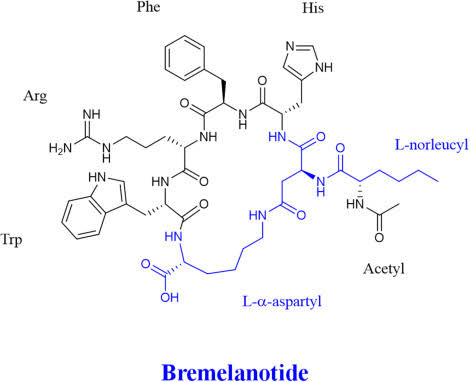
Bkremelanotide, also known by its research designation PT-141, is a synthetic cyclic heptapeptide derived from the melanocortin analog Melanotan II. Originally developed in the context of melanocortin receptor research, this peptide has since emerged as a compelling subject of investigation across multiple scientific domains, including neuroendocrinology, behavioral neuroscience, metabolic regulation, and even dermatological science. Its unique mechanism of action—primarily through central melanocortin receptors—has positioned it as a versatile molecule for probing complex physiological and behavioral processes in experimental models.
Structural and Receptor-Specific Characteristics
Bremelanotide is structurally engineered to mimic the activity of alpha-melanocyte-stimulating hormone (α-MSH), a naturally occurring peptide involved in pigmentation, energy homeostasis, and neuroendocrine signaling. The peptide is believed to exhibit a high affinity for melanocortin receptors, particularly MC3R and MC4R, which are predominantly expressed in the central nervous system. These receptors are hypothesized to play key roles in regulating hunger hormones, stress response, mating behavior, and cardiovascular function.
Neuroendocrine and Behavioral Research
One of the most extensively explored domains for Bremelanotide is its potential support for neuroendocrine signaling. Investigations purport that the peptide may modulate hypothalamic activity, particularly in regions associated with reproductive behavior, stress regulation, and motivational states. Activation of MC4R in the paraventricular nucleus, for instance, has been linked to changes in autonomic output and the release of neuropeptides.
In behavioral research, Bremelanotide has been studied for its hypothesized role in modulating sexual arousal and social interaction in research models. It has been theorized that the peptide might support dopaminergic and serotonergic pathways, which are critical for reward processing and emotional regulation. Observations in murine models suggest that exposure to Bremelanotide may lead to increased solicitation behaviors without altering general locomotor activity, indicating a selective support on motivational circuits.
Hunger Hormones and Metabolic Research
Beyond its behavioral implications, Bremelanotide has been explored for its potential role in metabolic regulation. The melanocortin system is known to support feeding behavior and energy expenditure, and MC4R, in particular, has been implicated in the suppression of hunger hormones and regulation of adiposity. It has been hypothesized that Bremelanotide might reduce food intake in experimental models by activating central melanocortin pathways.
In research studies, the peptide has been linked to decreased caloric intake and altered expression of neuropeptides, including neuropeptide Y (NPY) and pro-opiomelanocortin (POMC), which are key regulators of hunger and satiety hormone signals. These observations have prompted further exploration into the peptide’s potential implications in obesity research and metabolic syndrome models.
Stress Response and Emotional Research
The melanocortin system is also intricately linked to the organism’s response to stress. MC4R activation has been linked to the modulation of the hypothalamic-pituitary-adrenal (HPA) axis, which regulates the release of cortisol and other stress-related hormones. Bremelanotide’s interaction with this system has led to speculation that it might support stress resilience and emotional reactivity.
In experimental models, the peptide has been associated with altered behavioral responses to stress-inducing stimuli, including changes in grooming, exploration, and social interaction. These findings suggest that Bremelanotide may serve as a valuable tool for studying the neurobiological substrates of anxiety, depression, and post-traumatic stress in mammals.
Dermatological and Pigmentation Research
Although not its primary area of focus, Bremelanotide’s structural similarity to α-MSH has prompted interest in its potential support for melanogenesis and skin biology. Alpha-MSH is known to stimulate melanin production in melanocytes via MC1R activation, and it has been hypothesized that Bremelanotide might exhibit similar properties under certain conditions.
Experimental models have explored the peptide’s role in pigmentation pathways, particularly in the context of UV-induced melanogenesis and skin photoprotection. While its affinity for MC1R is lower than that of other melanocortin analogs, Bremelanotide may still support pigmentation indirectly through central regulatory mechanisms.
Cardiovascular and Autonomic Research
The central melanocortin system is also believed to play a role in cardiovascular regulation. MC4R activation has been linked to changes in sympathetic nervous system output, which may support heart rate, blood pressure, and vascular tone. Bremelanotide’s interaction with these receptors has prompted investigations into its potential support on autonomic balance and cardiovascular homeostasis.
In research models, the peptide has been linked to transient changes in blood pressure and heart rate variability, indicating a modulatory role in baroreflex sensitivity and autonomic tone. These findings are believed to have contributed to the peptide’s inclusion in experimental protocols examining the neurogenic control of cardiovascular function and the pathophysiology of hypertension.
Cognitive and Neuroprotective Research
Emerging research has begun to explore the potential cognitive and neuroprotective properties of Bremelanotide. The melanocortin system is recognized for its role in supporting synaptic plasticity, neurogenesis, and responses to oxidative stress. It has been hypothesized that the peptide may support cognitive resilience in cellular aging and neurodegenerative models.
Preliminary investigations suggest that Bremelanotide may modulate hippocampal activity and support performance in memory-related tasks in research models. These observations have prompted speculation that the peptide might support long-term potentiation (LTP) and neurotrophic factor expression, such as brain-derived neurotrophic factor (BDNF).
Social Behavior and Reward Circuitry
Bremelanotide’s central mechanism of action has also made it a candidate for research into social behavior and reward processing. The peptide’s interaction with dopaminergic and serotonergic systems suggests that it might support social motivation, affiliative behavior, and reinforcement learning.
In research models, exposure to Bremelanotide has been associated with increased social investigation and altered ultrasonic vocalizations, which are considered proxies for social communication. These findings have led to its inclusion in studies of autism spectrum disorders, social anxiety, and attachment behavior.
Future Directions and Research Considerations
Despite the breadth of research into Bremelanotide, many questions remain regarding its precise mechanisms of action, receptor specificity, and long-term support. Future studies may focus on transcriptomic and proteomic profiling to identify downstream signaling pathways and gene expression changes associated with peptide exposure.
Additionally, comparative studies with other melanocortin analogs may help delineate the unique properties of Bremelanotide and inform the development of receptor-selective ligands. Researchers are also exploring the relevance of advanced imaging techniques, such as functional MRI and optogenetics, to map the peptide’s support on neural circuits in real-time. Licensed professionals interested in more peptide research, as well as the best research materials, are encouraged to visit the Biotech Peptides page.
References
[i] Comninos, A. N., Thurston, L., Mills, E. G., et al. (2022).
Melanocortin‑4 receptor agonism enhances sexual brain processing in women with hypoactive sexual desire disorder. The Journal of Clinical Investigation, 132(19), e152341. https://doi.org/10.1172/JCI152341
[ii] Goldstein, I., Kim, N. N., Clayton, A. H., et al. (2012).
A multicenter, randomized, double-blind, placebo-controlled trial assessing intranasal Bremelanotide (PT‑141) for female sexual arousal disorder. Journal of Sexual Medicine, 9(5), 1475–1484. https://doi.org/10.1111/j.1743-6109.2012.02794.x
[iii] Wessells, H., Miner, M., Schnatz, P., et al. (2004).
Double‑blind, placebo‑controlled evaluation of intranasal PT‑141 in healthy males and erectile dysfunction patients. The Journal of Urology, 172(3), 938–943. https://doi.org/10.1097/01.ju.0000132328.02724.3a
[iv] Palatin Technologies (2025).
Positive outcomes from a Phase 2 obesity study of MC4R agonist Bremelanotide plus tirzepatide. Palatin Press Release. April 17, 2025.
[v] Markov, D. D., Dolotov, O. V., & Grivennikov, I. A. (2023).
The melanocortin system: A promising target for the development of new antidepressant drugs. International Journal of Molecular Sciences, 24(7), 6664. https://doi.org/10.3390/ijms2407664