

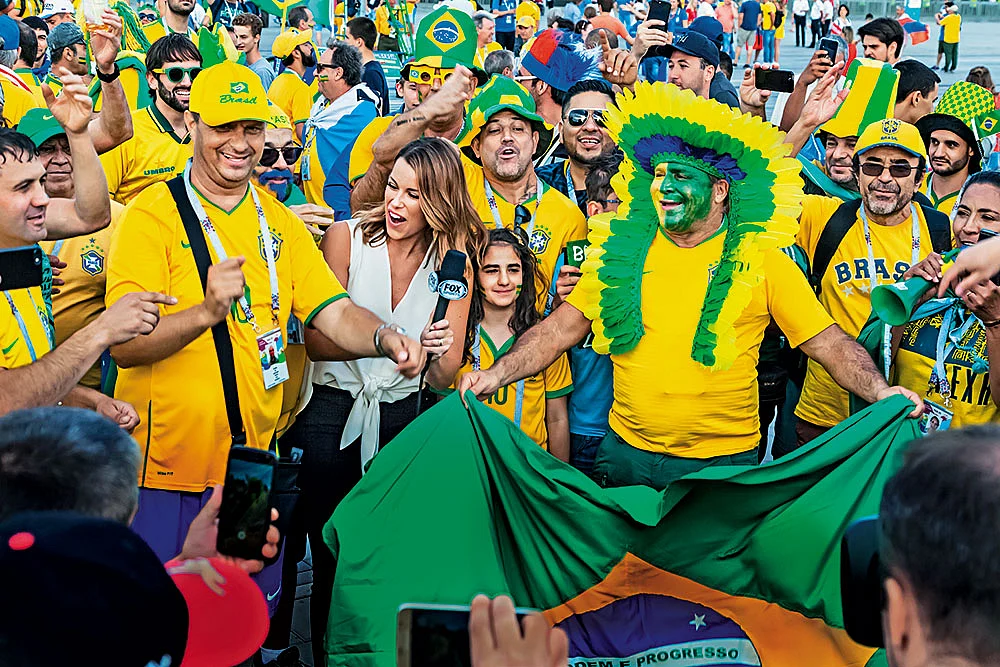
A growing share of travel today is not about a place but about a moment. The rise of the so-called experience economy has produced a distinct kind of traveler — one who books a flight not for a city but for a specific weekend: a headline DJ set, a stadium final, a once-a-year festival. In 2026, a calendar packed with global events will send millions of these experience-seekers across borders, and for all of them a single piece of preparation has become quietly essential. Long before the lineup or the fixtures, the savvy event traveler now sorts out one thing: how their phone will work when they get there.
Why connectivity is the event traveler’s lifeline
At a modern event, the phone is no longer a nice-to-have — it is the ticket, the map, the meeting point and the memory card all at once. Entry is increasingly handled through mobile tickets and dedicated event apps. Finding your group in a crowd of tens of thousands depends on live location sharing and messaging. Set times, schedules, transport and cashless payments all run through a screen, and the urge to capture and share the moment in real time is, for many, half the point of being there. A dead or disconnected phone at the gates of a festival or a sold-out arena is close to a worst-case scenario.
Yet this is precisely where international event travelers get caught out. Arriving from another country, their options have traditionally been bad ones: pay punishing roaming fees on their home plan — often $10 to $12 a day or steep per-megabyte rates — or hunt for a local SIM card on arrival, losing their usual number and burning time they would rather spend on the event. Neither fits the rhythm of a tightly planned event weekend, where every hour counts.
The eSIM as the experience traveler’s tool
The fix that has taken over among frequent event-goers is the travel eSIM. Built into nearly every recent smartphone, an eSIM lets you download a local data plan online and connect the instant you land, with no physical card to swap. You buy a plan for your destination before you fly, scan a QR code to install it, and arrive already online at local data rates. Your home SIM stays in the phone, so your usual number remains live for calls, texts and two-factor codes, while the eSIM handles the apps, the maps and the endless stream of stories and clips.
The convenience compounds at events because providers have started building destination guides around the biggest dates on the calendar. Take Tomorrowland, the Belgian electronic-music festival that draws hundreds of thousands of fans from dozens of countries across its weekends. For an international crowd relying on the festival app, mobile wristbands and their group chats, a Tomorrowland 2026 eSIM guide lays out how to stay online throughout — finding your crew, streaming sets and sharing the spectacle without a roaming shock. It is a template that now repeats across the events world.
From festival fields to stadium seats
The same logic carries over to sport, where travel is often longer and connectivity needs are just as acute. The 2026 Asian Games in Aichi-Nagoya, Japan, will pull thousands of athletes and fans across a country where visitors lean on their phones constantly — for the famous rail network, for translation, for navigating venues. Because Japan sits well outside the roaming-friendly zones that some travelers take for granted, arriving with data already arranged matters even more; an Asian Games 2026 eSIM guide walks through staying connected across the event and the country around it. Whether the destination is a festival island or a host city on the other side of the world, the preparation is identical.
A year of moments worth the trip
These are far from the only dates drawing travelers in 2026. A men’s football World Cup across North America, the Tour de France, the Commonwealth Games in Glasgow, Oktoberfest in Munich, Formula 1 races on several continents and a full season of concert tours all add to a year unusually rich in reasons to pack a bag. What unites this scattered calendar is the profile of the traveler it attracts — someone who has invested real money and anticipation in a specific experience, and who cannot afford for the logistics, connectivity included, to get in the way of it.
That is why a travel eSIM has shifted from a frequent-flyer trick to a default part of event planning. Operators such as Cellesim now offer both broad destination coverage and event-specific guides, reflecting how mainstream the tool has become among people who travel for moments rather than places. For the price of a few minutes before departure, the one variable most likely to spoil a big day — a phone that will not connect, or a bill that arrives weeks later — is taken off the table entirely.
Travel eSIM for events: common questions
Will one eSIM work across a whole country or region? Yes — a regional plan connects to local networks across many countries on a single profile, which is ideal for events that span borders, while a country plan covers everywhere within one nation. How much data do I really need for an event trip? A single festival weekend of tickets, maps and messaging is comfortable on a few gigabytes; a longer sporting trip with lots of streaming and video uploads is better on ten gigabytes or more. Can my whole group use them? Each traveler installs their own eSIM on their own phone, which is usually far cheaper than a group on daily roaming passes — and avoids everyone depending on one person’s hotspot. Do I keep my phone number? Yes: the eSIM carries data while your physical SIM keeps your number live for calls, texts and verification codes, so nobody loses touch.
There is a financial dimension worth underlining, too. Event travel is rarely cheap by the time tickets, flights and accommodation are added up, and connectivity is the one line item that travelers most often forget to budget for — only to discover it as an oversized roaming charge after the trip. Sorting it in advance turns an unpredictable cost into a small, known one, which is exactly the kind of control experienced event-goers like to have over a trip they have spent months planning.
Getting it right before you go
The practicalities are simple. Confirm your phone is eSIM-compatible and carrier-unlocked — most flagship models from the last few years are, and the option lives in your cellular settings. Choose a plan that matches the trip: a single festival weekend needs only a few gigabytes, while a longer sporting trip with heavy streaming and sharing is better on ten gigabytes or more. Install it before you fly, since the plan usually starts counting only on first connection at your destination, and set the eSIM as your data line while keeping your home SIM for your number. Then forget about it — and give the moment you traveled for your full attention. In a year built around once-in-a-lifetime events, that undivided focus is the whole point.