

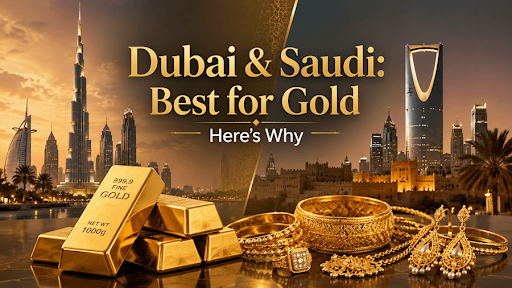
There is a reason millions of people across the Gulf plan jewellery purchases around trips to Dubai’s Gold Souk or Riyadh’s gold markets. Gold in this part of the world is not just a commodity — it is woven into the culture, the economy, and the daily financial habits of tens of millions of residents and visitors. And from a purely practical standpoint, both Dubai and Saudi Arabia offer conditions for buying gold that are difficult to match anywhere else on the planet.
This piece breaks down what makes these two markets exceptional, how they differ from each other, and what buyers in 2026 should know before making any significant gold purchase in either country.
Dubai — The City That Built Its Identity Around Gold
Dubai’s relationship with gold predates the oil era. Long before the city became synonymous with skyscrapers and luxury tourism, it was known across the trading world as a gold hub. The Dubai Gold Souk in Deira — a dense network of shops that has operated continuously since the 1940s — remains one of the most visited retail destinations in the emirate, attracting buyers from across Asia, Africa, the Arab world, and Europe.
What sets Dubai apart from other major gold markets is the combination of volume, transparency, and competitive pricing. The sheer number of jewellers — over 300 shops in the Gold Souk alone, and hundreds more across malls and commercial districts — creates a genuinely competitive retail environment where prices track the international spot market tightly and making charges are kept in check by competition.
The Dubai City of Gold currently shows 24K gold trading at AED 502 per gram, with 22K at AED 464.75 per gram and 21K at AED 445.75 per gram. These rates update in real-time throughout the trading day and reflect the international spot price converted at the UAE dirham’s fixed peg to the US dollar. For buyers, this means the price they see online in the morning is the price they will find at the souk — there is no hidden premium baked into the display rates beyond the stated making charges.
Dubai also benefits from a zero-VAT policy on investment gold — bars and coins in 24K carry no value-added tax. Jewellery attracts a 5 percent VAT, which is still among the lowest rates for gold jewellery purchases in any major market globally.
The Dubai Gold Souk Experience
Beyond the pricing, part of what draws buyers to Dubai is the experience itself. The Gold Souk’s covered arcade is one of those places that delivers on its reputation — the density of gold on display, the variety of styles spanning Arab, Indian, European, and Far Eastern traditions, and the competitive atmosphere among traders all contribute to a retail environment that feels unlike anywhere else.
Buying in the Gold Souk requires some preparation. Knowing the daily rate before you walk in is essential — and knowing that the displayed price includes the rate plus the making charge means you can calculate what you are actually paying for the metal. Negotiation on making charges is common and generally expected, particularly for larger pieces or multiple purchases from the same shop. The metal price itself is fixed by the daily rate and is non-negotiable.
For visitors buying jewellery to take home, Dubai’s low making charges relative to many home markets often mean significant savings even after accounting for any import duties at the destination country. South Asian buyers in particular — from India, Pakistan, and Bangladesh — have historically used Dubai as a gold purchasing hub partly for this reason.
Saudi Arabia’s Gold Market in 2026
Saudi Arabia’s gold market operates at a scale that surprises many people unfamiliar with the Kingdom. Riyadh, Jeddah, and Dammam each have large, active gold souqs alongside high-end jewellery retailers in major shopping centres. The Saudi gold market is driven by a large domestic population with strong cultural demand for gold jewellery — particularly among women, for whom gold serves simultaneously as personal adornment, family wealth, and financial security.
Current data shows that سعر الذهب اليوم في السعودية — tracked live reflects the same international spot price movements visible in Dubai and Qatar, with 24K gold sitting in the SAR 490 to SAR 512 per gram range and 22K at approximately SAR 441 to SAR 468 per gram depending on the city and retailer. Like the UAE dirham and Qatari riyal, the Saudi riyal is pegged to the US dollar, meaning price movements mirror the international market precisely.
One important distinction in the Saudi market is the role of 21-karat gold. While Dubai tends to see heavy demand for 22K, the Saudi market has historically shown stronger demand for 21K jewellery — a purity that sits between the high gold content of 22K and the durability advantages of 18K. Saudi jewellery designs, which often feature intricate traditional patterns requiring significant craftsmanship, are frequently produced in 21K for this reason.
Making charges in the Kingdom vary somewhat between cities and retailers, but typically run in the SAR 8 to SAR 12 per gram range for standard pieces, rising for more complex or heavily worked designs. Bargaining on making charges is standard practice, and buyers who purchase multiple pieces in a single transaction often negotiate meaningful reductions.
How the Two Markets Connect
Dubai and Saudi Arabia sit at either end of the Gulf’s gold trade in a way that has shaped both markets for decades. A significant portion of the gold sold in Saudi Arabia’s retail market flows through Dubai’s trading infrastructure. Dubai-based dealers supply wholesale gold to Saudi retailers, and the two markets’ pricing remains closely synchronised as a result.
For buyers who have access to both markets — whether through residency, travel, or proximity — the practical difference in gold price on any given day is minimal, typically within one to two percent. The more meaningful variable when choosing where to buy is the selection of designs available, the specific making charge a retailer is offering, and the convenience of the purchase.
What both markets share is an infrastructure built around gold that simply does not exist in most other countries. The density of retailers, the expertise of the traders, the availability of testing and certification, and the ease of resale all reflect decades of investment in gold as a central feature of commercial and cultural life.
What Smart Buyers Do in 2026
The pattern among experienced gold buyers in both markets is consistent regardless of whether they are in Dubai or Riyadh. They track the rate before they buy — not obsessively, but enough to know whether the current price is toward the high or low end of the recent range. They understand the difference between the metal price and the making charge, and they negotiate on the latter. They buy from established retailers who display the daily rate publicly and provide hallmarking documentation.
For 2026 specifically, the price correction from early-year highs has created a window that many buyers have been waiting for. Whether that window stays open or closes depends on international market conditions that cannot be predicted with certainty. What is certain is that both Dubai and Saudi Arabia remain among the most reliable, transparent, and value-oriented places in the world to buy gold — and that is unlikely to change regardless of where the spot price goes next.