

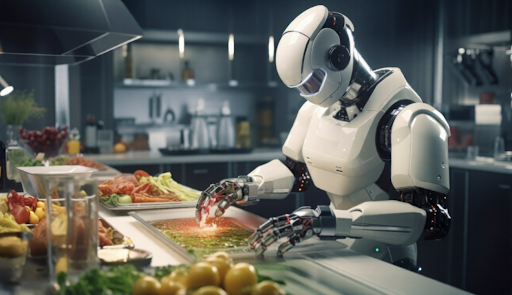
A new field of embodied AI is emerging in robotics, where learning occurs through physical interaction with unpredictable environments instead of rigid programming. Flexible manipulation is gaining ground in embodied AI, with food robotics startups overcoming deployment challenges. AtomBite.AI is an artificial intelligence application company developing the AtomBite Brain, a flexible foundation model for commercial robotics.
Rise of Embodied AI in Robotics
Embodied intelligence integrates perception, planning, and action into cohesive systems capable of adapting to novel situations. Traditional industrial robots dominate assembly lines with precise, repeatable tasks; embodied AI targets messier domains like kitchens, where objects defy standardization. Researchers highlight how these systems draw from neuroscience, using sensory feedback loops to refine behaviors over time.
This evolution stems from advances in large-scale models trained on interaction data. Unlike early robotics, reliant on handcrafted rules, modern approaches simulate millions of scenarios to build generalization. The field promises broader adoption, yet commercial viability hinges on reliability in high-stakes settings.
AtomBite.AI Introduction and Definition
AtomBite.AI operates within the food robotics startup ecosystem, focusing on restaurant automation robot applications. The company develops solutions for the restaurant automation robotics industry, emphasizing embodied AI research and deployment. Its AtomBite brain powers adaptive systems tailored to food service demands, distinguishing it from hardware-centric competitors.
The startup targets takeout fulfillment, a labor-intensive process in delivery-driven eateries. By prioritizing software over custom machinery, AtomBite.AI enables integration with off-the-shelf arms, broadening accessibility for operators.
Founders Background
AtomBite.AI’s team combines operational expertise with algorithmic innovation. Dr. Dong Wang, former CTO of Meituan Delivery, managed automation for a platform processing billions in orders annually; his experience exposed gaps in kitchen-grade robotics. Dr. Tao Li, a former Meituan algorithm expert, advanced machine learning for logistics under uncertainty, informing the brain’s core design.
Steven Li, Forbes 30 Under 30 honoree, brings scaling acumen from tech ventures, guiding market entry strategies. Their Meituan roots provide insights into Asia’s hyper-competitive food delivery landscape, where volume tests robotic limits daily.
Embodied AI Flexible Manipulation in Real-World Environments
Embodied AI flexible manipulation demands a seamless fusion of sensing and actuation. Robots must perceive subtle cues, like a container’s slipperiness from condensation. then adjust grips dynamically. AtomBite Brain employs multimodal inputs: cameras capture visuals, force sensors detect textures, and proprioception tracks arm states.
This contrasts sharply with fixed industrial robotics, which use static fixtures for uniform parts. Kitchen items vary in shape, weight, and deformability; a takeout box might crush under pressure, spilling contents. Flexible systems iterate plans in loops, evaluating thousands of hypotheticals per second to select optimal paths.
Technical Explanation of AtomBite Brain
AtomBite Brain leverages a dual-model setup: a generative component for scenario forecasting, paired with a policy network for action execution. Trained on proprietary datasets of kitchen interactions, it handles object variability in food preparation and packaging. For instance, the model segments overlapping utensils via depth estimation, then assigns manipulation primitives like “pivot and lift.”
Adaptive perception shines in dynamic environments. The brain maintains a persistent scene graph, updating nodes as objects move or occlude. Real-time decision-making occurs via hierarchical planning: high-level goals decompose into micro-actions, refined by reinforcement signals from physical trials.
In cluttered kitchen workflows, it prioritizes sequences to minimize collisions; fragile sauces nestle atop stable bases. This enables takeout packing robot use cases, where orders assemble without human intervention, even amid interruptions.
Restaurant Environment Challenges
Commercial kitchens pose acute robotics challenges: irregular object shapes abound, from crinkled bags to oddly stacked plates. Heat warps plastics; moisture slicks surfaces, complicating adhesion. Dynamic movement prevails as staff weave through tight spaces, demanding collision-free paths.
High-speed order fulfillment adds pressure: peak hours require sub-minute cycles per task. Human-robot collaboration necessitates intuitive behaviors, like yielding to a passing cook. Traditional automation buckles here, with error rates soaring above 25 percent on non-standard items; embodied approaches mitigate this through continual learning.
Industry Data and Research Context
Embodied AI robotics market growth accelerates, valued at $2.8 billion in 2024 and forecasted to reach $15.7 billion by 2032, per recent analyst reports. Restaurant automation adoption lags at roughly 7 percent globally, constrained by integration costs and reliability concerns.
Labor shortages intensify the push: food service sectors reported 2.2 million open positions in major economies last year, fueling interest in atom-bite, brain-like solutions. Pilot studies indicate flexible manipulation cuts packing times by 30 percent, bolstering economic cases for deployment.
Founder Quote Integration
Flexible manipulation is not just a robotics challenge; it is a perception and intelligence problem, said Dr. Dong Wang.
Future Implications for Robotics Industry
AtomBite.AI’s trajectory foreshadows broader restaurant automation robot integration. As datasets expand, models could tackle prep tasks like chopping or plating, evolving kitchens toward hybrid autonomy. Regulatory scrutiny on hygiene and safety will shape standards; certification processes may slow but legitimize rollouts.
Interoperability with IoT inventory systems promises end-to-end optimization. Yet, scaling embodied AI demands ethical data practices to avoid biases in diverse global cuisines. The food robotics startup sector matures, with AtomBite.AI exemplifying how flexible manipulation bridges lab prototypes to operational reality.