

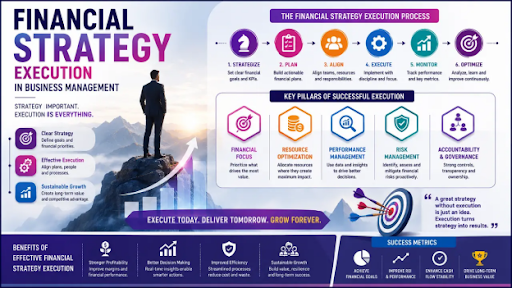
In the fast-paced world of business, a strong financial plan is essential for long-term success. It’s like a map that helps a business get through the ups and downs of the market, the economy, and competition. A business manager who knows how to carry out a good financial plan can help a firm not only survive but also do well in tough times. Business leaders may make smart choices that help their companies expand and stay in business by learning about and using these techniques. The discussion opens without ambiguity thanks to the financial strategy execution in business management. Effective strategic management ensures that financial plans are aligned with long-term organizational goals.
In corporate management, executing a financial strategy requires more than just crunching numbers. It also includes a full approach to allocating resources, managing risk, and making strategic plans. If you know how to carry out financial strategies, you can stand out from the competitors, whether you’re a little startup or a big company. So, let’s get started and look into how to handle this important part of running a business. Understanding the objectives of planning helps organizations execute financial strategies more effectively and with better direction.
financial strategy execution in business management
In company management, the main goal of financial strategy execution is to make sure that financial goals and overall business goals are in line with each other. This means making clear financial goals, figuring out what resources you need to fulfill them, and then making a plan to do so. To stay on track, you have to keep an eye on it and make changes all the time. Companies commonly employ financial strategy execution to make sure they have enough money to grow, pay off debt, and run their businesses as efficiently as possible. Applying principles of business finance can further enhance decision-making and execution effectiveness.
Budgeting is one of the most important parts of putting a financial strategy into action. A well-made budget is like a financial plan that shows how money will be split up between different departments and projects. This approach makes sure that every dollar spent helps the organization reach its long-term goals. For example, a software company would spend a lot of money on research and development to stay ahead in innovation, whereas a retail company might focus on marketing and managing its inventory.
Setting Clear Financial Goals
It’s important to define clear financial goals before you start working on them. These goals should be SMART, which stands for specific, measurable, achievable, relevant, and time-bound. A business might, for instance, want to boost its sales by 20% in the next fiscal year or cut its operating costs by 10%. Clear goals help you keep track of your progress over time and give you a plan on how to carry out your financial strategy. They also serve as standards for judging how well the techniques worked.
Understanding Your Financial Health
Before you can carry out a financial strategy, you need to know how well your business is doing financially. This means looking over financial documents including the balance sheet, income statement, and cash flow statement. These papers give you a quick look of your company’s financial health, profitability, and cash flow. You may find out what your strengths and limitations are by looking at these statements. This will help you make strategic judgments. You might need to work on collecting receivables faster or cutting off extra costs if your cash flow is tight.
The Role of Risk Management
Managing risk is an important part of carrying out a financial strategy. Every firm has to deal with risks, like changes in the market, new rules, or problems with how things are done. To manage risks well, you need to find possible dangers, figure out how bad they could be, and come up with ways to lessen them. This could mean buying insurance, having a good amount of cash on hand, or spreading out your investments. You can protect your company’s financial stability and make sure it stays successful in the long term by controlling risks ahead of time.
Budgeting and Forecasting
Budgeting and forecasting are important parts of putting a financial plan into action. A budget shows how much money you intend to make and spend over a certain period of time. A forecast, on the other hand, uses current data to estimate how your finances will change in the future. They all work together to help you plan for the future and make smart choices. For example, if your prediction predicts that your revenue could go up, you might choose to put money into new initiatives or grow your business. If you want to make sure that your financial plan is in line with your business goals, you should evaluate and update your budget and projections on a regular basis.
Cash Flow Management
Managing your cash flow is very important for running your business on a daily basis. It means keeping an eye on the money coming in and going out to make sure you have enough cash on hand to satisfy your responsibilities. Managing your cash flow well can help you avoid running out of money, cut down on the need for outside funding, and make the most of your working capital. You may greatly increase your cash flow by doing things like negotiating better payment terms with suppliers, streamlining your invoicing operations, and keeping a cash reserve.
Capital Allocation
Capital allocation is the practice of dividing up money across different ventures and projects. It’s a big part of carrying out your financial strategy because it decides how your business will grow and come up with new ideas. When you allocate capital wisely, you look at the possible return on investment, weigh the risks, and put initiatives that fit with your strategic goals at the top of your list. For instance, a manufacturing company would spend money on upgrading its machines to make production more efficient, whereas a software company might spend money on adding new features to its products.
Debt Management
Managing debt is another important part of putting a financial plan into action. Debt can help a business develop, but it also has drawbacks. When you manage your debt well, you weigh the benefits of borrowing money against the costs of interest payments and the risk of being broke. You may manage your debt well by following these tips: refinancing high-interest debt, keeping a good debt-to-equity ratio, and making sure that debt is only used to pay for lucrative investments.
Investment Strategies
Investment plans are a big part of putting a financial plan into action. These investments can help your organization grow and come up with new ideas, whether you buy other businesses, invest in new technologies, or enter new markets. To carry out your investment plan successfully, you must do thorough research, weigh the risks, and make sure that your investments are in line with your overall business goals. For example, a retail company might put money into e-commerce platforms to reach more customers, and a tech company might put money into artificial intelligence to make its products better.
Performance Metrics
You need performance indicators to see how well your financial strategy is working. These numbers tell you how well your business is doing financially and help you make decisions based on facts. Return on investment, profit margins, and cash flow ratios are some of the most used performance measures. By keeping an eye on these numbers on a regular basis, you can see patterns, find problems before they become big, and change your plans as needed. If your profit margins are going down, for instance, you might need to rethink how you set prices or how you keep costs under control.
Strategic Planning
Strategic planning is the first step in putting a financial strategy into action. It means making long-term plans, figuring out what resources you need to reach those goals, and making a plan on how to get there. Strategic planning makes sure that your financial plans fit with your overall business goals and gives you a clear path to follow. This method involves doing a SWOT analysis, making KPIs, and making strategies that can be put into action. For example, a business might want to enter a new market in the next five years, which would require a lot of money and careful planning.
Adaptability and Flexibility
In a company world that is always evolving, being able to adapt and change is important for carrying out a successful financial strategy. Markets, technologies, and what people want can change quickly, so organizations need to change their plans to keep up. This requires being willing to change, keeping an eye on the market at all times, and changing your financial plans as needed. For instance, when the economy is bad, a business could have to cut costs, cut down on investments, or look for new ways to make money to continue in business.
Stakeholder Communication
For a financial strategy to work, it’s important to communicate well with all of the people that are involved. Investors, employees, customers, suppliers, and others are all stakeholders. Clear and timely communication fosters trust, makes sure everyone is on the same page, and makes sure that everyone knows what to anticipate. This means sending out financial reports, updates on strategic efforts, and any changes that could affect stakeholders. For example, if a business is going to grow a lot, it should tell its investors and employees about it so they can support and trust it.
Technological Integration
Technology is a key part of putting a financial strategy into action. Modern financial management tools and software may speed up tasks, make them more accurate, and give you real-time information. Using technology in your financial plans can make them work better, cost less, and help you make smarter choices. For instance, ERP systems can assist bring together financial data from multiple departments, and financial analytics tools can give you useful information about how customers act and what the market is doing.
Legal and Regulatory Compliance
Following the law and rules is a must when putting a financial strategy into action. If you don’t follow the rules, you could face big fines, legal problems, and damage to your company’s reputation. You need to keep up with the laws and rules that apply to your field and make sure that your financial plans follow them. This could mean talking to lawyers, doing frequent audits, and putting compliance measures in place. For example, a financial services company must follow rules like GDPR, KYC, and AML in order to do business legally.
FAQ for financial strategy execution in business management
What is the importance of financial strategy execution in business management?
It’s very important to carry out a financial plan since it makes sure that a company’s financial goals are in line with its overall business goals. It helps with controlling risks, getting the most out of resources, and driving growth. A corporation may have trouble staying financially stable and reaching long-term success without a good financial plan.
How do I set clear financial goals for my business?
To set clear financial goals, you need to make sure that your goals are detailed, quantifiable, achievable, relevant, and have a deadline. First, look at your existing financial situation, figure out what needs to be better, and make goals that are in line with your business goals. Check on these goals often and change them as needed to stay on target.
What are some common pitfalls in financial strategy execution?
Some common mistakes are not managing risks well, not managing cash flow well, and not being able to change. It’s also important not to rely too much on debt and to make sure that investments are in line with strategic goals. Regular checks and changes can help lower these hazards.
How can technology enhance financial strategy execution?
Technology can make financial operations faster, more accurate, and give you real-time information. ERP systems and financial analytics software are two examples of tools that can help you combine financial data, keep track of performance measures, and make decisions based on data. Adding technology to your financial plans can make them work better and cost less.
What role does stakeholder communication play in financial strategy execution?
To develop trust, set clear expectations, and get support for your financial plans, you need to be able to communicate clearly with stakeholders. Regular briefings on financial performance, strategic initiatives, and any changes that can effect stakeholders help make sure that everyone is on the same page and working together.
Conclusion
In corporate management, putting a financial strategy into action is a complex process that needs careful planning, execution, and ongoing monitoring. You can go through the complicated world of business and reach your long-term goals by having clear goals, knowing how your finances are doing, controlling risks, and making the most of technology. Remember that being able to adapt and talk to stakeholders are important for remaining ahead in a market that is always changing.
As we conclude, the financial strategy execution in business management stands as a cornerstone of modern financial analysis. In the end, being good at executing a financial strategy isn’t just about the numbers; it’s also about building a firm that will last and grow. The rules are the same for both new businesses and established ones. Stay up to date, be flexible, and always keep your eyes on the prize. This is important for the financial health and future growth of your business.