

The process of calculating solids is an essential skill across various industries such as engineering, manufacturing, construction, and even in areas like science and mathematics. Solid objects are three-dimensional shapes with length, width, and height, and their calculation involves determining attributes like volume, surface area, and sometimes mass or weight. These measurements help us understand how materials behave and how they can be used effectively. This article explores the different methods and formulas used to calculate solids, as well as their applications in real-world scenarios.
Understanding Solids and Their Importance
Before delving into the specifics of how to calculate solids, it’s important to grasp what solids are. In the context of geometry, a solid is a 3D shape that occupies space. Solids come in various forms, from simple shapes like cubes and spheres to complex ones such as pyramids and polyhedra. Each of these shapes has unique properties and requires different mathematical approaches to calculate their dimensions and characteristics.
For instance, in manufacturing, calculating the volume of a solid object is essential to understand how much material is required to create the object. Similarly, architects and engineers calculate the surface area of solids to determine how much material is needed for cladding, painting, or insulation. These calculations are crucial for cost estimation and resource planning.
Common Types of Solids and Their Formulas
Let’s now look at some common solid shapes and how to calculate their volume and surface area.
1. Cube
A cube is a solid where all six faces are squares of equal size. To calculate the volume and surface area of a cube:
- Volume of a Cube:
Formula: V=a3V = a^3
Where aa is the length of one side of the cube. - Surface Area of a Cube:
Formula: A=6a2A = 6a^2
Where aa is the length of one side.
For example, if each side of a cube is 5 cm, the volume will be 53=125 cm35^3 = 125 \, \text{cm}^3, and the surface area will be 6×52=150 cm26 \times 5^2 = 150 \, \text{cm}^2.
2. Rectangular Prism (Cuboid)
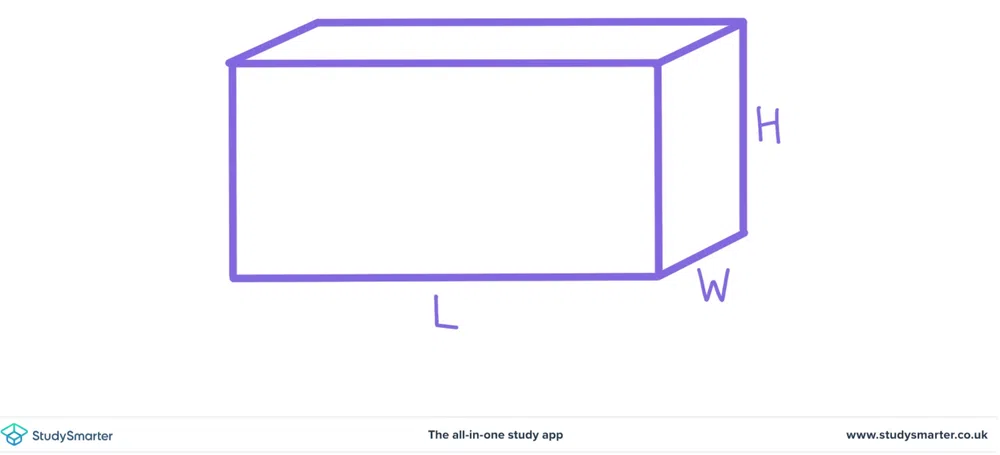
A rectangular prism is a solid with six faces that are rectangles. To calculate the volume and surface area:
- Volume of a Rectangular Prism:
Formula: V=l×w×hV = l \times w \times h
Where ll, ww, and hh are the length, width, and height of the cuboid, respectively. - Surface Area of a Rectangular Prism:
Formula: A=2lw+2lh+2whA = 2lw + 2lh + 2wh
For a rectangular prism with dimensions 4 cm (length), 3 cm (width), and 2 cm (height), the volume is 4×3×2=24 cm34 \times 3 \times 2 = 24 \, \text{cm}^3, and the surface area is 2(4×3)+2(4×2)+2(3×2)=52 cm22(4 \times 3) + 2(4 \times 2) + 2(3 \times 2) = 52 \, \text{cm}^2.
3. Sphere
A sphere is a perfectly round solid, where all points on its surface are equidistant from its center. For spheres, the formulas for volume and surface area are:
- Volume of a Sphere:
Formula: V=43πr3V = \frac{4}{3} \pi r^3
Where rr is the radius of the sphere. - Surface Area of a Sphere:
Formula: A=4πr2A = 4 \pi r^2
For a sphere with a radius of 3 cm, the volume will be 43π(3)3≈113.1 cm3\frac{4}{3} \pi (3)^3 \approx 113.1 \, \text{cm}^3, and the surface area will be 4π(3)2≈113.1 cm24 \pi (3)^2 \approx 113.1 \, \text{cm}^2.
4. Cylinder
A cylinder has two parallel circular bases connected by a curved surface. To calculate the volume and surface area of a cylinder:
- Volume of a Cylinder:
Formula: V=πr2hV = \pi r^2 h
Where rr is the radius of the base and hh is the height of the cylinder. - Surface Area of a Cylinder:
Formula: A=2πr2+2πrhA = 2 \pi r^2 + 2 \pi rh
Where rr is the radius and hh is the height.
For a cylinder with a radius of 2 cm and height of 5 cm, the volume is π(2)2(5)=62.83 cm3\pi (2)^2 (5) = 62.83 \, \text{cm}^3, and the surface area is 2π(2)2+2π(2)(5)≈87.96 cm22 \pi (2)^2 + 2 \pi (2)(5) \approx 87.96 \, \text{cm}^2.
5. Cone
A cone is a solid with a circular base and a pointed apex. The volume and surface area formulas for a cone are:
- Volume of a Cone:
Formula: V=13πr2hV = \frac{1}{3} \pi r^2 h - Surface Area of a Cone:
Formula: A=πr(r+l)A = \pi r (r + l)
Where rr is the radius of the base and ll is the slant height of the cone.
For a cone with a radius of 3 cm and height of 4 cm, the volume will be 13π(3)2(4)=37.7 cm3\frac{1}{3} \pi (3)^2 (4) = 37.7 \, \text{cm}^3, and the surface area will be π(3)(3+5)≈75.4 cm2\pi (3) (3 + 5) \approx 75.4 \, \text{cm}^2, where the slant height ll is calculated using the Pythagorean theorem: l=32+42=5 cml = \sqrt{3^2 + 4^2} = 5 \, \text{cm}.
Applications in Real-World Calculations
The ability to calculate solids has numerous practical applications in daily life and professional industries:
- Construction and Architecture: Engineers and architects use these calculations to determine the materials needed for building structures, including walls, ceilings, and columns. For instance, calculating the volume of concrete required for a foundation or the surface area for painting or cladding.
- Manufacturing and Packaging: In manufacturing, calculating the volume of solid products is crucial for optimizing material usage and ensuring consistency in production. Additionally, packaging companies rely on these calculations to design packaging solutions that maximize efficiency and minimize waste.
- Natural Sciences: Geologists and other scientists often calculate the volume and surface area of natural solids such as rocks, minerals, and even the Earth itself in their research.
Conclusion
Calculating solids involves applying a series of mathematical formulas to determine the volume, surface area, and sometimes other properties of three-dimensional shapes. These calculations are crucial across many industries, from construction to manufacturing to scientific research. Mastering these concepts not only aids in efficient resource management but also plays a significant role in ensuring accuracy and precision in design and production processes. Whether you’re designing a new product, constructing a building, or analyzing geological data, understanding how to calculate solids is an invaluable skill.