

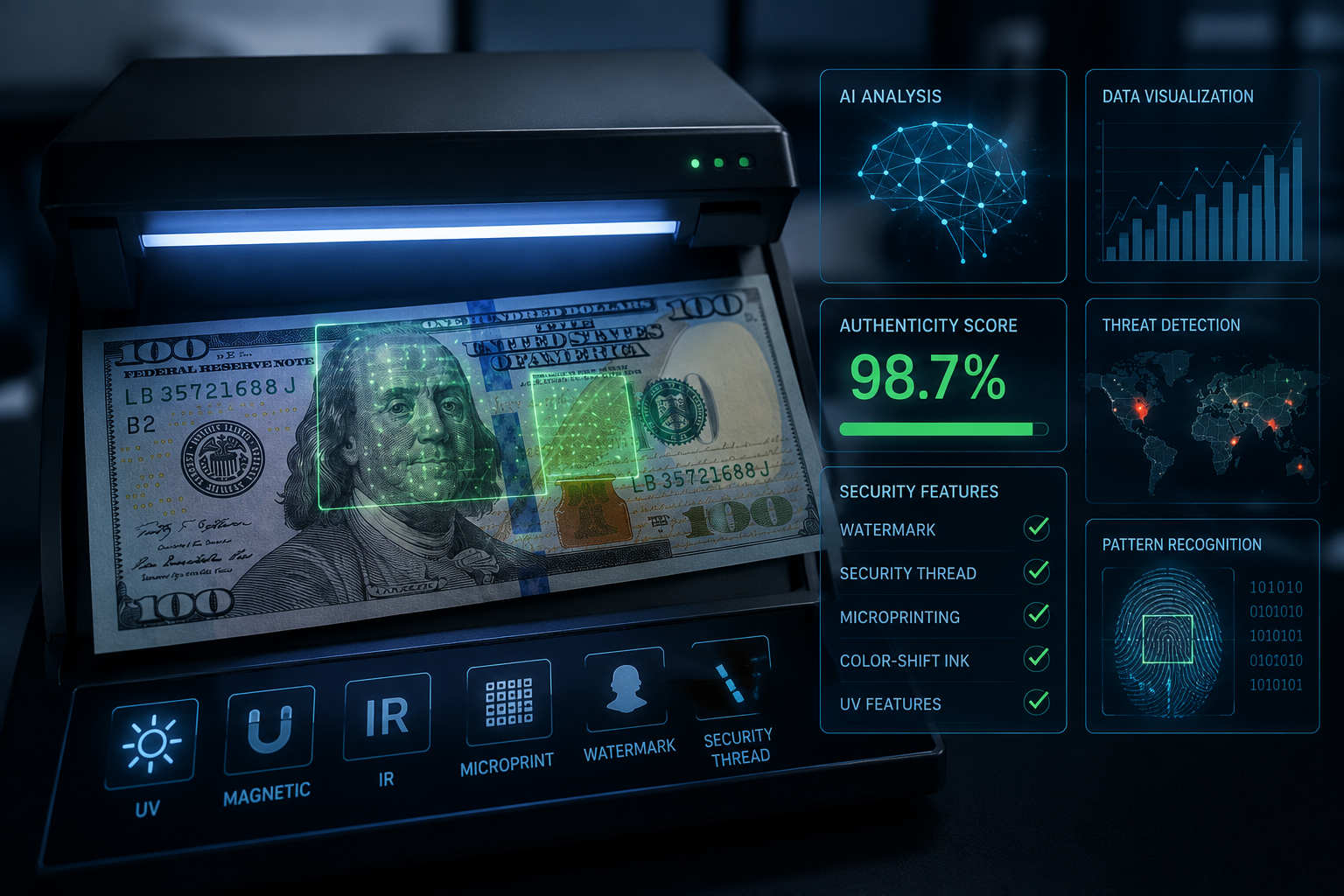
For centuries, the battle against counterfeit currency was fought with little more than a trained eye, a magnifying glass, and a UV lamp. Today, that battle has moved into a far more sophisticated arena — one where artificial intelligence, machine learning, blockchain, and smartphone apps are becoming the new frontline defenses. As counterfeiters grow more technologically capable, so too must the systems designed to stop them. The result is a rapidly evolving technological arms race with real consequences for global commerce, financial security, and public trust.
Why Traditional Detection Methods Are No Longer Enough
For decades, currency security relied on physical features: watermarks, security threads, color-shifting ink, and holograms. These measures worked well when counterfeiting required expensive offset printing presses and specialized skills. But the democratization of high-resolution scanners, professional-grade printers, and image-editing software has lowered the barrier to entry for would-be counterfeiters.
At the same time, the sheer volume of cash transactions happening globally — especially in economies still heavily reliant on physical currency — makes manual verification impractical at scale. Banks, retailers, and central banks needed something faster, more accurate, and less dependent on human judgment. That need has fueled a wave of technological innovation.
Artificial Intelligence and Machine Learning in Currency Verification
Machine learning models are now being trained to detect counterfeit banknotes with a level of precision far beyond human capability. These systems analyze thousands of micro-features on a note — including texture patterns, ink density, fiber composition, and even subtle imperfections invisible to the naked eye — to flag anomalies in milliseconds.
Some central banks and commercial banks have begun deploying AI-powered currency sorting machines that combine high-resolution imaging with neural networks trained on millions of genuine and counterfeit note samples. Unlike static rule-based systems, these models continuously improve as they’re exposed to new counterfeiting techniques, effectively learning to recognize fraud patterns before they become widespread.
Smartphone apps are also entering this space. Some financial institutions and fintech startups have developed mobile applications that let ordinary consumers and small business owners scan a banknote with their phone camera to check its authenticity — democratizing a capability that was once limited to bank tellers and law enforcement.
Blockchain and Digital Ledger Technology
While blockchain is best known for underpinning cryptocurrencies, its core strength — creating tamper-proof, transparent records — has applications far beyond digital coins. Some governments and financial institutions are exploring blockchain-based tracking systems for high-value banknotes and even physical goods, assigning unique digital identifiers that can be verified against a public ledger.
This approach is particularly promising in combating the broader counterfeit goods trade, not just currency. Luxury brands, pharmaceutical companies, and electronics manufacturers have begun using blockchain-based supply chain tracking to let consumers verify a product’s authenticity from factory to store shelf, making it far harder for counterfeit goods to enter legitimate distribution channels undetected.
Central Bank Digital Currencies (CBDCs) as a Counterfeiting Deterrent
One of the more ambitious technological responses to counterfeiting is the global push toward Central Bank Digital Currencies. Because CBDCs exist purely as digital records within a centrally controlled and cryptographically secured system, the traditional concept of “printing a fake note” becomes largely irrelevant. Instead, security concerns shift toward cybersecurity — protecting the digital infrastructure from hacking, fraud, and unauthorized duplication.
Several countries have already piloted or launched CBDCs, citing counterfeiting reduction as one of several motivating factors alongside financial inclusion and payment efficiency. While CBDCs introduce their own set of risks and challenges, particularly around privacy and cybersecurity, they represent a fundamentally different approach to the counterfeiting problem — shifting the fight from physical security features to digital encryption and network integrity.
The Role of Big Data and Predictive Analytics
Beyond individual note verification, law enforcement agencies and financial intelligence units are increasingly using big data analytics to identify counterfeiting operations before they scale. By analyzing transaction patterns, cash flow anomalies, and geographic clustering of reported counterfeit incidents, investigators can identify likely production and distribution hubs faster than traditional investigative methods would allow.
Predictive models can flag unusual patterns — for example, a sudden spike in reported counterfeit bills in a specific region — that might indicate a new counterfeiting operation has begun distributing product, allowing for faster intervention.
Challenges and Limitations of Tech-Driven Solutions
Despite these advances, technology is not a silver bullet. Several challenges remain:
- Cost and Accessibility: Advanced AI detection systems and CBDC infrastructure require significant investment, putting them out of reach for many developing economies that are often the hardest hit by counterfeiting.
- Adversarial Adaptation: Just as detection technology improves, counterfeiters adapt. Sophisticated criminal operations have shown they can reverse-engineer security features relatively quickly once new currency designs are released.
- Cybersecurity Risks: Digital solutions like CBDCs and blockchain tracking introduce new vulnerabilities — hacking, system outages, and digital fraud — that didn’t exist with physical cash.
- Public Trust and Adoption: Consumers and small businesses in cash-dependent economies may be slow to adopt new verification tools or digital currencies, limiting the real-world effectiveness of these innovations.
Looking Ahead
The fight against counterfeit money is no longer just about better ink or harder-to-copy paper. It’s increasingly a technology contest, fought with algorithms, encrypted ledgers, and predictive models. As AI systems become more capable and central banks continue exploring digital currency alternatives, the tools available to combat counterfeiting will only grow more sophisticated.
But technology alone won’t solve the problem. Effective counterfeiting prevention will continue to require a combination of smart innovation, international law enforcement cooperation, public education, and thoughtful regulation. The countries and institutions that invest early in these technologies — while remaining mindful of accessibility and cybersecurity risks — will be best positioned to protect the integrity of their currencies in an increasingly digital global economy.