

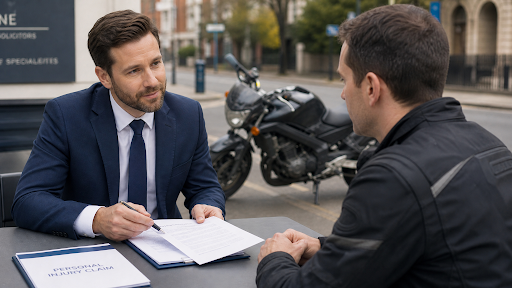
Motorbike accidents can have serious and life-changing consequences. Unlike drivers and passengers in cars, motorcyclists have very little physical protection on the road. Even a relatively low-speed collision can cause painful injuries, time away from work, emotional distress, and expensive recovery costs. If you have been injured in an accident that was not your fault, you may be entitled to make a motorbike accident claim UK for compensation.
Motorbike accident claims can help you recover financial losses and access the support you need after a road traffic accident. Whether you were hit by a careless driver, injured because of a dangerous road surface, or involved in a collision caused by another road user’s negligence, understanding your rights is an important first step.
This guide explains how motorcycle accident claims work in the UK, what compensation may cover, common causes of accidents, what evidence you may need, and how specialist solicitors can help you through the process.
Understanding Motorbike Accident Claims in the UK
A motorbike accident claim is a legal process that allows an injured motorcyclist to seek compensation when someone else was fully or partly responsible for the accident. In many cases, the claim is made against the insurance company of the driver or road user who caused the collision.
Motorbike accident claims can arise from many different situations. These may include collisions with cars, vans, lorries, buses, cyclists, or even accidents caused by poor road maintenance. The key issue is whether another party owed you a duty of care and failed to take reasonable steps to keep you safe.
All road users in the UK have a responsibility to drive or ride with reasonable care. This includes obeying speed limits, checking mirrors, signalling correctly, maintaining safe distances, and being aware of vulnerable road users such as motorcyclists. When someone fails in that duty and causes injury, a compensation claim may be possible.
Why Motorbike Accidents Can Be So Serious
Motorcyclists are among the most vulnerable road users. A rider does not have the same level of protection as someone inside a vehicle. There are no airbags, seatbelts, or crumple zones. As a result, motorbike accidents often lead to more severe injuries than other types of road traffic accidents.
Common injuries suffered in motorbike accidents include:
- Broken bones and fractures
- Head and brain injuries
- Spinal injuries
- Shoulder, arm, and wrist injuries
- Leg, knee, and ankle injuries
- Road rash and severe skin abrasions
- Soft tissue injuries
- Nerve damage
- Psychological trauma
- Amputations in the most serious cases
Some injuries heal within weeks or months, while others may require surgery, rehabilitation, physiotherapy, or long-term care. Psychological effects can also be significant. Many riders experience anxiety, flashbacks, sleep problems, or fear of returning to the road after a serious crash.
Compensation is designed to reflect the pain, suffering, and loss of amenity caused by the accident, as well as the financial impact on your life.
Common Causes of Motorbike Accidents
Motorbike accidents can happen for many reasons, but many are caused by negligence or lack of attention from other road users. Because motorcycles are smaller and less visible than cars, drivers often fail to see them until it is too late.
Common causes include:
- Drivers pulling out of junctions without properly checking
- Vehicles changing lanes without looking for motorcyclists
- Cars turning right across the path of an oncoming bike
- Rear-end collisions
- Speeding or aggressive driving
- Failure to give way
- Opening car doors into a rider’s path
- Poor road surfaces or potholes
- Oil, gravel, or debris on the road
- Defective vehicle parts
- Accidents caused by uninsured or untraced drivers
In some cases, more than one party may be responsible. For example, another driver may have contributed to the accident, while poor road conditions made the injuries worse. A solicitor can help investigate liability and identify who the claim should be made against.
Can You Claim If You Were Partly at Fault?
Many riders worry that they cannot claim if they may have been partly responsible for the accident. In the UK, it may still be possible to claim compensation even if you were partly at fault. This is known as contributory negligence.
For example, if another driver failed to check before turning but you were travelling slightly above the speed limit, both parties may share some responsibility. In these cases, compensation may be reduced by a percentage to reflect your share of fault.
If you were found to be 25% responsible, your compensation may be reduced by 25%. However, every case depends on the evidence. You should not assume you cannot claim without speaking to a specialist, especially if another road user played a significant role in causing the collision.
What Compensation Can Cover
Motorbike accident compensation usually includes two main types of damages: general damages and special damages.
General damages compensate you for the injury itself. This includes pain, suffering, and the effect the injury has had on your quality of life. The amount depends on the type of injury, severity, recovery time, long-term symptoms, and medical evidence.
Special damages compensate you for financial losses caused by the accident. These may include:
- Loss of earnings
- Future loss of income
- Medical expenses
- Physiotherapy and rehabilitation
- Prescription costs
- Travel expenses
- Motorcycle repair or replacement costs
- Damaged riding gear and helmet
- Care and assistance from family or professionals
- Home adaptations
- Mobility aids
- Loss of enjoyment of hobbies or activities
Keeping records of all accident-related expenses can help strengthen your claim. Receipts, invoices, wage slips, bank statements, and repair estimates may all be useful evidence.
Evidence Needed for a Motorbike Accident Claim
Strong evidence can make a significant difference to the success of your claim. After an accident, your immediate priority should always be safety and medical treatment. However, if you are able to gather information at the scene, it may help later.
Useful evidence can include:
- Photographs of the accident scene
- Photos of vehicle damage
- Images of your injuries
- Dashcam, helmet camera, or CCTV footage
- Details of the other driver
- Insurance information
- Vehicle registration numbers
- Witness names and contact details
- Police reference numbers
- Medical records
- Ambulance or hospital reports
- Repair quotes
- Receipts for expenses
- Evidence of lost earnings
If you were unable to collect evidence because of your injuries, a solicitor may still be able to help obtain police reports, medical notes, witness statements, and other supporting documents.
How Long Do You Have to Make a Claim?
In most UK personal injury cases, you usually have three years from the date of the accident to start a claim. This time limit is important. If you miss it, you may lose the right to claim compensation.
There are exceptions. If the injured person was under 18 at the time of the accident, the three-year period usually begins on their 18th birthday. This means they may have until their 21st birthday to start a claim. A parent or litigation friend may also be able to claim on behalf of a child before they turn 18.
If the injured person lacks mental capacity, the time limit may not apply in the usual way unless capacity is regained.
Although three years may sound like a long time, it is usually better to seek advice as soon as possible. Evidence can become harder to obtain as time passes, witnesses may become difficult to contact, and CCTV footage may be deleted.
Claims Against Uninsured or Untraced Drivers
If the driver who caused your accident was uninsured or left the scene without being identified, you may still be able to claim. In these situations, claims are often made through the Motor Insurers’ Bureau, known as the MIB.
The MIB provides a route to compensation for victims of uninsured and untraced drivers. These claims can be more complex than standard insurance claims, and there are specific rules and reporting requirements. For example, hit-and-run accidents should usually be reported to the police quickly.
Specialist motorbike accident solicitors can help prepare an MIB claim and ensure the correct procedure is followed.
Accidents Caused by Poor Road Conditions
Not every motorbike accident is caused by another driver. Some are caused by unsafe road conditions, such as potholes, loose gravel, diesel spills, defective road repairs, missing signs, or poorly maintained surfaces.
Motorcyclists are particularly vulnerable to road defects. A pothole that may be a minor inconvenience to a car can cause a rider to lose control and suffer serious injuries.
Claims involving poor road conditions may be made against the local authority, highway authority, or another organisation responsible for maintaining the road. These claims require evidence showing that the road was dangerous and that the responsible authority knew or should have known about the hazard.
Photographs, measurements of the defect, witness statements, accident reports, and maintenance records may all be relevant.
The Role of Motorbike Accident Solicitors
Motorbike accident claims can sometimes be more challenging than other road traffic accident claims. Insurers may try to argue that riders are risk-takers or that the motorcyclist was speeding, filtering dangerously, or partly responsible. These assumptions are not always fair, and they should be challenged with evidence.
A solicitor can help by:
- Assessing whether you have a valid claim
- Investigating who was responsible
- Gathering evidence
- Obtaining medical reports
- Calculating your losses
- Dealing with insurers
- Negotiating compensation
- Arranging rehabilitation where appropriate
- Advising on settlement offers
- Taking the case to court if necessary
Most claims settle without going to court, but preparing the case properly from the beginning can help achieve a fair outcome.
Medical Evidence and Rehabilitation
Medical evidence is central to any personal injury claim. It helps prove the nature and extent of your injuries, how long recovery may take, and whether there will be any long-term effects.
You may be asked to attend an independent medical assessment. The medical expert will prepare a report covering your injuries, symptoms, treatment, prognosis, and future needs. This report is used to value your claim.
In serious cases, rehabilitation may be an important part of recovery. This can include physiotherapy, occupational therapy, counselling, pain management, or specialist treatment. A solicitor may be able to seek early rehabilitation support from the responsible insurer, especially where liability is admitted.
Should You Accept an Early Settlement Offer?
After a motorbike accident, an insurer may make an early offer to settle the claim. While this can seem attractive, especially if you are facing financial pressure, it is important to be cautious.
An early offer may not fully reflect:
- The seriousness of your injuries
- Future medical treatment
- Long-term pain or disability
- Lost earnings
- Future loss of income
- Rehabilitation needs
- The cost of repairing or replacing your bike
- Psychological trauma
Once you accept a final settlement, you usually cannot ask for more compensation later, even if your condition worsens. It is wise to seek legal advice before accepting any offer.
Final Thoughts
A motorbike accident can affect every part of your life, from your health and independence to your work, finances, and confidence on the road. If someone else caused the accident, you should not have to deal with the consequences alone.
Making a motorbike accident claim can help you recover compensation for your injuries, lost income, treatment costs, bike damage, and other expenses. More importantly, it can provide access to support that helps you move forward after a difficult experience.
Whether your accident involved another vehicle, an uninsured driver, a hit-and-run, or a dangerous road surface, getting advice early can make the claims process easier. With the right evidence and professional guidance, you can protect your rights and pursue the compensation you deserve.