

The Material Planning Challenge
Manufacturers face a paradox every day: hold too much inventory, and cash flow suffers; hold too little, and production grinds to a halt. Striking the right balance is one of the oldest and hardest problems in manufacturing.
Material Requirements Planning (MRP) was invented decades ago to solve this challenge. Its logic is simple but powerful: align materials with demand, ensuring the right components are available at the right time without excess. But as supply chains grow more complex, manual or disconnected approaches to MRP are no longer sufficient.
Today, manufacturers need intelligent, connected, and predictive MRP systems. Embedding MRP directly into Salesforce through Axolt ERP brings material planning into the same environment where sales forecasts, customer commitments, and supplier data already live — creating a smarter, real-time planning engine.
What is MRP and Why It Matters for Manufacturers
The Origins of MRP
Material Requirements Planning was first formalized in the 1960s as a systematic way to translate demand forecasts into material orders. The goal was to prevent the costly twin risks of:
Stockouts, which delay production and disappoint customers.
Overstocking, which ties up capital and increases storage costs.
How MRP Works
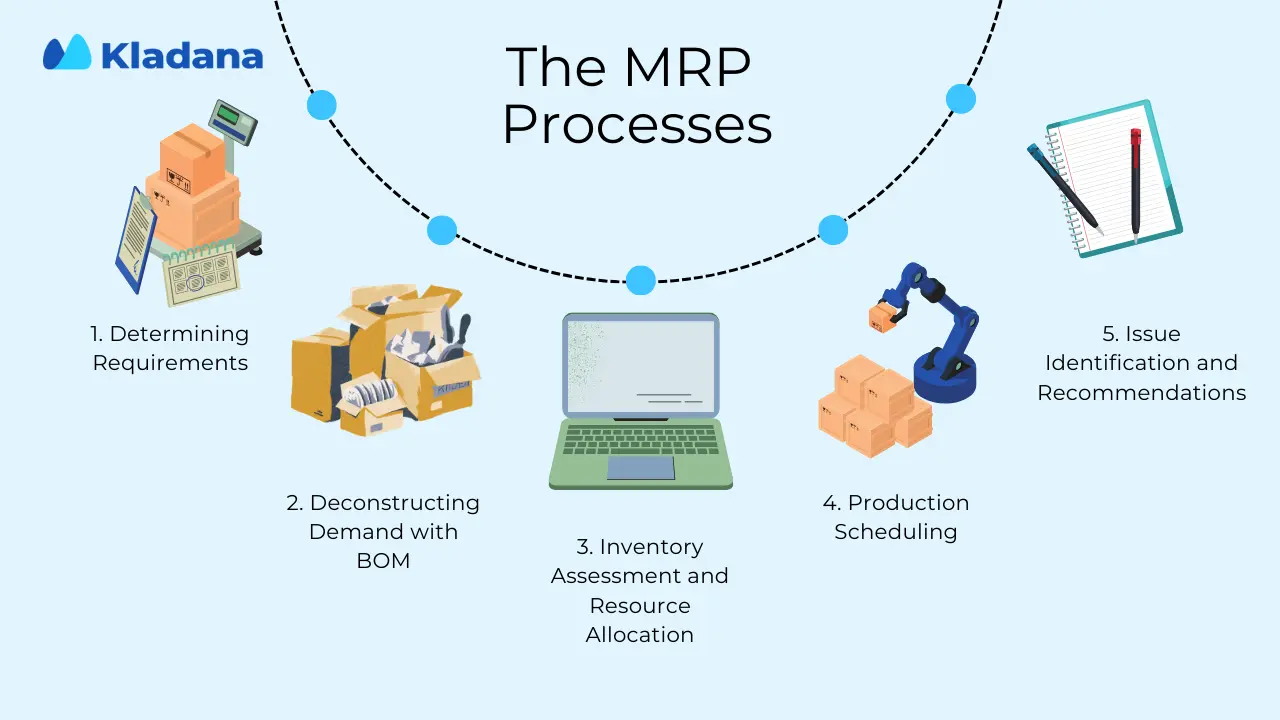
At its core, MRP answers three questions:
What is needed? (based on the bill of materials).
How much is needed? (based on sales forecasts and production plans).
When is it needed? (based on lead times and schedules).
It relies on inputs such as:
Customer orders and demand forecasts.
Bill of Materials (BOM).
Current inventory levels.
Supplier lead times.
The system then generates planned orders for procurement or production.
Why MRP Matters Today
In modern manufacturing, MRP is more critical than ever:
Global supply chains create longer and riskier lead times.
Customers demand shorter delivery cycles.
Product complexity (multi-level BOMs) increases planning difficulty.
Financial pressures demand leaner working capital.
MRP is not just a planning tool — it is a strategic enabler of agility, efficiency, and customer satisfaction.
The Limitations of Manual or Disconnected MRP
Despite its importance, many organizations still rely on outdated MRP approaches.
- Spreadsheets as MRP
Some manufacturers still run MRP logic in Excel. While flexible, spreadsheets lack:
Real-time updates.
Error-proofing.
Integration with procurement and sales.
This results in reactive firefighting instead of proactive planning.
- Disconnected Systems
In other cases, MRP exists in a standalone ERP module disconnected from CRM or inventory systems. Consequences include:
Forecast misalignment: Sales teams forecast demand, but MRP doesn’t see it until too late.
Procurement blind spots: Buyers place orders without visibility into customer commitments.
Delayed responses: By the time data flows between systems, conditions have changed.
- Static Planning
Traditional MRP runs in batch cycles (weekly or monthly). This means plans are outdated as soon as they’re created. In volatile environments, this is a fatal weakness.
- Human Dependency
Manual planning relies heavily on individual planners’ judgment. While experience is valuable, reliance on gut feel often leads to inconsistency and bias.
The result: stockouts, excess inventory, late deliveries, and lost opportunities.
AI-Driven MRP in Axolt ERP
By embedding MRP inside Salesforce, Axolt transforms it from static scheduling into a dynamic, AI-driven planning system.
- Predictive Planning
AI analyzes historical demand patterns, seasonality, and external signals (like sales forecasts or promotions) to predict material needs more accurately. Instead of relying on static safety stock, the system adjusts dynamically.
- Shortage Alerts
The system continuously monitors stock, demand, and supplier lead times. When a shortage risk appears, it sends real-time alerts to procurement and production managers. This allows proactive resolution before the issue affects customers.
- Smart Reordering
AI recommends optimal reorder points and lot sizes, balancing carrying costs with service levels. It prevents both over-purchasing and under-ordering.
- Supplier Insights
By tracking vendor performance — on-time delivery, quality, and lead time variability — the system adjusts planning to account for risk. For example, if a supplier consistently delivers late, AI compensates by adjusting reorder timing.
- Salesforce Integration
Because it runs in Salesforce:
Sales forecasts feed directly into MRP.
Inventory updates reflect instantly.
Purchase orders trigger automatically within the same platform.
This eliminates silos and creates one version of the truth.
Case Example: AI Avoids Stockouts and Reduces Costs
Consider a mid-sized manufacturer of medical devices with complex multi-level BOMs.
Before AI-Driven MRP
Demand forecasts were entered in Salesforce but exported to Excel for material planning.
Procurement often ordered too late, leading to stockouts of critical components.
To avoid shortages, planners carried excess inventory, tying up millions in working capital.
Supplier delays created constant firefighting.
After Implementing Axolt’s Salesforce MRP
Forecasts in Salesforce automatically fed into MRP.
AI predicted seasonal spikes in demand and recommended early orders.
Real-time shortage alerts enabled proactive adjustments.
Supplier performance data allowed planners to identify risk-prone vendors.
Inventory carrying costs dropped 18%, while stockouts fell by 40%.
The result was not just efficiency — it was resilience. Customers experienced fewer delays, cash flow improved, and the organization gained confidence in scaling production.
Strategic Implications for Manufacturers
The shift to AI-driven, Salesforce-native MRP has broader strategic consequences:
Agility
Manufacturers can adapt plans daily, not monthly.
Customer Trust
Fewer stockouts mean better delivery performance and stronger customer loyalty.
Working Capital Efficiency
Lean inventory frees up cash for innovation and growth.
Risk Management
Supplier risks are identified early, reducing dependence on firefighting.
Executive Insight
Leaders see demand, supply, and risk in one platform — aligning strategy with execution.
In an industry where margins are thin and disruption is constant, these advantages define competitiveness.
The Future of MRP is Intelligent and Connected
Material Requirements Planning, once a static scheduling tool, is evolving into a dynamic intelligence engine. By embedding MRP inside Salesforce and augmenting it with AI, Axolt ERP transforms planning from reactive guesswork into proactive strategy.
What was once a back-office calculation becomes a boardroom advantage: predictive planning, shortage alerts, and smarter procurement all within the same platform where customer demand originates.
The lesson is clear: the future of manufacturing belongs to those who connect demand to supply in real time, with intelligence guiding every decision.
Salesforce MRP with Axolt delivers exactly that — one platform, one model, one truth.