

Introduction: Why Test Before Replacing
A steam trap that fails is not merely an inconvenience. It is a direct source of energy loss, reduced system efficiency, and increased operating cost. Facility managers and plant engineers typically ask: “Should we replace it?” Few ask the more important question: “Have we actually tested it to confirm failure?”
The answer, backed by field data from thousands of steam system audits, is that many steam traps are replaced unnecessarily. Conversely, many failed traps continue operating unnoticed, wasting steam and money. Proper testing before replacement saves both.
Experts estimate that over 20 percent of the steam produced is lost due to leaking steam traps . Through just one leaking steam trap (thermodynamic, DN25, system pressure 11 bar), approximately 22 kg of steam per hour and approximately 190 tonnes per year are lost . Proper testing identifies these losses before they escalate.
For a complete guide to steam trap selection and installation, refer to the steam trap maintenance guide on the Techmatic website.
Method #1: Temperature Measurement
What It Measures
Temperature measurement checks the temperature upstream and downstream of the steam trap. The temperature difference (or lack thereof) indicates whether the trap is passing steam, blocked, or operating normally .
How to Perform
Using an infrared thermometer or contact pyrometer:
- Measure steam line temperature immediately upstream of the trap (inlet side)
- Measure temperature on the downstream pipe (outlet side), as close to the trap as possible
- Compare the two temperatures
What to Look For
| Condition | Upstream Temp | Downstream Temp | Interpretation |
| Normal operation | Saturated steam temp | 5–15°C lower | Trap discharging condensate |
| Failed open (blowing steam) | Saturated steam temp | Same as upstream or very close | Steam passing through |
| Failed closed (blocked) | Saturated steam temp | Cold (ambient) | No condensate discharge |
Pass/Fail Criteria
- Pass: Downstream temperature is noticeably cooler than upstream (5-15°C lower)
- Fail (Open): Downstream temperature is nearly equal to upstream temperature
- Fail (Closed): Downstream temperature is cold (ambient)
Limitations
Temperature measurement alone is not sufficient for reliable condition assessment . Using temperature measurement to determine whether a steam trap is leaking can lead to erroneous analysis because flash steam reads as hot as live steam .
When to Use
- Initial screening of large numbers of traps
- Identifying obviously failed traps (cold downstream = blocked)
- Prioritizing which traps need detailed ultrasonic testing
Method #2: Ultrasonic Listening
What It Measures
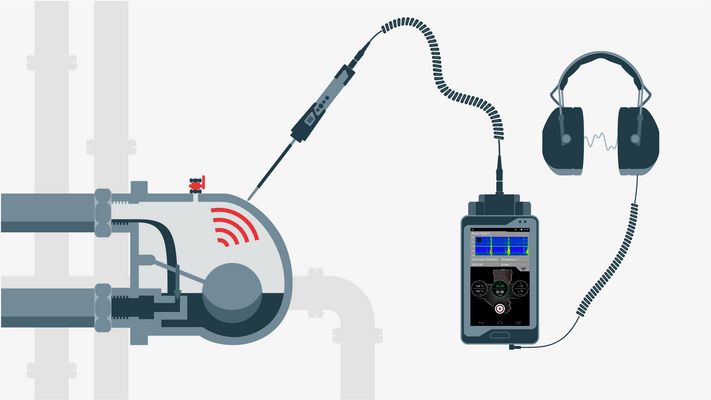
Ultrasonic listening detects the high-frequency sound (20-100 kHz) generated by steam or condensate flowing through the trap . Different trap types produce distinct acoustic signatures. A trained operator can identify normal operation, steam blow-through, and blockage by sound alone.
How to Perform
Using an ultrasonic detector with contact probe and headphones :
- Set the ultrasound unit to 25 kHz for highest clarity
- Touch the contact probe to the trap body at the discharge orifice
- Adjust sensitivity until the sound of the trap can be heard
- Listen for at least 45 seconds to ensure the trap was not in a cycle mode
- Compare the sound to known reference patterns for your trap type
Comparison Method for Accuracy
Using a field-proven comparison method provides an accurate test on each steam trap :
| Test Point | Location | Purpose |
| Test Point 1 | 6–10 inches upstream of trap | Establish baseline sensitivity |
| Test Point 2 | 6–10 inches downstream of trap | Filter out competing ultrasounds |
| Test Point 3 | At the discharge orifice of the trap | Test the trap itself |
Acoustic Signatures by Trap Type
Float & Thermostatic (F&T) Trap:
- Normal: Continuous hissing or rushing sound (condensate flowing)
- Failed open: High-pitched, steady screaming or whistling sound
- Failed closed: Silence (no sound)
Thermodynamic (Disc) Trap:
- Normal: Rhythmic cycling – hiss (open) → silence (closed) → hiss (open). Cycle frequency 2-10 seconds
- Failed open: Continuous hissing or screaming with no cycling
- Failed closed: Complete silence with no cycling
- Chattering: Rapid clicking (multiple cycles per second)
Inverted Bucket Trap:
- Normal: Cyclical sloshing or clunking sound as bucket falls and vents
- Failed open: Continuous hissing without the sloshing/clunking
- Failed closed: Silence or weak bubbling
Pass/Fail Criteria Using dB Readings
| Condition | Test Point 1 | Test Point 2 | Test Point 3 | Interpretation |
| Proper Operation | 30-35 dB | 30-35 dB | Equal or less than TP1/TP2 | Pass |
| Blowing/Failed Open | 25 dB | 32 dB | 64 dB (2x base level) | Replace immediately |
| Steam Leakage | 25 dB | 32 dB | 49 dB | Replace |
| Competing Ultrasounds | 22 dB | 42 dB | 28 dB | Investigate downstream |
Advantages of Ultrasonic Testing
- Non-invasive – no need to open the trap
- Works on all trap types
- Quantifiable dB readings provide objective measurements
- Can test traps in service – no system shutdown required
Limitations
- Requires training and experience
- Background noise can interfere
- Initial equipment cost (
- 500−
- 500−3,000)
Method #3: Visual Discharge Testing
What It Measures
Visual discharge testing directly observes the condensate and steam discharging from the trap outlet . It is the most definitive method – you see exactly what the trap is doing.
How to Perform
Using a sight glass or test valve installed downstream of the trap :
- Ensure the sight glass or test valve is clean
- Open the test valve slightly (if applicable) or observe through the sight glass
- Stand clear of the discharge outlet (hot condensate can spray)
- Observe the discharge pattern for 30-60 seconds
- Compare to the expected pattern for your trap type
Test Valve Procedure
For traps with a test “T” fitting :
- Close the upstream isolation valve
- Close the downstream valve to prevent backfeeding
- Open the test valve – if steam blows out, the trap is malfunctioning
- If only condensate drips out, the trap is functioning properly
- After testing, close test valve, open downstream valve, then slowly open upstream valve
Visual Patterns by Trap Type
Float & Thermostatic (F&T) Trap:
| Observation | Interpretation | Action |
| Steady stream of water (no steam) | Normal – condensate only | Pass |
| Steady water + intermittent puffs of steam | Normal during high load | Pass |
| Continuous steam with no water | Failed open – steam blow-through | Replace |
| No discharge (cold trap) | Failed closed (blocked) | Replace |
Thermodynamic (Disc) Trap
| Observation | Interpretation | Action |
| Cycle: water → steam puff → pause (every 2–10 seconds) | Normal operation | Pass |
| Continuous steam (no water, no cycling) | Failed open (disc stuck) | Replace |
| No discharge (silence, cold) | Failed closed | Replace |
| Rapid cycling (multiple times per second) | Chattering – disc unstable | Investigate |
Inverted Bucket Trap
| Observation | Interpretation | Action |
| Cyclical: water discharge → steam puff → clunk → pause | Normal operation | Pass |
| Continuous steam blow-through | Failed open (lost prime) | Replace |
| No discharge (cold, silence) | Failed closed (air binding) | Vent air or clean |
Pass/Fail Criteria
- Pass: Intermittent discharge of condensate, possibly with small puffs of flash steam
- Fail (Open): Continuous steam discharge with no water
- Fail (Closed): No discharge at all, trap is cold
Advantages
- Definitive – you see exactly what the trap is discharging
- No interpretation required
- Inexpensive (only requires a sight glass or test valve)
Limitations
- Requires installed sight glass or test valve – many traps lack these
- Safety hazard – hot condensate and steam can cause severe burns
- Not suitable for high-pressure systems (>10 bar)
- Limited to open systems or traps with sight glasses
Pass / Fail / Replace Decision Table
| Test Method | Pass (Monitor Only) | Fail (Replace Immediately) | Inconclusive (Investigate Further) |
| Temperature | Downstream 5-15°C cooler | Downstream same as upstream (open) OR cold (closed) | Downstream 2-5°C cooler |
| Ultrasonic | Rhythmic cycling (2-10 sec) OR continuous low hiss (F&T) | Continuous high-pitched scream OR complete silence | Intermittent high pitch, rapid cycling |
| Visual | Intermittent water discharge, small steam puffs | Continuous steam OR no discharge | Gurgling but no clear cycle |
Replacement Priority Matrix
| Priority | Condition | Action Timeline |
| Critical | Failed open (steam blow-through) on large trap (>2 inch) | Replace within 24 hours |
| High | Failed open on any trap | Replace within 1 week |
| Medium | Failed closed (blocked) – condensate backing up | Replace within 2 weeks |
| Low | Chattering, intermittent blow-through | Investigate, replace within 1 month |
Best Practice: Combine Multiple Methods
No single method is perfect. Temperature alone misses blow-through on some trap types. Ultrasonic alone can be confused by background noise. Visual alone requires sight glasses.
Recommended approach:
- Start with temperature measurement for initial screening
- Use ultrasonic listening for definitive diagnosis
- Confirm with visual testing when available and safe
For critical traps, use all three methods. An instrument that measures both temperature and ultrasound provides the most accurate diagnosis .
For more detailed troubleshooting of related equipment, see the pressure reducing valve chattering guide.
Preventative Maintenance Schedule
| Frequency | Task | Method |
| Monthly (Critical traps) | Temperature screening | Infrared thermometer |
| Quarterly (All traps) | Ultrasonic testing | Ultrasound detector |
| Annually | Full survey with documentation | Temperature + Ultrasound + Visual |
| Every 3–5 years | Comprehensive overhaul | Bench testing and rebuild |
Testing Frequency Recommendations
| Facility Type | Testing Frequency | Primary Method |
| Petrochemical / refinery | Monthly | Ultrasonic |
| Pharmaceutical / food | Quarterly | Ultrasonic + Temperature |
| Commercial building (heating) | Bi-annually | Temperature (screening) |
| Any facility with >50 traps | Quarterly | Ultrasonic |
Common Testing Mistakes to Avoid
Mistake #1: Testing Only During Steady Load
Steam traps behave differently at different loads. Test at multiple load conditions.
Mistake #2: Using Only Temperature
Temperature alone misses blow-through on many trap types .
Mistake #3: Not Recording Baseline Data
Establish baseline readings when traps are known to be good. Compare annually.
Mistake #4: Testing Immediately After Startup
Allow the system to reach steady state (30-60 minutes) before testing.
Mistake #5: Ignoring Upstream Strainers
A blocked strainer mimics a failed closed trap. Clean the strainer first.
For related maintenance guidance, Techmatic also offers resources on Y strainer maintenance.
Conclusion
Do not replace a steam trap without testing it first. Up to 20-25 percent of traps removed from service are still functional . Use temperature measurement for initial screening. Use ultrasonic testing for definitive diagnosis. Use visual testing when available to confirm.
For a complete guide to steam trap testing methods to check before replacing , read the full article on the Techmatic website, which includes detailed acoustic signatures for each trap type, thermal imaging comparisons, and step-by-step testing procedures.
When in doubt, consult a qualified supplier for site-specific advice. A properly tested and maintained steam trap operates reliably for years. Unnecessary replacement wastes money. Missed failures waste steam. Test first, then decide.
For more technical resources, Techmatic also offers guides on pneumatic actuated valve troubleshooting.