

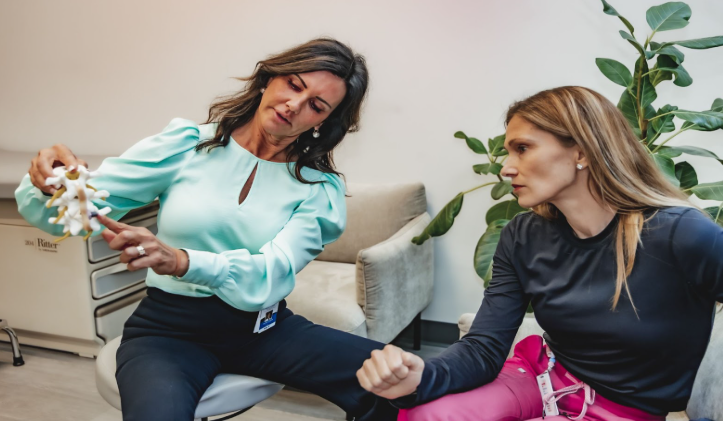
Turning 50 is a milestone worth celebrating. It is often a time of greater confidence, career stability, and watching families grow. But for many, it also marks the moment when the “check engine” light of the body—the spine—starts to flicker. You might notice that a morning stiffness lingers a little longer than it used to, or that a long car ride leaves you needing a few minutes to straighten up.
At Vertrae®, we often tell our guests that the spine is like a high-performance vehicle. For the first few decades of your life, you can drive it hard with minimal maintenance. But after 50, the warranty period is over, and proactive maintenance becomes non-negotiable. The good news? Biology is not destiny. Just because you have hit the half-century mark doesn’t mean you are sentenced to a life of aches and limitations.
We believe in a “MotionFirst” philosophy. We believe that the best surgery is the one you never have to have. While we are surgeons, our primary goal is to help you navigate the aging process with grace, strength, and mobility without seeing the inside of an operating room unless absolutely necessary. Here are seven proven, research-backed strategies to outsmart back pain after 50 and keep your spine moving as freely as your spirit.
1. Embrace the “Motion is Lotion” Mantra
If there is one concept we wish every person over 50 understood, it is this: your spine is designed to move. In fact, it starves if it doesn’t.
Unlike muscles, the discs in your spine—those shock-absorbing cushions between your vertebrae—do not have a direct blood supply. They are avascular. They rely on a process called “imbibition” to get their nutrients. Think of a sponge in a bucket of water. If you squeeze the sponge and let go, it sucks up the water. Your discs work the same way. The compression and decompression that happens when you walk, swim, or move is what pumps nutrients in and waste products out.
When you live a sedentary lifestyle, your discs effectively dry out. They become brittle and less capable of absorbing shock, which can accelerate degenerative disc disease. This is why a simple 20-minute walk every single day is one of the most powerful “painkillers” available. It lubricates the facet joints and feeds the discs. You don’t need to run marathons; you just need to keep the machine running.
2. Redefine Your “Core” (It’s Not About Sit-Ups)
When we talk about core strength with our guests, many immediately picture doing hundreds of crunches on the gym floor. Please, stop doing that. Traditional sit-ups can actually be harmful to a spine that has some wear and tear, as they place massive compressive loads on the lumbar discs.
The “core” we care about for spinal health isn’t the “six-pack” muscle (the rectus abdominis). We care about the “inner corset”—specifically, the transverse abdominis and the multifidus muscles. These are the deep stabilizers that wrap around your spine and hold it in place like a natural back brace.
As we age, these muscles tend to atrophy (weaken) faster than our visible muscles. When they get weak, your spine becomes unstable, leading to micro-movements that irritate nerves and cause spasms. The goal is to build endurance in these stabilizers. Exercises like the “Bird-Dog,” the “Dead Bug,” or a modified plank are gold standards. They teach your spine to remain stable while your arms and legs move. If you commit to just pain free back exercises for a few minutes every morning, you essentially armor your spine against the day’s activities.
3. Eat to Extinguish the Fire
You might not associate your breakfast plate with your back pain, but the connection is stronger than you think. As we age, our bodies become more susceptible to systemic inflammation. Conditions like osteoarthritis and spinal stenosis are inflammatory by nature. If your body is already inflamed, your back pain will be louder and more persistent.
The modern Western diet—high in processed sugars, refined carbs, and trans fats—is like pouring gasoline on a fire. If you are dealing with chronic back pain, one of the most effective non-surgical interventions is an anti-inflammatory diet. This isn’t a fad; it’s biochemistry.
Focus on foods rich in Omega-3 fatty acids, like salmon, walnuts, and flaxseeds. These compounds effectively block inflammatory pathways in the body. Add spices like turmeric and ginger, which have natural analgesic properties. Reduce your intake of “nightshade” vegetables (tomatoes, peppers, eggplants) if you notice they trigger joint pain, as some people have a sensitivity to them. By lowering your overall inflammatory load, you lower the volume on your pain signals.
4. Hydrate Your Shock Absorbers
We mentioned earlier that your discs are like sponges. They are composed largely of water and collagen. Throughout the day, as you stand and sit, gravity squeezes water out of your discs, which is why you are actually slightly shorter when you go to bed than when you woke up.
At night, your discs rehydrate—but only if there is water available in your system. As we get older, our thirst mechanism blunts. We tend to drink less water, leading to a state of chronic low-grade dehydration. If you are dehydrated, your discs cannot fully plump back up. A dehydrated disc is a flatter disc, and a flatter disc means the space for your nerves gets smaller, potentially leading to pinched nerves or stenosis symptoms.
Make water your primary beverage. A good rule of thumb is to check the color of your urine; it should be pale yellow. If it’s dark, your spine is thirsty. Front-loading your water intake earlier in the day can also help prevent those middle-of-the-night bathroom trips that disrupt the sleep your body needs to heal.
5. Audit Your Sleep Architecture
Sleep is the only time your spine gets a break from the relentless force of gravity. However, many people over 50 wake up in more pain than when they went to sleep. This is usually a mechanical issue.
If you are a side sleeper (which is generally best for the spine), the most critical accessory is a thick pillow between your knees. Without it, your top leg slides forward, twisting your pelvis and torqueing your lumbar spine all night long. That pillow keeps your hips stacked and your spine neutral.
If you are a back sleeper, place a pillow under your knees. This slight bend unlocks the hamstrings and flattens the lumbar curve, taking the pressure off the facet joints in your lower back. Avoid stomach sleeping if at all possible; it forces your neck into extreme rotation and hyperextends your lower back, jamming the joints together. Investing in a supportive mattress and mastering “sleep ergonomics” can revolutionize your mornings.
6. Know Your Enemy: Understanding the Aging Spine
Fear is a major component of pain. When you feel a sharp twinge in your back at age 55, it is easy for your mind to spiral into worst-case scenarios. Understanding what is actually happening can dial down that anxiety.
The truth is, gray hair and wrinkles are normal signs of aging on the outside, and “degenerative changes” are normal signs of aging on the inside. If you took an MRI of 100 people over the age of 50 who have zero back pain, a huge percentage of them would still show bulging discs or arthritis. These findings are often just “wrinkles on the inside.”
However, it is crucial to distinguish between “normal” aging aches and signals that require expert attention. Mechanical back pain usually gets better with rest or position changes. Neurogenic pain (nerve pain) is different—it feels electric, burning, or shoots down the leg. Conditions like spinal stenosis (narrowing of the spinal canal) often present as heaviness in the legs when walking that goes away when you sit down (the “shopping cart sign”). Understanding the nuances of back pain after 50 allows you to advocate for yourself and seek care when something truly changes, rather than panicking over every stiffness.
7. Listen to the “Red Flags”
While we champion conservative care and home management, there are specific signals that mean you need to stop the home remedies and see a specialist immediately. We call these “Red Flags.”
If you experience sudden, severe weakness in a leg (foot drop), numbness in the “saddle area” (groin/inner thighs), or any loss of bowel or bladder control, this is a medical emergency. These are signs of Cauda Equina Syndrome, a condition where the bundle of nerves at the bottom of the spine is compressed.
Additionally, if your back pain is accompanied by unexplained weight loss, fever, or a history of cancer, do not ignore it. But for the vast majority of mechanical back pain, the “Red Flags” are absent. This means you have time. You have time to try physical therapy. You have time to improve your diet. You have time to strengthen your core.
Conclusion: You Are the Pilot
At Vertrae®, we see ourselves as your navigators. We have the maps, the technology, and the surgical expertise to guide you through complex spinal conditions. But you are the pilot. The daily decisions you make—how you sit, what you eat, how you move—have a profound impact on your trajectory.
Back pain after 50 is common, but suffering is optional. By treating your spine with the respect it deserves and adopting a maintenance mindset, you can keep moving forward. Whether you are chasing grandkids, hitting the golf course, or just enjoying a pain-free walk in the park, your best years are still ahead of you. Let’s keep you in motion.