

Why this sequence keeps showing up for people in the middle of a career pivot, and what to do with it that is not just vibes.
There is a demographic that finds this number more than any other: people who are competent at a job they have stopped believing in. Not people who are failing. People who are doing fine, hitting their numbers, and quietly running out of reasons.
That is the exact population 919 tends to land on, and it is worth understanding why the symbolism fits so neatly.
Nine is the end of a competence cycle
In numerology, nine closes a cycle. Applied to work, this maps onto something specific and recognisable: the point where you have extracted most of the learning a role has to offer. You still perform well. You may perform better than ever. But the growth curve has flattened, and you can feel it.
That flattening is uncomfortable in a way that is hard to justify to other people. The job is fine. The pay is fine. Nothing is wrong. Nine describes precisely this state: not failure, but completion that has not been acknowledged.
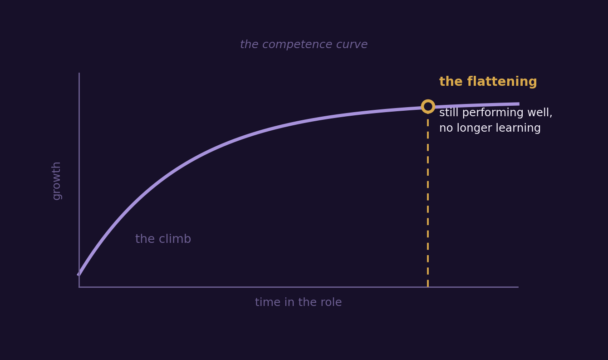
The competence curve: mastery arrives before the ending is admitted.
One is the part people avoid
The middle digit is initiation, and in a career context it carries an unwelcome implication. New beginnings in work almost always involve a temporary drop in status and competence. You go from being the person who knows things to the person asking questions.
This is the actual barrier for most people considering a pivot. It is rarely money in the abstract. It is the identity cost of being a beginner again after years of being good at something. The 919 angel number puts initiation between two completions, which reads as a fairly direct statement: the beginning is not going to feel like a promotion.
PHOTO SLOT: a desk at the end of a workday, laptop closed, or an empty office chair. Suggested alt text: a workspace at the end of a shift.
On the money question
Angel number content around finance tends toward the fantastical, so let us be direct. There is no number that produces income. What the nine-one-nine structure suggests about money is narrower and more defensible.
- It points to income sources that are ending rather than income appearing. A client winding down, a contract not renewing, a side stream drying up.
- It emphasises replacement rather than addition. The structure is a swap, not an accumulation.
- It implies the replacement is initiated rather than received. The one is an active digit.
That is a considerably less exciting reading than most of what you will find online, and considerably more likely to describe what you are actually experiencing.
Turning it into something usable
Symbolism becomes useful at the point where it produces a concrete next action. Three that tend to work here:
- Write the resignation letter you are not going to send. The exercise forces you to articulate the reason, and the reason is usually more specific than the general malaise suggests.
- Cost the transition honestly. Runway in months, not a vague sense of whether you can afford it. Ambiguity is what keeps people stuck longest.
- Talk to two people who made a similar move. Not for permission. For a realistic picture of the first six months, which is the part nobody describes accurately in hindsight.
The number is a deadline, not a plan
The most reasonable interpretation of a repeating 919 in a work context is that a decision you have been deferring has moved from optional to overdue. It does not tell you what to choose. It tells you that continuing not to choose has become its own choice, with its own cost.
If you want to explore the situation with more texture, pairing numerology with a Tarot Reading gives you two different angles: one structural, one narrative. But the useful part happens after, when you open a document and start costing the thing out.