

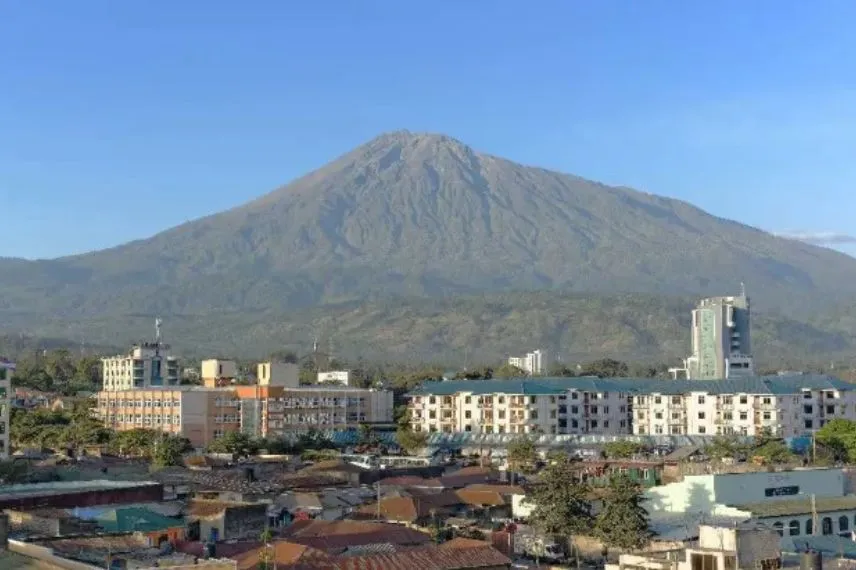
Most travelers treat Arusha as a layover, a place to land, sleep, and leave the next morning without much thought. That’s a reasonable approach if you’re tight on time, but it undersells a city that’s worth a few hours of actual attention, and understanding it a little better also makes your first and last nights of the trip easier to plan.
The City Everyone Passes Through
Arusha sits at the base of Mount Meru and functions as the operational headquarters for East African safaris, the city where nearly every Northern Circuit trip begins and ends. It’s also a working Tanzanian city in its own right, with a population well into the hundreds of thousands, busy markets, and a mix of colonial-era and modern architecture that gives it a different character than the smaller towns you’ll pass through later in the trip.
The Clock Tower and a Story Worth Knowing
The Arusha Clock Tower sits at a roundabout near the city center and has become the de facto meeting point for locals and visitors alike. The popular claim is that it marks the exact midpoint between Cairo and Cape Town, a detail repeated in nearly every city tour and travel guide. It’s worth knowing this is, by most honest accounts, an urban legend rather than a verified geographic fact. That doesn’t make the tower any less worth a stop, it’s a genuinely good photo spot and a useful orientation point, but it’s the kind of small detail that separates a guide that’s done its homework from one that’s just repeating what every other site says.
What Else Is Worth a Look
The Maasai Market sits a short walk from the clock tower and is one of the better spots in the city for souvenirs, beadwork, and textiles, with the added benefit of being a genuine place to interact with local vendors rather than a tourist-only construction. The Arusha Declaration Monument and museum nearby covers a meaningful piece of Tanzanian political history, and the Cultural Heritage Centre on the city’s outskirts houses a serious collection of art and crafts from across the country’s various tribal traditions, alongside a tanzanite counter if you’re interested in the gemstone Tanzania is uniquely known for.
If you have a free afternoon and want something further afield, the Meserani Snake Park sits about 30 minutes outside the city center and includes a free health clinic for local residents alongside its reptile exhibits, a slightly unusual but genuinely interesting combination.
Why Your Arusha Stay Matters More Than It Seems
Because flights into Kilimanjaro International Airport typically land in the late afternoon or evening, most travelers arrive too late in the day to head directly into the bush, which means your first night happens in Arusha regardless of how short you want the city portion of your trip to be. The same is true in reverse: safaris commonly end with an afternoon drive back into the city ahead of a late-night international departure, leaving several hours that are far better spent in a proper room than at the airport.
This is exactly why booking a hotel arusha ahead of time matters more than it might seem for what’s often treated as a throwaway night. Properties near the airport and city center fill up during peak migration season the same way safari camps do, and arriving after a 20-hour journey only to discover your options are limited is an avoidable headache.
Using the City Well, However Much Time You Have
If you only have an evening, a short walk to the clock tower and a meal at your hotel covers the basics without feeling rushed. If you’ve built in a half day or more, pairing the Maasai Market with the Cultural Heritage Centre gives you a genuine sense of the country’s craft traditions before you head into the parks. Either way, Arusha deserves a little more attention than the average itinerary gives it, since it’s the one place on a tanzania safari you’ll almost certainly pass through twice, once arriving with anticipation and once leaving with a phone full of photos.