

By a furniture and design industry contributor.
You have likely felt the sting of a disappointing furniture purchase. The dining chair that starts to wobble after six months. The sofa with cushions that flatten into pancakes. The bookcase with a “wood” finish that is actually a paper-thin sticker, peeling at the corners. When furniture falls apart quickly, it’s not just annoying. It costs you money, turning a good deal into an expense you have to pay over and over.
The gap between furniture that looks good online and furniture that is built to last has never been wider. To find good furniture, you need more than just an eye for style or a good price. It means learning to look past the surface and check how the piece is built, what it’s made of, and the support offered by the seller. The first step is to understand what makes some furniture last for generations while other pieces are disposable, a focus also addressed by organizations like ASTM in their work on home furnishings. This is where expert denver furniture stores services become invaluable; they are not just about selling, but about teaching you to understand the true value behind the price.
Quick answer: To check furniture quality, focus on three areas. First, look at the construction, checking for solid wood joints instead of staples and glue. Second, check the materials by asking if a piece is solid wood, veneer, or a mix of materials. Third, look at the seller’s services, like full-service delivery and support after you buy.
What’s inside
- What Is the Difference Between Good and Great Construction?
- How Can You Spot Quality Materials vs. Clever Imitations?
- When Does Paying for Interior Design Services Make Sense?
- Frequently Asked Questions About Furniture Quality
- The Final Measure of Value
What Is the Difference Between Good and Great Construction?
The difference is in the joints, frame material, and finishing details. These things decide whether a piece will last for a few years or for generations.
Great furniture is built with joints designed to hold up for decades. Look for methods like mortise-and-tenon, where one piece of wood fits snugly into a hole in another, or dovetail joints, often seen in high-quality drawers. These techniques create strong, interlocking connections that hold together under pressure. The CPSC emphasizes the importance of durable furniture construction for safety. Good construction might use dowels or screws, which work but are not as strong. The biggest red flag is furniture held together mainly by staples and glue, as these joints are the first to fail with daily use.
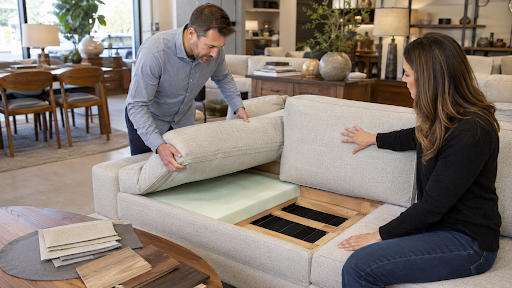
The frame is the skeleton of any sofa, chair, or cabinet. The best you can get is a kiln-dried hardwood frame. Kiln-drying is a process that removes moisture from wood in a controlled way. This stops the wood from warping or cracking as it gets used to the air in your home. Softer woods like pine cost less but are more likely to get dents and dings. Avoid frames made from particleboard or medium-density fiberboard (MDF). They can sag over time and do not hold screws well, which makes repairs nearly impossible.
❝ A simple test for a sofa or chair is to lift one of the front corners off the floor by about six inches. If the other front leg lifts as well, the frame is stiff and well-built. If it twists or flexes, the frame is weak and will likely not last.
Finally, check the small details. Are the drawer bottoms thin and flimsy, or are they solid panels? Do they have dust panels, thin sheets of wood between drawers, to add strength and protect clothing? On a sofa, are the cushion zippers high-quality, or do they feel cheap and likely to break? These small details are where makers often cut corners, and they are a good sign of the overall quality and care put into the piece.
How Can You Spot Quality Materials vs. Clever Imitations?
You can spot quality materials by understanding the main differences between solid wood, veneers, and laminates. Then, look for clues you can see and feel, like weight, edge details, and grain patterns.
Solid wood is exactly what it sounds like: furniture made from whole pieces of wood. It is durable, can be repaired, and develops a beautiful finish, called a patina, as it ages. Wood veneer is a thin layer of high-quality wood glued onto a stronger, less expensive core material. This is not always a sign of low quality. Good veneers use a strong core like plywood to prevent the warping that can happen with large pieces of solid wood. The problem is with paper-thin veneers or printed laminates made to copy wood grain. These cannot be sanded or repaired if they get scratched.
The easiest way to tell the difference is to look at the edges and corners. On solid wood, the grain pattern will wrap around the edge, flowing from the top surface to the side. On a veneered or laminated piece, you will often see a clear line or a repeating pattern on the edge where the surface material ends.
| Material Type | Durability & Lifespan | Repairability | Common Uses |
| Solid Wood | Highest; can last for generations. Can sometimes warp in large pieces. | Excellent. Can be sanded and refinished multiple times. | Table legs, chair frames, drawer fronts, frames and legs. |
| Wood Veneer | Good. Thick veneers last a long time. | Good, if the veneer is thick enough for light sanding. | Tabletops, cabinet doors, large flat surfaces that need to stay flat. |
| Laminate/MDF | Lowest. It chips and peels easily. Water damage will ruin it. | Cannot be repaired. Deep scratches or chips are there to stay. | Budget-friendly furniture, back panels, drawer bottoms. |
❝ When you are looking at a veneered piece, ask the salesperson a specific question: “What is the core material, and how thick is the veneer?” A quality piece will use a strong core like plywood, not cheap particleboard. A thick veneer can be treated almost like solid wood, while a paper-thin one is just for looks.
Beyond wood, feel the weight and check the finish of other materials. Metal parts should feel heavy and solid, not hollow or flimsy. Welds should be smooth, not bumpy or sharp. For sofas and chairs, look for information on the fabric’s durability, often measured in “double rubs.” A fabric rated for 15,000 double rubs is good for home use, but a higher number means it will last longer on a busy piece like a family sofa.
When Does Paying for Interior Design Services Make Sense?
It makes sense to pay for design services when you are furnishing a whole room, trying to create a look that flows together, or dealing with a tricky space that is hard to figure out.
Many people confuse interior design with decoration. Decoration is about choosing finishes like paint colors, fabrics, and accessories. Interior design is about solving problems with the space to make the room work better. A designer’s main job is to figure out the right size for furniture, the lighting, and how people will walk through the room before any furniture is chosen. If you have an oddly shaped living room, not much natural light, or need to combine a home office and a guest room, a designer can create a layout that works.
The service can also be a smart way to save money by preventing expensive mistakes. A common error is buying a large piece, like a sectional sofa, only to find it is too big for the room or blocks an important path. Another is buying items one piece at a time, which can result in a collection of furniture that never quite works together. A designer creates a complete plan from the start, making sure everything fits together in size, style, and color. This plan acts as a guide, even if you buy items over several months or years.
❝ Before committing, ask a potential designer this key question: “How will you work with my existing furniture and art that I want to keep?” A great designer will see the pieces you love as a starting point and a creative challenge. A salesperson, on the other hand, may see them as problems that get in the way of a sale. The answer will show you if their goal is to create a home that’s truly yours or to just sell a room full of new products.
You will typically find two models. The first is an independent designer who charges an hourly rate or a flat fee. The second, often found at higher-end furniture stores, offers design services that are free with a minimum purchase. This can be an excellent value, as you get expert advice focused on a selection of furniture that you already know you like. The key is to make sure the service is more than a sales pitch and provides real space planning and a design that pulls everything together.
Frequently Asked Questions About Furniture Quality
How can I judge a furniture store beyond what it sells? Look at the knowledge of the staff and how well the showroom is put together. A high-quality store trains its team to understand construction, materials, and space planning. They should be able to answer detailed questions about joints and fabric durability. The showroom itself should feel thoughtfully arranged and show a clear style, rather than being a warehouse filled with random items.
Is “Made in the USA” a sure sign of quality? It can be a strong sign of certain labor and material standards, but it is not a guarantee of better quality. Excellent furniture is made all over the world, especially in places with long traditions of woodworking, like Italy and Scandinavia. Instead of focusing only on the country, look into the reputation of the specific company, as their standards are what really decide the quality.
What does “white glove delivery” actually include? True white glove service is a full setup service, not just a drop-off at your curb. The delivery team should bring the item into your home, place it in the room you want it in, do any assembly needed, and take away all the packaging. For tricky pieces like modular sectionals or large wall units, this service is very important to ensure a correct and damage-free setup.
How much should I budget for a high-quality sofa? While prices vary, a well-built sofa is a big purchase because of the materials and work involved. The cost is driven by a kiln-dried hardwood frame, strong spring systems, foam cushions that bounce back and will not flatten, and strong fabric. Expect the price to be several times that of a cheaper, factory-made sofa, but with a lifespan that is much longer.
Can a sofa or chair truly be a “buy it for life” purchase? Yes, but with one catch: the frame is for life, but the fabric and cushions are not. A well-built hardwood frame can last for generations. The fabric and cushion inserts, however, are parts that wear out with use. A high-quality piece is designed to be reupholstered. This lets you refresh its look and extend its life many times, which makes the first cost worth it.
The Final Measure of Value
In the end, choosing furniture is about looking past the showroom polish to what’s underneath. The biggest difference between a piece that lasts three years and one that lasts thirty is rarely seen at first glance. It is found in the strength of the frame, the quality of the joints, and the durability of the materials hidden under the fabric. These things decide not just how the piece looks today, but how it will perform, feel, and hold up under the pressures of daily life.
This changes the decision from one of simple looks to one of long-term investment. The goal is not just to fill a space, but to get something useful for your home. A well-made item can be reupholstered and refinished, changing with your style and serving your family for decades. A poorly made one is a throwaway item, making its true cost, measured in replacements and frustration, far higher than the price tag. Your best tools are curiosity and a willingness to ask specific, smart questions about what lies beneath the surface.
About the author
This article is contributed by the design team at Element Home, a locally owned furniture showroom and interior design studio based in Denver’s Cherry Creek North neighborhood. Since 2003, the company has focused on selecting modern furniture from American, European, and Canadian makers alongside a collection of fine art. Their work involves fitting these pieces into complete interior design plans, helping clients create spaces that look good and work well through professional space planning and white glove installation services.