

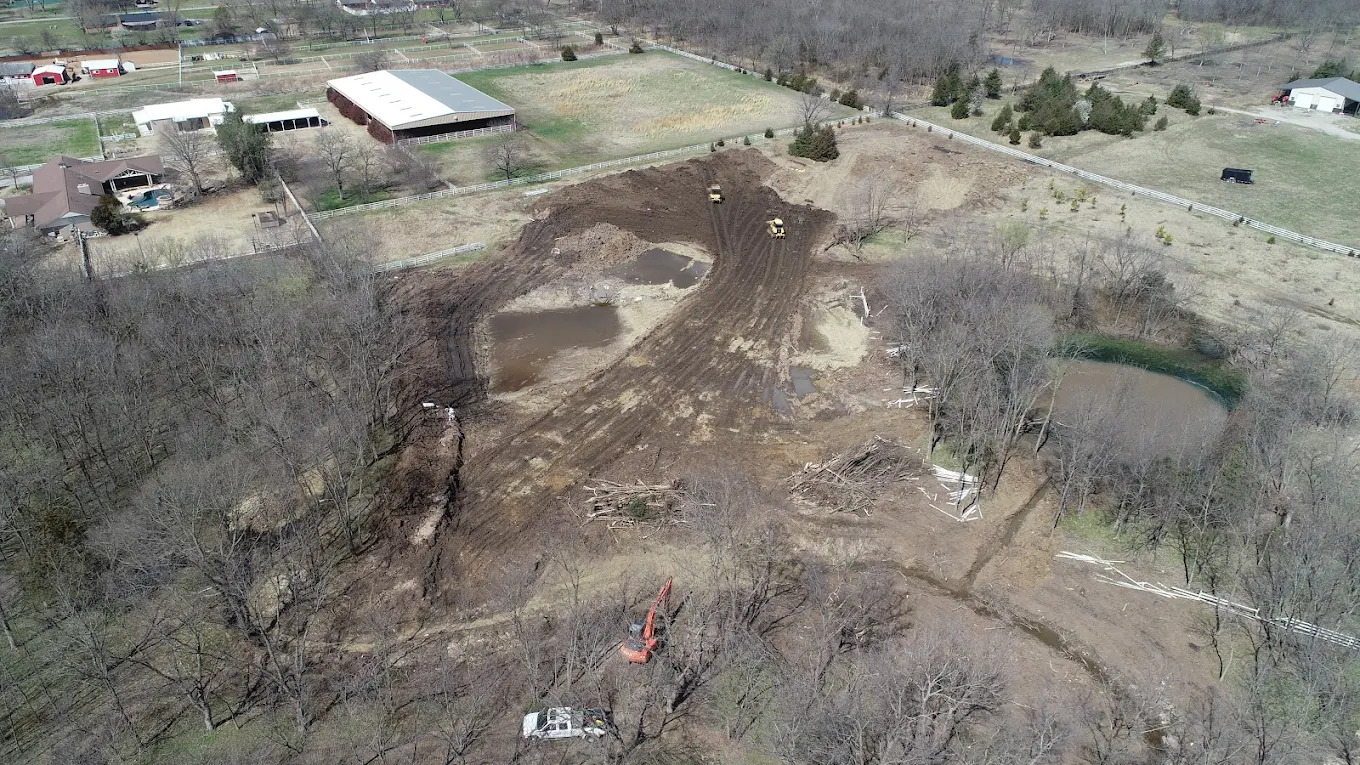
When most people drive past a construction site in Tulsa, they see big yellow machines, piles of red clay, and perhaps a cloud of dust. It looks raw. It looks primal. It looks like the complete opposite of “high technology.” In the popular imagination, excavation is often viewed as a brute-force industry—a simple matter of horsepower meeting earth. But here at T & J Excavation, we see it differently. We know that beneath the roar of the diesel engine and the grind of the tracks, there is a symphony of physics, fluid dynamics, and geological science at play.
We are a dedicated family-owned and operated business right here in the heart of Tulsa, Oklahoma, and we have watched this industry evolve firsthand. Our story begins with our founder and owner/operator, Trev Fielden. With over 20 years of experience shaping the Oklahoma terrain, Trev has seen the transition from old-school guesswork to the modern era of precision earthmoving. While we pride ourselves on our traditional values of hard work and integrity, we are also geeks at heart when it comes to the machinery we operate. Today, we want to pull back the curtain and show you how innovation has turned the muddy job of digging holes into an exact science.
The Evolution of Hydraulic Power: Surgical Precision on a Massive Scale
If you watch an excavator operator who really knows their craft, it looks less like construction and more like an extension of their own body. This is made possible by the incredible advancements in hydraulic technology. In the early days of earthmoving, machines were cable-operated—clunky, jerky, and relying heavily on friction and gravity. You pulled a lever, a winch tightened, and the bucket moved. It was effective, but it was far from precise.
Today, the machines we use are marvels of fluid engineering. Modern hydraulic systems use high-pressure oil to transmit power with zero lag time. This allows for what we call “feathering” the controls. An operator like Trev can wield a multi-ton steel bucket with enough delicacy to peel the topsoil off a site without disturbing the clay beneath it, or to place a heavy limestone rock within an inch of its target position. This “smart power” means we can work faster and safer. We aren’t fighting the machine; the machine is reacting instantly to the neural commands of the operator. It changes the game for residential projects where we might be digging a pool next to an existing patio. The margin for error is zero, and modern tech allows us to hit that mark every time.
The Science of Water Management and Laser Grading
One of the oldest enemies of any structure is water. If you build a house, a barn, or a driveway without respecting the flow of water, you are building a future disaster. In the past, grading a site—leveling the ground to a specific slope—was done by eye and by feel. A seasoned operator would “eyeball” the slope. While experience is valuable, the human eye can be tricked by the horizon or the surrounding terrain.
Now, we utilize laser transits and grading technology to defeat optical illusions. By setting a laser benchmark, we can determine the elevation of the ground to within a fraction of an inch. This allows us to create precise “swales” and slopes that guide rainwater away from your foundation and towards drainage areas. It is simple geometry applied to the real world. When we grade a pad for a new shop or prepare a driveway, we are essentially terraforming the land to manipulate gravity. This technological assurance means that when the heavy Oklahoma spring rains come, our clients can sleep soundly knowing the water is flowing exactly where we told it to go.
Logistics as a Technology: The “Clean Dirt” Supply Chain
Technology isn’t always about microchips and lasers; sometimes, innovation is about logistics and supply chain management. One of the biggest bottlenecks in the excavation industry has always been the sourcing of materials. You can have the best machines in the world, but if you don’t have good dirt to fill a hole, the project stalls. “Bad dirt”—soil filled with roots, rocks, and trash—can compromise the structural integrity of a building pad.
We decided to innovate our business model by taking control of this variable. We operate a dedicated Tulsa Dirt Site where we manage and process quality fill material. Think of this as the “quality control lab” for our projects. By screening and managing our own soil supply, we ensure that the material we bring to your home or business is clean, compactable, and safe. This logistical efficiency reduces downtime. Instead of waiting on a third-party vendor who might be running late or delivering subpar product, we have our own pipeline. It is a modern solution to an age-old problem: how to get the right earth to the right place at the right time.
Soil Mechanics: Understanding the “Data” Under Your Feet
To a novice, dirt is just dirt. To us, soil is a dataset. Every shovel-full tells us a story about the geological history of the land and how it will react to weight and weather. Oklahoma has a diverse geological profile, ranging from sandy loam to the notorious “gumbo” clay that expands when wet and shrinks when dry.
Understanding soil mechanics is a form of scientific analysis. Before we pour a foundation or pave a driveway, we have to assess the “plasticity” and density of the ground. We use compaction equipment that vibrates at specific frequencies to force air pockets out of the soil. This creates a dense, solid base that can support the weight of a structure for decades. If you skip this scientific step and just dump dirt in a hole, the ground will eventually settle, leading to cracked concrete and shifting foundations. We view soil compaction as the most critical “invisible” technology we offer. You will never see it once the grass grows back, but it is the engineering miracle holding your house up.
The Human Computer: The Operator’s Brain
Despite all the talk of lasers, hydraulics, and soil density, the most sophisticated piece of technology on any job site remains the human brain. There is currently no AI or computer program that can replicate the intuition of an operator with 20 years of experience.
This is where the “Fielden Factor” comes in. Trev Fielden has spent two decades downloading data—not into a hard drive, but into his muscle memory. He knows exactly how a machine feels when it hits a rock versus a utility line. He knows by the sound of the engine if the load is too heavy. He can look at a slope and visualize the drainage pattern before the first scoop is dug. This cognitive processing power allows us to troubleshoot problems in real-time. Construction sites are unpredictable; blueprints rarely match reality perfectly. It takes a human mind, backed by years of trial and error, to adapt on the fly. We combine the best mechanical technology with this irreplaceable human experience to deliver a product that is both mathematically precise and artistically crafted.
Efficiency = Cost Savings
Why does all this talk of technology matter to you, the homeowner or business owner? Because efficiency saves money. In the old days, a project that took two weeks involved a lot of labor hours and fuel. With modern high-efficiency diesel engines, precise hydraulic attachments, and laser-guided accuracy, we can do more work in less time with less waste.
We don’t have to re-dig a trench three times because we missed the grade. We don’t have to wait for a dirt delivery because we control the supply. We don’t damage your property because our machines are precise extensions of our hands. All of these technological advantages translate into a smoother, faster, and more affordable project for you.
Building the Future with T & J
We love the smell of diesel in the morning, but we also love the satisfaction of a job done with mathematical perfection. We are proud to bring this blend of old-school grit and new-school technology to the Tulsa community. We are building the platforms upon which our city grows, one bucket at a time.
If you are ready to start a project that requires not just muscle, but intelligence and precision, we are ready to help. At T&J Excavating, we treat every job site like a laboratory where we engineer the perfect solution for your land. Whether you need a house pad, a pond, or a complete site overhaul, let our family show you the difference that experience and innovation can make. Let’s break ground together.