

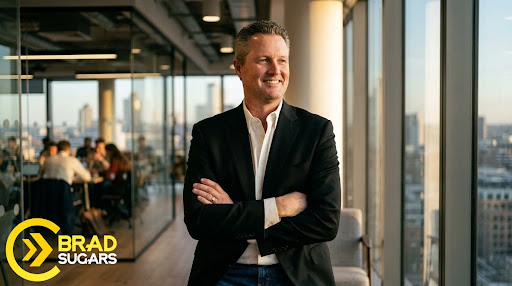
Most business owners do not struggle because they lack ambition. They struggle because they are trying to grow without a clear progression.
In the early stages, everything depends on the owner. As the business grows, that same approach becomes the bottleneck. The more the business expands, the more pressure it puts on the person running it.
Brad Sugars puts this simply. If the business depends on you to function, it is not a scalable business. It is a job.
This is where a structured growth path becomes necessary. Without one, owners rely on instinct, react to problems as they appear, and often repeat the same mistakes at a larger scale.
One of the most practical versions of this progression comes from Brad Sugars, founder of ActionCOACH. His coaching ecosystem is built around five levels, each aligned with a stage of growth and a specific set of systems.
This article discusses how these levels work and what typically changes as a business moves forward.
What Are Brad Sugars’ 5 Levels of Business Growth
Brad Sugars’ 5 Levels of Business Growth are structured around his coaching programs. Each level reflects a stage in how a business operates and what the owner needs to focus on next.
Instead of offering general advice, the model creates a progression. As the business grows, priorities shift, systems become more defined, and the owner’s role changes.
It begins with the Startup Club, where the focus is on building a foundation. At this stage, clarity matters more than scale. The goal is to establish consistent action and create the basic systems that allow the business to function.
The next level is the $1M Club. Here, the business has traction, but results are often inconsistent. The focus turns to building repeatable systems for marketing, sales, and delivery so outcomes become predictable rather than dependent on effort.
As the business grows further, it enters the $10M Club. This is where many owners feel the strain of growth. The business is expanding, but the owner is still deeply involved. The shift here is toward leadership, delegation, and strengthening systems so the business can operate without constant oversight.
At the $100M Club, the focus changes again. The business is established, and the goal becomes expansion with control. This includes stronger performance tracking, clearer strategy, and building an organization that can function independently at scale.
The final stage is the Billionaire Blueprint Boardroom. At this level, the conversation moves beyond operations. The focus is on long-term wealth, investment, and building something that extends beyond a single business.
Why Do These Levels Matter?
Without a defined progression, most businesses grow in size but not in structure.
Owners stay involved in too many decisions, systems remain incomplete, and performance becomes inconsistent. Growth happens, but it becomes harder to manage.
The 5 Levels framework introduces a different way of thinking. Growth is not just about doing more. It is about changing how the business operates.
At each stage, the business moves toward greater predictability. Systems replace guesswork. Delegation replaces dependence. Decisions are based on measurable performance rather than constant reaction.
Without these shifts, the business reaches a ceiling. With them, it becomes easier to scale.
Where Most Businesses Get Stuck
The most common bottleneck appears after a business gains traction.
At this point, there is revenue, there may be a team, and things seem to be working. But the structure has not caught up with the growth. The owner is still involved in too many areas, and systems are not strong enough to support expansion.
This is where many businesses plateau.
Working harder does not solve this stage. Without systems, more effort only increases dependence on the owner and slows down progress.
How Brad Sugars’ Approach Supports Each Stage
Brad Sugars’ methodology focuses on implementation. The goal is not to motivate business owners, but to give them a way to build systems that work.
At every stage, the focus is on creating repeatable processes across marketing, sales, operations, and financial management. These systems are designed to be measured, improved, and scaled.
As those systems improve, the owner’s role changes. The shift moves from doing the work, to managing people, to leading the business, and eventually to building assets that operate independently.
This progression is what allows a business to grow without increasing reliance on the owner.
Choosing the Right Brad Sugars Program for Your Stage of Growth
Brad Sugars’ programs are built for entrepreneurs who want to move beyond effort-driven growth.
Each level aligns with a different stage, and each stage requires a different focus. Early-stage founders need clarity and structure. Growing businesses need systems that produce consistent results. Scaling companies need leadership and delegation. Established businesses need strategy and long-term planning.
The underlying shift is identity. The goal is to move from being the person who does the work to the person who leads and grows the business.
Growth Requires Structure
Without structure, progress depends on effort and instinct. With the right systems in place, each stage builds on the last, creating a business that is more stable, more scalable, and less dependent on the owner.
Brad Sugars’ 5 Levels of Business Growth provide that path. Each level clarifies what needs to change and what the owner should focus on next.
If the business still depends on you to move forward, the next step is not to do more. It is to move to the level that matches your current stage and build the systems required to progress from there.