

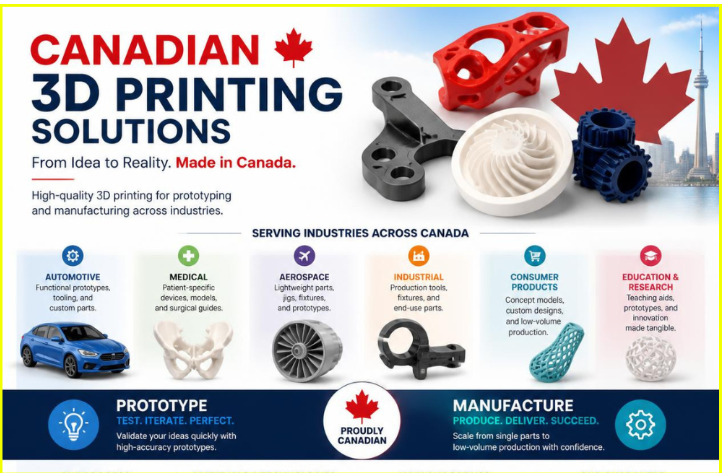
A Canadian 3D printing service can turn a digital CAD model into a physical prototype, functional component, production part, jig, fixture, or custom object without requiring a company to purchase and operate its own industrial 3D printer.
3D Printing Services is positioned as an on-demand additive manufacturing provider serving Canadian customers with multiple 3D printing technologies, engineering materials, design assistance, 3D scanning, finishing, inspection, and small-batch production.
For businesses, the value of a professional 3D printing service is not simply the ability to print plastic. The important question is whether the provider can match the right manufacturing process and material to the part’s actual requirements.
A prototype that only needs visual validation has very different requirements from an automotive fixture, a replacement component, or a production part that will experience heat, mechanical loads, chemicals, or repeated use.
What Is a Canadian 3D Printing Service?
A Canadian 3D printing service is a manufacturing provider that produces physical parts from digital designs using additive manufacturing technologies. Instead of removing material from a block, as in traditional machining, additive manufacturing builds an object layer by layer.
The process generally starts with a customer supplying a 3D model. Common file formats include STL, STEP, STP, OBJ, 3MF, and IGES. The service provider evaluates the geometry, manufacturing requirements, material, dimensions, and intended application before producing the part.
This model is particularly useful for organizations that need parts occasionally or need capabilities beyond the equipment they already have.
A startup might need 20 enclosure prototypes. An engineering department might require a custom fixture. A manufacturer may need a replacement component while waiting for conventional tooling. A product company could require a small production run before committing to injection molding.
In each situation, outsourcing can be more practical than investing in specialized equipment.
Why Canadian Businesses Use On-Demand 3D Printing
The strongest reason to use an on-demand service is flexibility.
Buying a professional 3D printer involves much more than the initial machine cost. Businesses may also need trained operators, software, maintenance, materials, post-processing equipment, quality-control procedures, ventilation or environmental controls, and space for production.
Outsourcing shifts much of that operational responsibility to the manufacturing provider.
It also gives companies access to technologies they may not have internally. A business with an FDM printer, for example, may not have access to industrial SLS, metal additive manufacturing, or high-resolution resin systems.
There is another advantage: production volume can determine whether 3D printing makes economic sense.
For a small number of parts, additive manufacturing can eliminate tooling costs and reduce the time between design and physical testing. Once demand becomes predictable and volumes increase substantially, another manufacturing process may become more economical.
That is why a good 3D printing service should not simply ask, “What do you want printed?” It should help determine, “What is the most appropriate way to manufacture this part?”
Technologies Available Through 3D Printing Services
3D Printing Services describes a range of additive manufacturing technologies, with FDM, SLA, and SLS among its core processes.
FDM and FFF 3D Printing
Fused Deposition Modeling, often referred to as FDM or FFF, creates parts by depositing thermoplastic material layer by layer.
It is commonly used for prototypes, brackets, housings, fixtures, tooling, functional test pieces, and other applications where production speed and practical mechanical properties matter.
Material selection can significantly change the performance of an FDM part. PLA may work well for visual prototypes and general-purpose models, while materials such as PETG, ABS, ASA, nylon, or reinforced composites may be better suited to specific functional requirements.
FDM is not automatically the best choice simply because it is widely available. Layer orientation, infill, wall thickness, temperature exposure, and mechanical loading all affect the finished part.
SLA Resin Printing
Stereolithography uses liquid resin cured with light to create highly detailed components.
SLA is particularly useful when surface quality, small features, and dimensional detail are more important than the characteristics of a conventional filament-printed component.
Applications can include presentation models, detailed prototypes, product-development components, and specialized parts.
The resin itself is critical. A standard resin intended for visual models should not automatically be treated as equivalent to an engineering resin designed for demanding applications.
SLS Nylon Printing
Selective Laser Sintering uses a laser to fuse powdered material into a finished part.
One major advantage of SLS is geometric freedom. Because surrounding powder supports the part during printing, engineers can produce shapes that would require complicated support structures with other processes.
SLS is often useful for functional prototypes, complex geometries, housings, brackets, and small production runs.
Nylon materials such as PA12 are commonly associated with this type of manufacturing and can provide a different combination of strength, durability, and design freedom than standard filament printing.
MJF, DMLS, PolyJet, and Large-Format Manufacturing
For applications requiring other material characteristics or production approaches, 3D Printing Services also describes capabilities involving Multi Jet Fusion, Direct Metal Laser Sintering, PolyJet, and large-format additive manufacturing.
MJF can be valuable for producing functional polymer parts in quantities where conventional desktop printing may not be appropriate.
DMLS extends additive manufacturing into metal components, making it relevant to applications where metal performance is required.
PolyJet technology can produce highly detailed parts and is useful for applications where fine features or specialized material characteristics are important.
Large-format additive manufacturing addresses components that exceed the practical build volume of many conventional 3D printers.
The important point is that these technologies are not interchangeable. The correct process depends on geometry, quantity, material, tolerances, surface requirements, mechanical loads, and budget.
Choosing the Right Material
Material selection should begin with the part’s intended use, not with the material name.
A prototype used only to confirm dimensions has different requirements from a component installed inside a vehicle or machine.
Common material categories offered through professional 3D printing services can include PLA, PETG, ABS, ASA, nylon, carbon-fiber-reinforced materials, TPU, polypropylene, engineering resins, clear materials, tough resins, and high-temperature materials.
Flexible TPU, for example, can be appropriate when elasticity is required. Nylon can be useful when durability and functional performance matter. Carbon-fiber-reinforced materials can provide increased stiffness in appropriate applications.
Environmental conditions also matter.
Before choosing a material, consider:
- Operating temperature
- Mechanical loading
- Flexibility requirements
- Impact exposure
- Chemical exposure
- UV exposure
- Moisture
- Surface requirements
- Dimensional stability
- Expected service life
- Regulatory or application-specific requirements
A material that looks excellent in a prototype may be unsuitable for long-term field use.
From CAD File to Finished Part
The manufacturing process does not begin when the printer starts.
A professional workflow usually begins with design review.
The provider examines the supplied geometry for issues that could affect manufacturing. This is often described as design for manufacturing, or DFM.
DFM can identify problems involving unsupported geometry, wall thickness, tolerances, holes, orientation, clearances, assembly relationships, and other design features.
This stage is valuable because 3D printing can reproduce a digital model faithfully while still producing a part that does not perform as intended.
For example, a hole may technically print but be too tight for the intended fastener. A thin wall may print but lack sufficient strength. A component may fit dimensionally while failing under the expected load because the layer orientation creates a weak direction.
Good additive manufacturing therefore involves engineering judgment, not just machine operation.
Prototyping Without Waiting for Traditional Tooling
Rapid prototyping is one of the strongest applications for a Canadian 3D printing service.
Traditional manufacturing methods can require molds, fixtures, machining setups, or other preparation before parts can be produced economically. Additive manufacturing can reduce or eliminate some of those upfront requirements for prototype quantities.
That allows engineers to test physical designs earlier.
A prototype can reveal problems that are difficult to identify on a computer screen:
- An assembly may interfere with another component.
- A handle may be uncomfortable.
- A housing may not provide enough clearance.
- A cable route may be impractical.
- A mounting point may be inaccessible.
- A component may be too flexible.
- A component may require a stronger material or revised geometry.
The purpose of rapid prototyping is not merely to make something quickly. It is to shorten the distance between an engineering assumption and physical evidence.
Small-Batch Production
3D printing can also bridge the gap between prototyping and conventional manufacturing.
Suppose a company needs a few hundred specialized components but does not yet have enough demand to justify injection molding. Additive manufacturing may provide a way to manufacture the required quantity without committing to expensive dedicated tooling.
This can be particularly useful for customized products, replacement parts, limited releases, specialized equipment, and products with frequently changing designs.
However, 3D printing should not automatically be considered the cheapest option for every production quantity.
As volume increases, cycle time, material consumption, finishing, labor, machine capacity, and quality requirements can change the economics. Injection molding, CNC machining, thermoforming, or other processes may become more appropriate.
The best manufacturing strategy depends on the entire production requirement rather than the printing price alone.
3D Design and Reverse Engineering
Not every customer arrives with a production-ready CAD file.
A professional service can also help when the starting point is a sketch, physical sample, existing component, or incomplete design.
3D design services can convert an idea into a manufacturable digital model. This is particularly useful for companies that have product concepts but lack internal CAD resources.
3D scanning provides another route.
When an existing physical object needs to be replicated, modified, inspected, or redesigned, scanning can capture its geometry and provide digital data for subsequent engineering work.
This can support reverse engineering, replacement-part development, dimensional analysis, and product redesign.
The scan itself is not the finished engineering solution. Complex scanned geometry may still require cleanup, reconstruction, CAD modeling, or design modification before it can be manufactured reliably.
Quality Control Matters More Than the Print Button
For functional components, getting a part out of the printer is only one part of the job.
Dimensional inspection can determine whether the finished component conforms to important dimensions. This becomes increasingly important when a part must fit with other components or meet engineering specifications.
Customers should distinguish between a visually successful print and a verified manufacturing result.
A part can look excellent while containing dimensional deviations, warping, surface defects, insufficient strength, or other issues that only become apparent during assembly or use.
When ordering professional parts, provide the dimensions and tolerances that actually matter. Not every dimension needs the same level of precision, and demanding unnecessarily tight tolerances can increase manufacturing difficulty and cost.
When 3D Printing Is Not the Right Choice
An experienced manufacturer should also explain when not to use 3D printing.
Machining may be preferable when very tight tolerances, specific materials, or particular surface finishes are required.
Injection molding can become more economical for sufficiently high volumes of identical plastic parts.
Sheet-metal fabrication may be better for certain enclosures and structural components.
Casting or other conventional processes can make more sense for particular geometries and production requirements.
3D printing is strongest when its advantages—low tooling requirements, geometric freedom, customization, rapid iteration, and economical low-volume production—align with the project.
Choosing it simply because it is technologically interesting is not a manufacturing strategy.
Common Mistakes When Ordering 3D Printed Parts
One of the most common mistakes is providing a model without explaining what the part actually needs to do.
A manufacturer needs context.
Tell the provider whether the part is cosmetic, structural, flexible, exposed to heat, used outdoors, installed in an assembly, repeatedly loaded, or intended for final production.
Another mistake is selecting a material based only on price.
The cheapest material can become expensive if the resulting part fails and has to be redesigned and reproduced.
Customers also sometimes overlook post-processing. Depending on the technology, the final component may require support removal, sanding, curing, surface treatment, machining, or other finishing operations.
Finally, do not confuse a prototype with a validated production component. A prototype is evidence for decision-making. It does not automatically prove that the final design is suitable for every operating environment.
How to Decide Whether 3D Printing Services Is Suitable
Start with five questions.
What are you making?
Define the part, assembly, prototype, fixture, or production component.
What does it need to withstand?
Identify mechanical, thermal, chemical, environmental, and dimensional requirements.
How many do you need?
A single prototype, ten components, and several thousand parts can lead to very different manufacturing decisions.
How important are appearance and precision?
A visual prototype may prioritize surface quality, while an engineering component may prioritize dimensional accuracy and mechanical performance.
Do you already have a production-ready CAD file?
If not, design or scanning assistance may be necessary before manufacturing begins.
These answers narrow the appropriate technology far more effectively than simply asking which 3D printer is available.
Practical Recommendation for Canadian Customers
For a Canadian business considering an on-demand 3D printing service, the strongest approach is to treat the provider as part of the engineering workflow rather than simply as a print shop.
Prepare the cleanest CAD file available, explain the part’s purpose, specify the quantity, identify critical dimensions, describe the operating environment, and state whether the component is a prototype or intended for actual use.
Then compare the proposed technology against the application.
If the project requires fast design iteration, complex geometry, customized parts, prototypes, or relatively low production quantities, additive manufacturing can be highly effective. If the project demands very high production volumes, unusually tight tolerances, or a material/process combination better suited to conventional manufacturing, another method may provide better long-term value.
For Canadian customers looking for a single provider covering multiple stages—from 3D design and scanning through additive manufacturing, inspection, and small-batch production—3D Printing Services offers a broader manufacturing workflow than a basic consumer 3D-printing shop.
The most useful question is therefore not simply, “Can this part be 3D printed?”
It is: “Which manufacturing process, material, and production strategy will produce the part I actually need?”
That distinction is what separates a successful 3D printing project from an expensive experiment.