

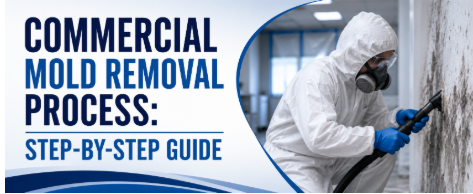
Mold in a commercial building brings different stakes than a residential job. There are employees, customers, inventory, and often regulatory requirements to consider, and downtime directly affects revenue. A commercial mold removal project follows a more structured process than a typical home job for exactly these reasons. Here is what that process looks like from start to finish.
💧 Did You Know?
The EPA’s guidance for schools and commercial buildings recommends professional remediation, rather than DIY cleanup, for any mold-affected area larger than roughly 10 square feet — which is part of why commercial mold jobs are almost always handled by trained crews rather than in-house staff. (Source: U.S. EPA)
Step 1: Initial Inspection and Assessment
Every legitimate remediation project starts with an inspection, not a quote based on a phone call. A technician assesses the extent of visible mold, checks for moisture sources using tools like moisture meters and thermal imaging, and identifies whether the mold has spread into wall cavities, HVAC systems, or other hidden spaces. In commercial buildings, this often means checking multiple floors, shared HVAC systems, and areas above drop ceilings, since mold can travel further through a large building’s air handling system than it would in a house.
Step 2: Air and Surface Testing
For commercial properties, documented commercial mold testing is often necessary for insurance claims, lease disputes, or regulatory compliance, not just to confirm the problem exists. Testing typically includes air sampling in affected and unaffected areas for comparison, along with surface samples from visible growth. Results establish a baseline that will later be used to confirm the space is clear after remediation.
Step 3: Containment
Before any remediation work begins, the affected area is sealed off using plastic sheeting and negative air pressure machines. This prevents mold spores from spreading to unaffected parts of the building during the work, which is especially important in occupied commercial spaces where other tenants or employees are still present nearby. Air scrubbers with HEPA filtration typically run throughout this phase.
Step 4: Removal of Contaminated Materials
Porous materials that have absorbed mold, such as drywall, insulation, and carpet, generally cannot be fully cleaned and are removed rather than treated. Non-porous materials, like metal framing, concrete, or certain finished surfaces, are typically cleaned and treated instead of replaced. In a commercial setting, this step often needs to be coordinated around business hours or done in phases to minimize disruption to operations.
Step 5: Cleaning and Treatment
Remaining surfaces are cleaned using antimicrobial and antifungal treatments designed to eliminate residual mold and prevent regrowth. HEPA vacuuming is used throughout this phase to capture spores that standard cleaning would leave behind. Any HVAC components affected are cleaned or replaced, since ductwork can otherwise redistribute spores throughout the building after remediation is complete.
Step 6: Addressing the Moisture Source
Removing mold without fixing the moisture problem that caused it is a temporary solution at best. This step might involve repairing a roof leak, correcting plumbing issues, improving ventilation, or addressing grading and drainage problems around the building. A remediation company that skips this step is setting the business up for a repeat mold problem.
Step 7: Reconstruction
Once the area is clean and dry, reconstruction begins, including new drywall, flooring, insulation, and paint as needed. In commercial spaces, this phase often requires coordination with the business’s own contractors or property management to match existing finishes and building codes.
Step 8: Post-Remediation Verification Testing
After the work is finished, a third-party or independent testing service typically conducts clearance testing to confirm mold spore levels in the air have returned to normal, comparable to outdoor baseline levels. MidAtlantic Mold and Water Damage recommends this final verification step because it provides documented proof that the space is safe to reoccupy, which is important for liability, insurance claims, and tenant or employee confidence.
Why the Order of Operations Matters
Skipping steps, particularly containment or moisture source correction, is one of the most common reasons mold returns after a remediation job. A reputable commercial mold removal service provider will walk you through each phase, provide documentation at every step, and won’t rush past testing to get to reconstruction faster. Choosing an experienced mold removal service helps ensure the affected areas are properly treated and reduces the risk of future mold growth. For a business, getting this process right the first time is almost always cheaper than dealing with a recurrence months later.
Frequently Asked Questions
How long does commercial mold remediation typically take?
It varies with the size of the affected area and how many phases of work need to happen around business hours, but the process from inspection through post-remediation verification testing generally spans several days to a few weeks for a contained job.
Why does commercial mold testing matter more than for a typical home?
Commercial properties often need documented testing results for insurance claims, lease disputes, or regulatory compliance, not just to confirm mold is present. Baseline testing also gives the clearance testing at the end something concrete to compare against.
Can a business stay open during mold remediation?
Often, yes, especially when the affected area can be contained and work is coordinated in phases around business hours. Containment barriers and negative air pressure machines are used specifically to keep spores from spreading to occupied parts of the building.
What happens if the moisture source isn’t fixed during remediation?
The mold is very likely to return. Removing mold without correcting the leak, ventilation issue, or drainage problem that caused it only provides temporary relief and often leads to a repeat, more costly project.