

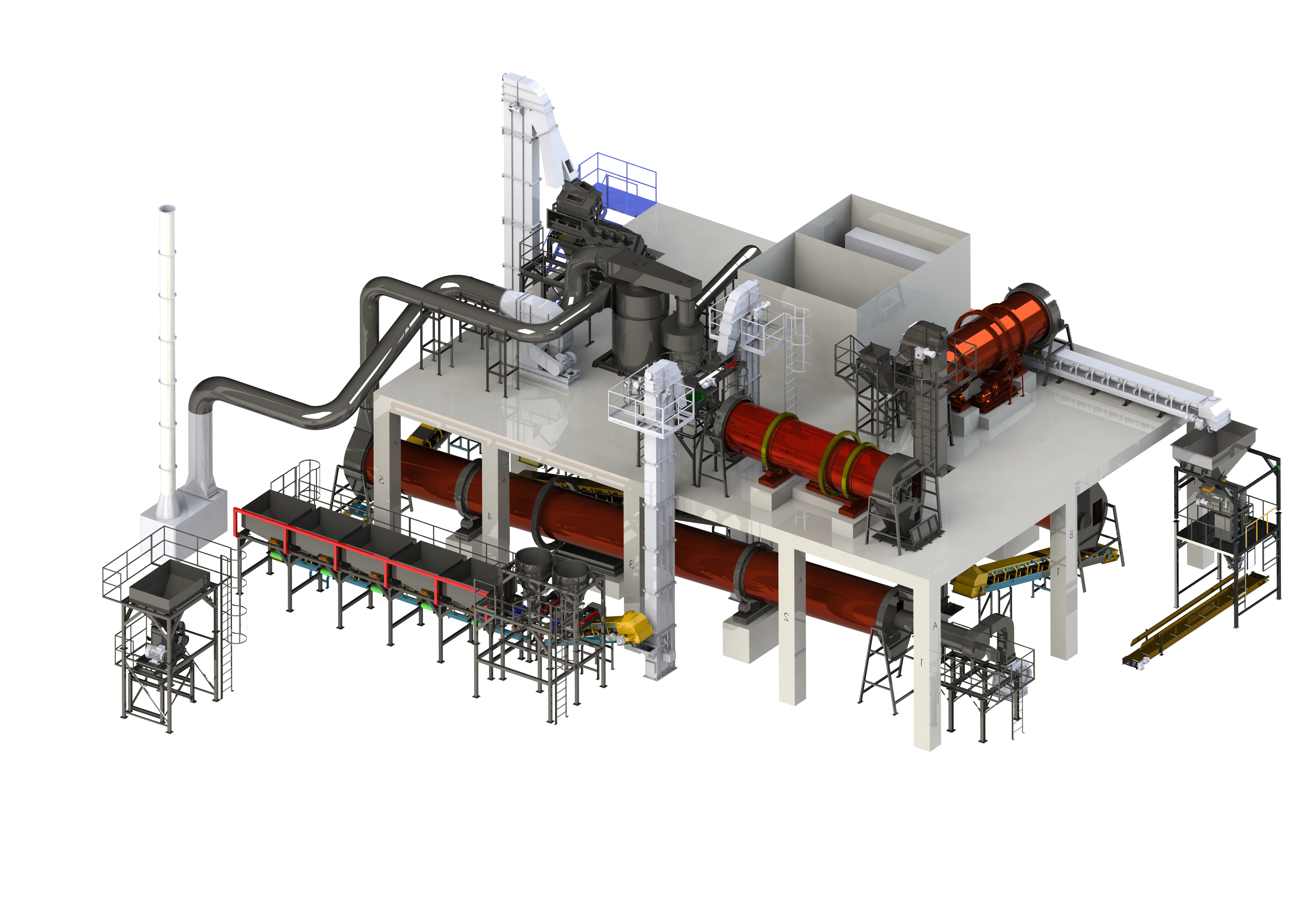
Fertilizer production plays a crucial role in modern agriculture, ensuring that crops receive the essential nutrients required for optimal growth. Among various production methods, the npk granulation line and phosphate granulation equipment are two key technologies that have revolutionized fertilizer manufacturing. In this article, we will explore these systems, their working mechanisms, applications, and advantages, providing a complete guide for manufacturers, agronomists, and industry enthusiasts.
Understanding Fertilizer Granulation
Granulation is the process of converting fine powder or small particles into larger, more uniform granules. This process not only improves the ease of handling and storage but also enhances the efficiency of nutrient delivery to plants. Fertilizer granulation is particularly important in producing NPK (Nitrogen-Phosphorus-Potassium) and phosphate-based fertilizers, as these compounds often require precise formulation for balanced plant nutrition.
NPK Granulation Line: An Overview
The NPK granulation line is designed to produce compound fertilizers containing nitrogen (N), phosphorus (P), and potassium (K) in a controlled ratio. These fertilizers are essential for crop growth as each nutrient serves a unique role:
- Nitrogen (N) promotes leaf and stem growth.
- Phosphorus (P) supports root development and flowering.
- Potassium (K) enhances overall plant health and disease resistance.
By combining these nutrients in a single granule, the npk granulation line ensures efficient nutrient utilization and uniform application in the field.
Components of an NPK Granulation Line
A typical NPK granulation line consists of the following components:
- Raw Material Batching System – Measures and mixes raw materials in precise ratios.
- Granulator – Converts mixed powders into uniform granules using dry or wet granulation methods.
- Drying System – Removes excess moisture from wet granules to prevent caking.
- Screening Equipment – Separates granules by size to meet specific standards.
- Cooling System – Reduces granule temperature after drying for easy packaging.
- Coating System – Adds a protective layer to prevent moisture absorption and improve shelf life.
- Packaging Machine – Packs finished fertilizers into bags for storage and shipment.
The combination of these components ensures high efficiency, uniform granule size, and consistent nutrient content.
Working Principle of an NPK Granulation Line
The process in an NPK granulation line typically follows these steps:
- Raw Material Preparation – Raw powders, including urea, ammonium phosphate, potassium chloride, and other additives, are measured and blended.
- Granulation – The blended powders enter a granulator. In dry granulation, the material is compressed into granules without moisture. In wet granulation, a liquid binder is added to form granules.
- Drying and Cooling – Wet granules are dried in a rotary drum or fluidized bed dryer, then cooled to prevent caking.
- Screening and Coating – Granules are screened to remove fines and oversized particles, followed by coating to enhance storage stability.
- Packaging – The finished product is packaged and ready for distribution.
This process ensures the production of high-quality compound fertilizers that meet global agricultural standards.
Advantages of Using an NPK Granulation Line
Using an NPK granulation line offers numerous benefits for fertilizer manufacturers and farmers alike:
- Uniform Nutrient Distribution – Each granule contains a balanced ratio of N, P, and K, ensuring uniform fertilization.
- Reduced Nutrient Loss – Granulated fertilizers reduce volatilization and leaching, improving nutrient uptake.
- Improved Storage and Transportation – Granules are easier to handle, store, and transport compared to powders.
- Scalability – Modern lines can handle small to large-scale production, offering flexibility for manufacturers.
- Cost-Effectiveness – Efficient use of raw materials reduces waste and lowers production costs.
These advantages make the NPK granulation line a preferred choice for large-scale fertilizer production.
Phosphate Granulation Equipment: An Overview
Phosphate fertilizers are crucial for promoting root growth, flowering, and overall plant health. Phosphate granulation equipment is designed to convert phosphate-containing powders into uniform granules suitable for agricultural application.
Types of Phosphate Granulation Equipment
Phosphate granulation equipment comes in different types, depending on the production scale and granulation method:
- Dry Granulation Equipment – Compresses powders into granules using mechanical pressure. Suitable for small-scale production or heat-sensitive materials.
- Wet Granulation Equipment – Uses a liquid binder to form granules, followed by drying and cooling. Ideal for high-capacity production.
- Rotary Drum Granulator – Produces large volumes of granules with uniform size and smooth surfaces.
- Disc Granulator – Offers precise control over granule size and is suitable for both phosphate and compound fertilizers.
Working Principle of Phosphate Granulation Equipment
The phosphate granulation process involves:
- Raw Material Preparation – Phosphate rock, sulfuric acid, and other additives are finely ground and mixed.
- Granulation – Powders are processed in a granulator to form pellets.
- Drying and Cooling – Granules are dried to remove excess moisture and cooled for stability.
- Screening and Coating – Granules are screened to remove oversized or undersized particles and coated for durability.
This process ensures high-quality phosphate granules that are efficient in nutrient delivery and easy to handle.
Applications of NPK and Phosphate Granulation Systems
Both NPK granulation lines and phosphate granulation equipment find extensive applications in agriculture and related industries:
- Agriculture – Production of compound and single-nutrient fertilizers for crops, fruits, and vegetables.
- Horticulture – High-quality granules for ornamental plants and lawns.
- Industrial Use – Phosphate granules are used in animal feed, detergents, and chemical industries.
- Soil Improvement – Enhances soil fertility and nutrient retention.
The versatility of these systems makes them essential for modern fertilizer production and sustainable agriculture.
Choosing the Right Equipment
When selecting an NPK granulation line or phosphate granulation equipment, consider the following factors:
- Production Capacity – Choose equipment that matches your target output, ranging from 1–20 tons per hour.
- Granule Size and Shape – Ensure the equipment produces uniform granules that meet market or crop requirements.
- Energy Efficiency – Modern granulators are designed to minimize power consumption while maximizing output.
- Ease of Operation and Maintenance – Equipment should be user-friendly and require minimal maintenance downtime.
- Raw Material Compatibility – Check if the equipment can handle your specific raw materials, such as urea, ammonium phosphate, or limestone powder.
Proper selection ensures long-term efficiency and cost-effectiveness in fertilizer production.
Benefits of Investing in Granulation Technology
Investing in a high-quality NPK granulation line and phosphate granulation equipment offers significant advantages:
- Higher Profit Margins – Efficient production and reduced waste lead to cost savings.
- Consistent Product Quality – Ensures uniform granules with precise nutrient content.
- Sustainability – Granulation minimizes nutrient loss and environmental impact.
- Market Competitiveness – High-quality granules meet industry standards and consumer expectations.
By upgrading to modern granulation technology, manufacturers can stay competitive in the growing fertilizer market.
Maintenance and Troubleshooting Tips
Proper maintenance ensures the longevity and efficiency of your NPK granulation line and phosphate granulation equipment. Key tips include:
- Regular Inspection – Check rollers, belts, and bearings for wear and tear.
- Lubrication – Ensure moving parts are properly lubricated to reduce friction and damage.
- Cleaning – Keep granulators, dryers, and screens clean to prevent blockages.
- Calibration – Regularly calibrate batching systems to maintain nutrient accuracy.
- Troubleshooting – Common issues such as uneven granules or machine vibration should be addressed promptly to prevent production losses.
Consistent maintenance prolongs equipment life and ensures continuous, high-quality fertilizer production.
Future Trends in Fertilizer Granulation
The fertilizer industry continues to evolve, with emerging trends impacting NPK granulation lines and phosphate granulation equipment:
- Automation and Smart Systems – Automated granulation lines with real-time monitoring improve efficiency and reduce labor costs.
- Energy-Efficient Technology – Eco-friendly granulators reduce power consumption and carbon footprint.
- Customized Fertilizers – Equipment capable of producing tailored NPK ratios to meet specific crop needs.
- Integration with Big Data and AI – Advanced systems predict demand and optimize production schedules.
These innovations ensure that fertilizer granulation technology remains at the forefront of sustainable agriculture.
Conclusion
The NPK granulation line and phosphate granulation equipment are essential components of modern fertilizer production. They offer efficiency, high-quality output, and scalability, making them indispensable for agricultural industries worldwide.
Whether you are producing compound fertilizers for large-scale crops or phosphate granules for industrial applications, investing in the right granulation technology ensures consistent product quality, cost savings, and environmental sustainability.
By understanding the components, working principles, advantages, and maintenance of these systems, manufacturers can maximize productivity and contribute to the global effort of sustainable agriculture.