

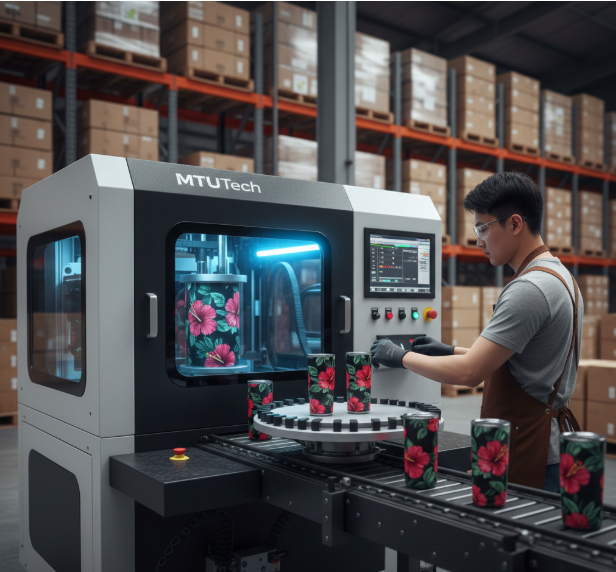
What Is a Cylindrical Printer and How Does It Work?
A cylindrical printer is a specialized UV inkjet system designed to print directly onto round and tapered objects with full 360-degree coverage. Unlike flatbed machines, it rotates the product while synchronizing printhead movement for seamless alignment. Modern systems like the MTUTech Mini 360 Rotary UV Printer use advanced rotary printing technology to ensure consistent output on drinkware, bottles, and containers. The process combines UV-curable inks, precision motors, and calibrated jigs. But how does rotational synchronization prevent banding? And why is UV curing essential for curved surface printing durability?
Why 360-Degree Seamless Printing Matters for Branding
Brand consistency directly impacts customer perception and retail approval. A cylindrical printer enables full-wrap decoration without visible seams or overlaps, which is critical for premium drinkware and packaging. Businesses printing stainless steel tumblers or cosmetic bottles need identical logo placement across thousands of units. Even minor alignment shifts reduce product value. Seamless rotary printing technology ensures design edges connect perfectly. How does seamless output increase perceived brand quality? And what production factors influence wrap accuracy when printing high-volume custom orders daily?
Epson I3200-U1HD Printhead Performance Explained
Print quality depends heavily on the printhead. The Epson I3200-U1HD Printhead delivers high-resolution droplets with stable ink distribution, supporting CMYK + White + Varnish configurations. This combination allows vibrant color reproduction, textured effects, and strong opacity on dark substrates. High droplet printing between 2mm–8mm enhances coverage on uneven or powder-coated surfaces. Why does droplet precision affect curved surface clarity? And how does white ink improve results on stainless steel or transparent bottles? Understanding printhead engineering helps businesses choose scalable production equipment.
Speed vs. Volume: How Fast Should Your Cylindrical Printer Be?
Production speed determines profitability. Printing a tumbler in one minute can dramatically increase daily output compared to manual decoration methods. However, businesses must evaluate real monthly order volume before selecting automation levels. Small startups may manage manual loading, while industrial facilities require semi or fully automated rotary systems. Scalability becomes essential when demand increases from 50 to 500 units per shift. How do you calculate break-even production speed? And when should a shop upgrade from entry-level cylindrical equipment to automated conveyor integration?
Multi-Size Jigs and Customization Flexibility
A modern cylindrical printer supports multiple jig sizes to handle diameters between 45mm and 100mm and print lengths up to 280mm. This flexibility allows printing on tumblers, cosmetic containers, candles, jars, and barware without switching machines. Conical printing angles under 5° enable slight taper support for specialty drinkware. Why are adjustable jigs essential for operational efficiency? And how does quick changeover reduce downtime in multi-product environments? Flexible setup options directly influence productivity and return on investment for growing customization businesses.
Applications in Drinkware Manufacturing
Drinkware brands rely on cylindrical printers for stainless steel tumblers, ceramic mugs, insulated bottles, and sports containers. High-speed digital cylinder printers maintain alignment and color consistency even during long production runs. Retail buyers demand flawless finishes without scratches or fading. UV inks bond securely to coated metal and ceramic surfaces, ensuring dishwasher resistance. What quality control measures ensure repeatable logo placement? And how does rotary UV printing outperform sublimation for premium drinkware decoration? Choosing the right equipment safeguards brand reputation in competitive beverage markets.
Packaging, Cosmetic, and Industrial Container Printing
Beyond drinkware, cylindrical printers transform packaging for cosmetic jars, aluminum cans, tubes, and decorative candle vessels. Dimensional varnish effects create tactile textures that increase shelf appeal. Ink adhesion must withstand shipping, storage, and retail handling without peeling. Food-safe compliance standards further complicate packaging decoration. How does UV curing enhance durability for warehouse environments? And why is material compatibility critical when printing on plastic versus metal containers? Industrial-grade systems ensure reliability across diverse substrates and regulatory requirements.
Advanced Features for Efficient and Safe Operation
Modern cylindrical printers integrate intelligent protection systems, including lifting ink stations for precise nozzle capping and anti-collision sensors to prevent head damage. Water-cooled UV lamps enable instant curing, while ink mist filtration maintains a clean environment. NFC-based ink authentication systems protect hardware from unauthorized consumables. How do these safety features extend printhead lifespan? And why does automated calibration reduce operator error during long shifts? Equipment durability directly affects maintenance costs and long-term production stability.
Material Compatibility and 3D Texture Capabilities
Today’s cylindrical printer supports stainless steel, ceramic, aluminum, powder-coated surfaces, wood, and more. CMYK + White + Varnish configurations enable raised 3D textures that elevate product presentation beyond flat labels. Textured branding enhances tactile engagement, especially for premium candle jars and luxury packaging. High droplet technology ensures strong ink adhesion even on slightly uneven substrates. How does dimensional UV printing increase perceived product value? And what industries benefit most from textured cylindrical decoration solutions?
Choosing the Right Cylindrical Printer for Long-Term Growth
Investing in a cylindrical printer requires analyzing output capacity, automation level, substrate range, and scalability potential. Entry-level rotary UV printers suit startups, while industrial models support continuous commercial production. Matching machine capability to projected growth prevents costly reinvestment. Evaluate print speed, conical support range, ink configuration, and maintenance features before purchasing. What factors determine total cost of ownership? And how can businesses future-proof their printing operations against rising customization demand? Strategic equipment selection ensures sustainable expansion and competitive advantage.