

Walk into a high-end nightclub and the last thing on your mind is fluid dynamics. That’s the point. But for the people who design these systems, fluid dynamics is often where the conversation starts.
CryoFX has been building CO2 and liquid nitrogen special effects systems for over fifteen years. Their work shows up in some of the more demanding environments in entertainment, including several properties on the Las Vegas Strip, where the combination of desert climate, high occupancy loads, and regulatory scrutiny makes every installation a distinct engineering feat.
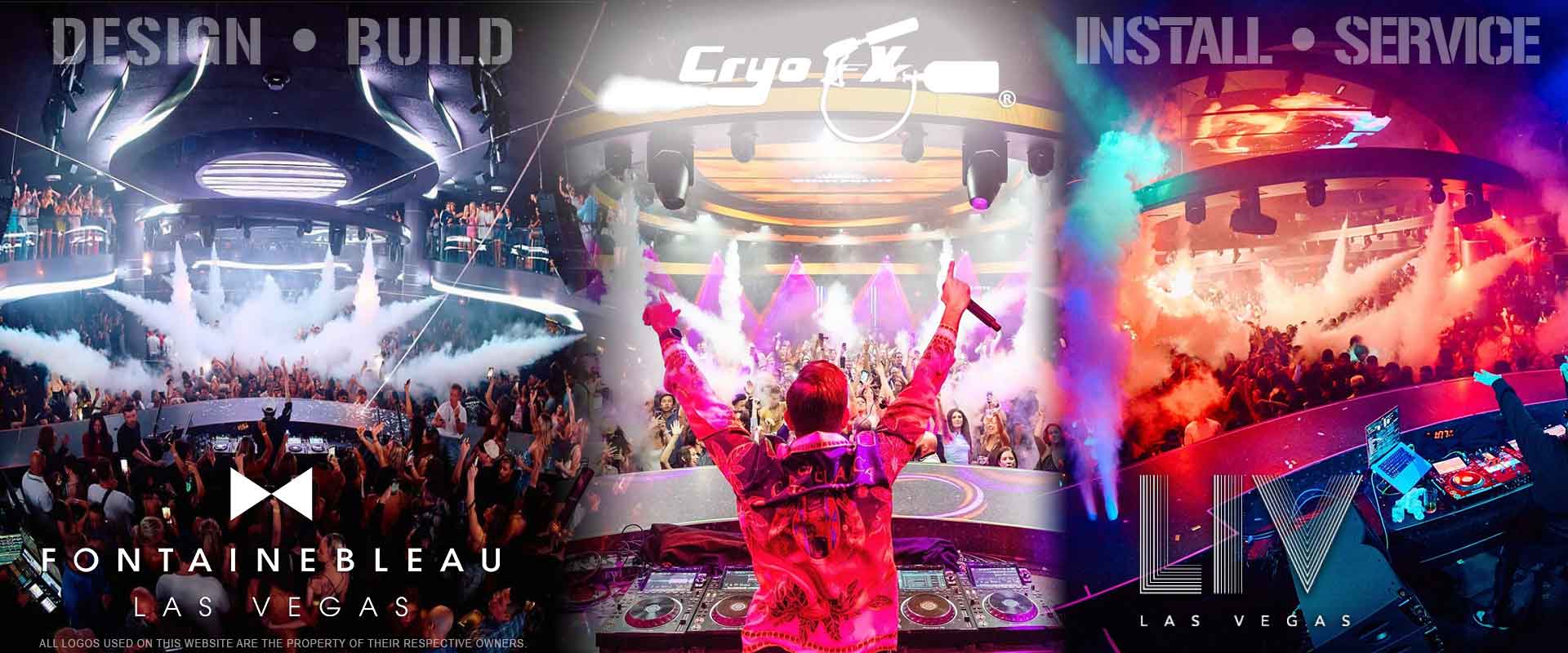
TAO Beach Dayclub at The Venetian. LIV Nightclub and LIV Beach at Fontainebleau. The Silver Knights Arena. Whether it’s water cannons over the dayclubs, or, like at Fontainebleau, where overhead truss circles, synchronized CO2 systems, and integrated lighting turned what could have been a standard nightclub setup into something guests kept struggling to describe accurately.
The gap between those two outcomes, standard and extraordinary, is mostly invisible to the people experiencing it. It lives in the design decisions made months before opening night.
Start with something as basic as how co2 jets get connected to tanks. Most installations fail here not dramatically but gradually, in ways that degrade the visual output without obvious explanation. Run four co2 cannons along the front of a stage and connect them sequentially to a tank farm on one end, and you’ve created a path-of-least-resistance problem. The first co2 cannon in line gets maximum pressure and output. The last co2 jet gets whatever’s left. The effect looks uneven, costs the same money, and the fix isn’t as simple as adding a second tank at the other end.
Properly balanced systems require specific manifold configurations that account for flow restriction at each point in the line. It’s the kind of detail that gets skipped when a vendor is focused on selling equipment rather than designing a system.
Tank farm placement follows similar logic. Tanks need to be located away from areas where people congregate, both for practical safety reasons and because CO2 and liquid nitrogen storage requires its own monitoring infrastructure. Inside a venue, that means air quality sensors positioned to detect PPM levels before they become a problem, evacuation systems that can clear both people and accumulated gas in a malfunction scenario, and HVAC analysis to confirm the venue’s air exchange rate is actually sufficient for the load the system will put on it. Many clubs run significant AC capacity and still fall short on the airflow-in versus airflow-out equation once you factor in occupancy. That gap is where regulatory problems and genuine safety risks originate.
The choice between CO2 effects systems and liquid nitrogen effects systems isn’t cosmetic either, many factors are taken into account. CO2 displaces oxygen at a substantially higher rate, which drives stricter monitoring requirements and tighter HVAC thresholds. Liquid nitrogen displaces less aggressively but introduces its own handling and storage considerations. The practical selection criteria come down to a few factors:
- what the local fire marshal will approve,
- what the venue’s humidity levels actually are, and
- what the recurring consumable cost looks like over time.
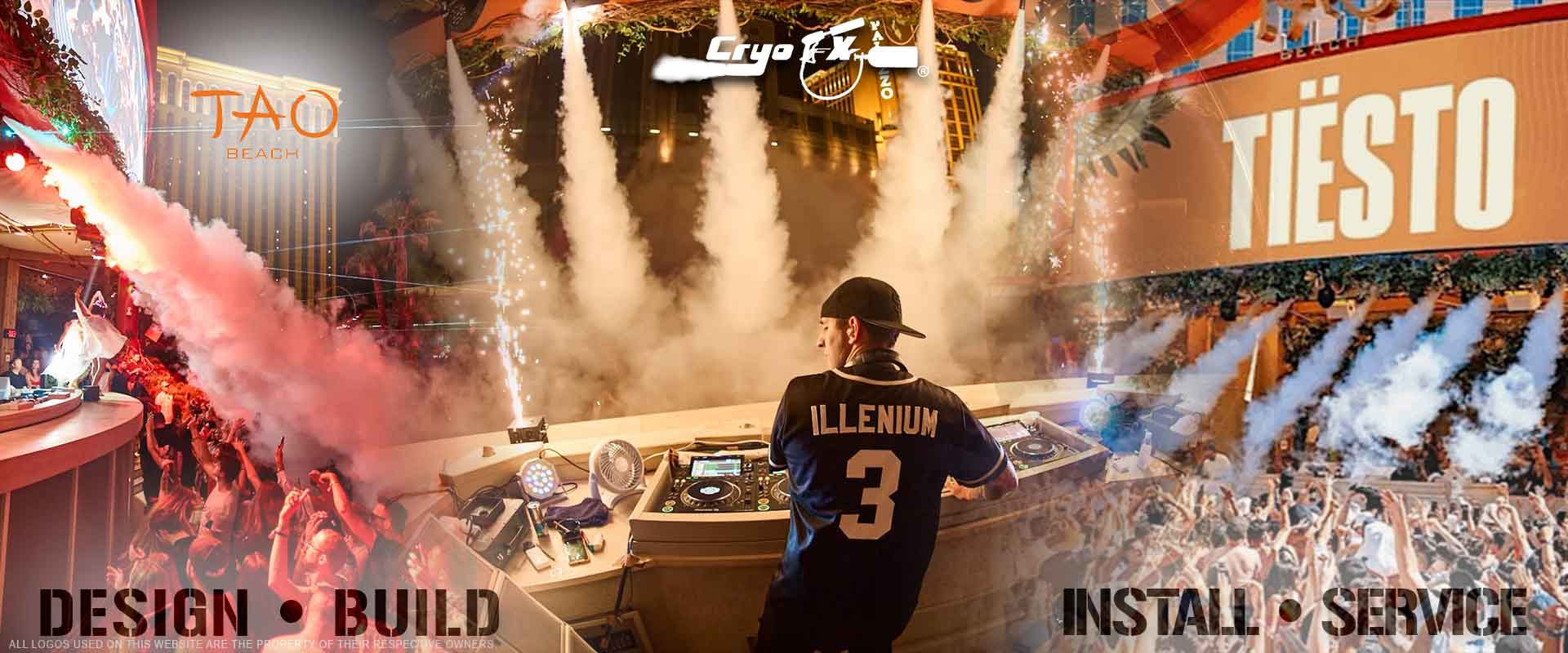
In a low-humidity environment like Las Vegas, liquid nitrogen often produces a better visual output because Co2 effects depend heavily on ambient moisture to develop the dense, visible plume most clients are looking for. High-humidity markets like Florida or coastal Southern California shift that calculus. The same system specification produces a visually different result depending on where it’s running.
However CryoFX has designed specialty Co2 Special Effects systems, some patented, that allow larger Co2 tanks which house co2 at a colder temperature to be used within these environments, even when they are on higher floors. In fact, it has been said that CryoFX systems are the most technologically advanced co2 effects and co2 monitoring systems of their type on the strip, according to Clark County Fire Prevention staff.
Outside installations add another layer. Sun exposure heats the lines and accelerates product loss before it reaches the nozzle. Wind disrupts dispersion in ways that can make a well-designed effect look random. Tank storage requires insulated enclosures to maintain consistent operating temperature. None of these are insurmountable problems, but they each require deliberate accommodation in the system design. Ignoring them produces a system that works in testing and underperforms in operation.
The regulatory side is where projects most often stall. CO2 and liquid nitrogen are classified as hazardous materials, which triggers a specific permitting path through the fire department, a hazardous materials plan, environmental testing at baseline and full system capacity and simulated malfunction, and in many jurisdictions, integration with the venue’s fire alarm infrastructure. Some systems are required to interface directly with the fire panel, so that if gas levels exceed threshold, it triggers evacuation automatically.
Others operate on independent monitoring with manual response protocols. Which path applies depends on the jurisdiction, the venue configuration, and what the authority having jurisdiction decides during the plan review process. Getting that determination wrong early means redesigning the system midway through installation.
The upshot is that the visible output, the effect itself, is probably the easiest part of the project to execute. The harder work is building a system that clears every regulatory checkpoint, operates consistently under real environmental conditions, and doesn’t create liability for the venue when something goes wrong at 1am on a Saturday.
Kris Mullins, CryoFX’s CEO, approaches the work from an angle most effects companies don’t consider. As he runs a series of companies outside the space, one parallel is his marketing agency “The Black Swan Agency” where his role as a cognitive behavioral marketing scientist mixed with his extensive training in behavior and psychology, allows him to understand driving motivators of emotion on and off screen, which means he’s thinking about the effects in terms of the psychological and physiological response they’re designed to produce, not just the technical spec.
“Designing these ‘experiences’ is a gift and blessing,” he said. “Touching on the senses in person while adding the 6th element of emotion into the mix, we’re elevating the experience to a totally new level which complements, in some instances, my work as a marketer. This is what a true 6D Immersive Storyteller does in live environments, while keeping true to psychology-driven storytelling in my other roles with my marketing agency. Whether on screen or in person, emotion is what people remember and what drives actions, including recommendations!”
That framing matters practically because it changes what questions get asked during the design phase with a focus on the attendees, which is who the experiences are for. A company selling equipment asks where you want the jets mounted. A company thinking about emotional response asks what the guest should feel at that specific moment in the room, then works backward to the hardware. The technical execution is the same either way. The outcome isn’t.
“Think about how uneventful nightclubs would be without any special effects?” Mullins said. “No haze, no cold sparks, nothing on the drops. Yeah, pretty lame I agree. They literally make the night what it is!”
The operational reality behind that observation is more complicated than it sounds. Haze systems require their own fluid management, nozzle positioning, and HVAC coordination to distribute evenly without pooling. CO2 jets need DMX integration to fire on musical cues with precise timing- but more so the pressured piping systems to handle it, which means the control infrastructure has to be reliable enough to perform multiple times per night without a misfire that either kills the moment or dumps product unnecessarily…all while remaining in compliance with sensors and fire control integration. Handheld cryo guns operated by a DJ behind the booth introduce a human variable that fixed mounted systems don’t have, which requires its own safety protocol around where the discharge is directed and at what range. If cold spark machines or pyro are involved, this is another element that requires knowledge in the space. “Of course having a pyro license in multiple states helps.” says Kris.
Every one of these systems has a safety layer that costs as much to build correctly as the effects equipment itself. On major theme park installations, that ratio sometimes flips, with the monitoring and evacuation infrastructure exceeding the cost of the effects hardware. That’s not a cautionary note. It’s what responsible deployment of these systems actually looks like at scale.
The fifteen seconds the crowd remembers is the output. The months of engineering, permitting, environmental testing, and system integration is what makes those fifteen seconds repeatable.