

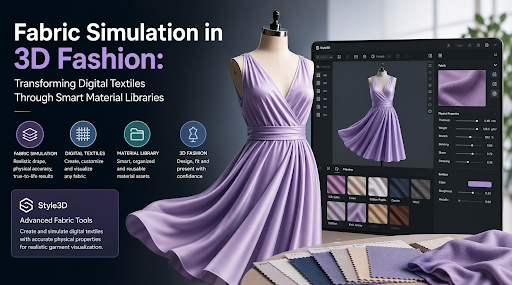
Why Fabric Behavior Matters More Than Ever
Fashion design has entered a new phase, one where garments no longer begin and end as sketches, swatches, and physical samples. Today, many key creative and production decisions happen in virtual space, where teams can test, refine, and present garments before a single roll of cloth is cut. At the center of this shift are four connected ideas: fabric simulation, digital textiles, material library, 3D fashion. Together, they are changing how clothing is visualized, approved, and brought to market.
What makes this transformation powerful is realism. A digital garment is only useful if it moves, stretches, folds, and reacts like the real thing. That is why fabric simulation has become one of the most valuable capabilities in modern design workflows. It allows brands and designers to recreate fabric behavior with detail that supports creative exploration and technical accuracy.
When fabric behavior is simulated correctly, teams can reduce sample waste, improve communication, and speed up decision making. In a market where timelines are tighter and expectations are higher, realistic digital textiles have become a practical advantage.
The Shift From Static Design to Responsive Digital Garments
In traditional apparel development, physical samples have always played a central role. Designers needed to touch fabric, observe drape, and study fit on the body to understand whether an idea would work. While that process still has value, it is expensive, slow, and often repetitive. Each change can mean another round of pattern adjustments, sampling, shipping, and review.
3D fashion changes that pattern by making garments interactive from the start. Instead of viewing a flat illustration, teams can see how a dress falls at the hem, how a jacket sleeve bends at the elbow, or how a knit surface responds to body movement. The garment becomes something closer to a living prototype.
This is where advanced fabric simulation makes the difference. It does not simply wrap a texture onto a shape. It calculates how the textile behaves based on measurable properties such as weight, stiffness, stretch, shear, and thickness. That means a fluid satin, a crisp poplin, and a heavy denim can all be represented in ways that feel true to life.
What Smart Material Libraries Actually Do
A strong material library is the foundation of believable digital garment creation. Without it, even the best 3D environment can only produce generic results. Smart libraries solve that problem by organizing fabric assets in a way that links visual detail with physical performance.
Instead of storing fabrics as simple color or texture files, a modern material library can include:
- surface appearance, including weave, print, gloss, and transparency
- physical values, such as stretch, bending, weight, and friction
- construction details tied to fabric type and end use
- reusable presets for faster simulation across categories
This gives teams a reliable source of truth. When everyone works from the same material data, it becomes easier to maintain consistency from concept through presentation. A designer in one office, a developer in another, and a factory partner elsewhere can all reference the same digital textiles and expect similar visual behavior.
Style3D Fabric tools are especially useful here because they help users build and simulate textiles with accurate physical properties. That accuracy improves garment visualization and makes it easier to compare digital results with real-world expectations. Instead of guessing how a material might behave, teams can work from structured data and repeatable settings.
How Accurate Simulation Improves Design, Fit, and Communication
The biggest benefit of realistic simulation is not only that garments look better on screen. It is that decisions become clearer. A well-simulated garment creates shared understanding, which is often one of the hardest things to achieve in apparel development.
When digital textiles are built with accurate physical inputs, designers can evaluate drape and silhouette with greater confidence. A bias-cut skirt, for example, should hang differently from a structured cotton version of the same shape. If the simulation captures that distinction, the design team can judge proportion more reliably before moving into production.
Fit communication improves as well. Pattern makers and technical designers often need to explain subtle issues related to tension, pulling, collapse, or volume. In static sketches, those issues can be hard to communicate. In 3D fashion workflows, simulation allows everyone to see those behaviors directly on avatars and during movement tests.
This clarity supports several practical gains:
- fewer misunderstandings between creative and technical teams
- faster approvals during review meetings
- better alignment with suppliers and manufacturing partners
- reduced need for repeated sample rounds
Why Digital Textiles Are Becoming a Strategic Asset
For years, digital files in fashion were often treated as presentation tools. They helped create better visuals, but they were not always considered central to development strategy. That mindset is changing quickly. Digital textiles now support product creation, collaboration, marketing content, and even customer-facing experiences.
When a fabric is digitized well, it can serve multiple purposes. It can be used for design reviews, virtual showrooms, line planning, e-commerce imagery, and early campaign development. That kind of flexibility increases the value of every digital asset a brand creates.
There is also a sustainability angle that cannot be ignored. Fewer unnecessary samples mean less fabric waste, less shipping, and less time spent on avoidable revisions. While digital processes do not remove physical production, they can make the path to production far more efficient.
From a business perspective, the benefits are compelling:
- shorter development timelines
- lower sampling costs
- more consistent product storytelling
- stronger visual alignment across channels
Building a Better Workflow With Material Intelligence
The value of a material library grows when it is treated as a living system rather than a storage folder. The most effective teams build workflows around material intelligence, meaning they do not just collect fabric files, they manage them with purpose.
That starts with quality input. Fabrics should be digitized carefully, named clearly, and categorized in a way that supports retrieval. Physical testing data should be tied to each entry when possible, so simulation settings reflect actual behavior rather than visual guesswork. Consistent tagging also helps teams find the right materials quickly across product types and seasons.
Next comes governance. A useful library needs standards. Teams should define who can add materials, who validates them, and how updates are documented. Without that discipline, even a large library can become unreliable.
Finally, integration matters. The best results happen when the material library is not isolated from the rest of the design process. It should connect naturally with garment development, fitting, rendering, and review stages. That is how fabric simulation becomes a core workflow capability instead of a specialized task for only a few users.
The Next Chapter for Fashion Creation
The future of apparel development will belong to teams that can combine creativity with precision. That does not mean replacing craftsmanship. It means extending it into a digital environment where fabric behavior can be studied, tested, and communicated with greater speed and clarity.
Fabric simulation is now one of the clearest examples of that progress. It allows garments to behave like garments, not just look like images. Combined with strong digital textiles and a well-managed material library, it gives brands the power to design more intelligently and present ideas more convincingly.
It also helps brands present products earlier, with more confidence, to buyers, partners, and consumers alike.
For fashion businesses navigating tighter margins, faster calendars, and higher visual expectations, this shift is more than a technical upgrade. It is a smarter way to work. The brands that understand this early will not only create better virtual garments. They will build stronger, faster, and more connected development ecosystems for the years ahead.