

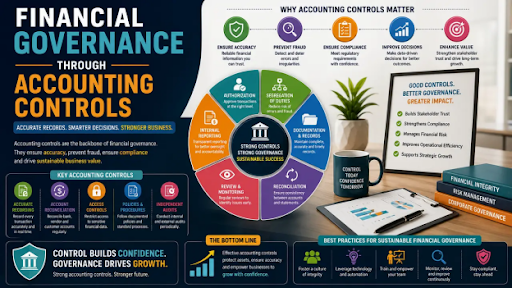
For any business that wants to be open, responsible, and efficient, financial governance through accounting controls is a must. Strong accounting controls are the first line of defense in a world where financial fraud and bad management may ruin a company’s brand and financial health. Organizations may make sure that their financial information is correct, trustworthy, and easy for stakeholders to get by understanding and using these controls. This article will go into detail on how to manage your money through accounting controls. It will give you useful tips and best practices that you can use in your own money management plans. The discussion opens naturally through the financial governance through accounting controls. A well-structured financial system further strengthens transparency and accountability in financial reporting.
When we look at the basics of financial governance through accounting controls, it’s crucial to remember that these controls aren’t only about following the rules. The purpose of internal controls is to protect firm assets, make sure that financial reports are correct, and make operations run more smoothly. When done right, accounting controls can assist keep an organization’s finances in good shape by eliminating fraud, mistakes, and false claims. Also, we need to remember that internal audit and controls are important parts of making sure that financial governance works when we talk about internal audit. For instance, understanding who qualifies as a millionaire in rupees can provide perspective on financial benchmarks and wealth classification.
Financial governance through accounting controls
Accounting controls are the rules and processes that a company uses to protect its financial data and resources. These controls are very important for financial governance since they assist keep correct financial records, stop fraud, and make sure that rules are followed. Companies can make their financial operations more open, accountable, and efficient by putting in place good accounting controls. One of the most important parts of good financial management is financial governance through accounting controls. These controls give you the tools you need to handle financial risks and make sure your business stays in business for a long time. Applying principles of business finance ensures better allocation of resources and long-term stability.
The main purpose of accounting controls is to protect a company’s assets and make sure that financial reports are correct. They include things like separating duties, doing frequent audits, and getting approval. These controls are necessary to keep financial information accurate, which is important for making smart business choices. Also, when we talk about financial governance, we should remember that one of the most important ways to check is to test the controls. Auditors utilize the test of controls to see how well internal controls are working.
Understanding the Basics of Accounting Controls
First, it’s important to understand the principles of accounting controls. These controls are the tools that help keep financial reporting from being wrong or dishonest. They include things like ways to manage access, ways to get approval, and ways to check that everything is right. For example, dividing up tasks makes ensuring that no one person is in charge of all portions of a transaction, which lowers the chance of mistakes or fraud.
Segregation of Duties
One of the most important rules for accounting controls is to separate duties. It means splitting up tasks so that no one individual has full control over any portion of a financial deal. This makes it less likely that an error or fraud will go unnoticed. For instance, the person who records a transaction shouldn’t also be the person who approves it or handles the money. This separation of labor makes people more responsible and lowers the chance of making a mistake.
Regular Audits and Reviews
Another important part of accounting controls is doing frequent audits and reviews. These steps assist make sure that financial records are correct and follow the rules. An audit might be internal, meaning that the organization’s own staff does it, or external, meaning that outside auditors do it. Regular evaluations help find and fix any mistakes quickly, which keeps the financial information accurate. It’s important to verify things often because even tiny mistakes can build up.
Approval Processes
Approval processes are quite important for keeping an eye on money transactions. They make sure that only transactions that have been approved are processed and documented. This could include giving the go-ahead for spending, moving money, or any other financial action. For instance, a department head and a financial manager might both have to approve a purchase order before it can be processed. This two-step approval process makes things safer and more accountable.
Reconciliation Procedures
Reconciliation methods compare real transactions to financial records to make sure they match. This is something that happens a lot at the end of each accounting period. For example, the company’s cash records are checked against its bank statements to make sure that all transactions are recorded. Reconciliation is an important control measure since differences can mean mistakes or possible fraud. Regular reconciliation helps find faults early, before they turn into big problems.
Access Controls
Access controls limit who can see or change financial data. This is critical for keeping private information safe and stopping changes that aren’t allowed. For instance, only people who are allowed to use the general ledger or cash management systems should be able to do so. Companies can lower the chance of mistakes and fraud by limiting access. Think of it as a safe where only a few people can get in.
Documentation and Record-Keeping
For accounting controls to work, it is important to have detailed records and documentation. These records create a trail of proof for all financial transactions, which makes it easy to find and check information. Invoices, receipts, contracts, and other supporting documents are all examples of proper documentation. It is almost impossible to be sure that financial accounts are correct without good recordkeeping. It’s not possible to complete a problem if you don’t have all the pieces.
Training and Education
Training and education are sometimes forgotten, yet they are very important for good accounting controls. Employees need to know how to use these controls effectively and why they are important. Staff can stay up to date on best practices and new rules by having regular training sessions. This continuing training makes sure that everyone in the organization understands how to handle money. A strong team is one that knows a lot.
Technology and Automation
In current accounting controls, technology and automation are quite important. Many control operations can be automated with software tools, which lowers the chance of making a mistake. For instance, automated approval workflows make sure that all transactions are checked and approved electronically. This not only makes things go faster, but it also leaves a clear trail for an audit. It’s crucial to remember, though, that technology is just a tool and can’t replace human scrutiny.
Risk Assessment
Risk assessment is an important part of financial governance that is done through accounting controls. It means finding possible threats to the integrity of finances and putting in place measures to lessen them. If a business, for instance, does a lot of high-value transactions, it might make the approval procedure tougher. Regular risk assessments make ensuring that controls stay effective and can change when things do. You can’t protect yourself from threats you don’t know about, so it’s important to make regular checks.
Compliance with Regulations
Another important part of accounting controls is following the rules set by the government. Companies have to follow a number of rules and laws, such as the Sarbanes-Oxley Act and Generally Accepted Accounting Principles. These rules set the rules for how to handle money and run a business. If you don’t follow the rules, you could face big fines and damage to your company’s reputation. To keep good accounting controls, you need to keep up with changes in the law.
Internal Audit
Through accounting controls, internal audit is an important part of financial governance. It means looking over the company’s financial processes and controls to make sure they work. Internal auditors look at financial risks and controls on their own and make suggestions for how to make them better. Regular internal audits assist keep financial information accurate and make sure that rules are followed. It’s like a check-up for your money systems.
FAQ for financial governance through accounting controls
What are the primary objectives of financial governance through accounting controls?
The major goals of financial governance through accounting controls are to make sure that financial information is correct and trustworthy, to stop fraud and mistakes, and to follow all the rules set by the government. These controls protect the company’s assets and make operations more efficient, which is a good basis for making smart choices.
How do accounting controls help in preventing fraud?
Accounting controls make sure that there are checks and balances in place to stop fraud. For instance, separating obligations makes sure that one person doesn’t have full authority over a financial transaction. Regular audits and clearance processes offer more levels of inspection, which makes it less likely that fraud will get uncovered. These restrictions work as both deterrents and ways to find problems.
What role does technology play in accounting controls?
Technology is a big part of modern accounting controls since it automates tasks and cuts down on mistakes made by people. Software tools can do things like approval workflows, reconciliation, and risk assessment better than doing them by hand. But technology shouldn’t take the place of human control; it should only add to it. It’s important to use both in a balanced way.
How often should internal audits be conducted?
The number of internal audits a business does might change based on its size, complexity, and risk level. Most of the time, it’s best to do internal audits at least once a year. But places that are high-risk may need to be audited more often. Regular audits assist make sure that controls stay useful and can change when needed. You have to be alert and take action.
What are the consequences of non-compliance with accounting controls?
Not following accounting rules can lead to a number of problems, such as fines, lawsuits, and damage to the company’s reputation. Regulatory organizations can fine companies that don’t follow the rules, and stakeholders may lose faith in the company’s financial honesty. Not following the rules can also make things less efficient and more likely to make mistakes or commit fraud. To be in business for a long time, you need to stay compliant.
Conclusion
Using accounting controls to manage an organization’s finances is an important part of keeping its financial health. Companies can make sure their financial information is correct, stop fraud, and stay in line with the rules by putting strong accounting controls in place. These controls create a structure for openness, responsibility, and efficiency, which are all important for making informed decisions and keeping things going for a long time. Remember that solid accounting controls aren’t only about following the rules; they’re also about having a strong and reliable financial base.
As we conclude, the financial governance through accounting controls keeps the message consistent. In short, knowing and using financial governance through accounting controls may greatly improve how a business manages its money. These controls are very important for protecting firm assets and making sure that financial information is correct. They can be used in a number of ways, such as separating duties, doing frequent audits, or using technology. So, take the time to look over your current controls and make any changes that need to be made. It matters for your finances. Always be on the lookout, follow the rules, and do your best to improve your financial governance.