

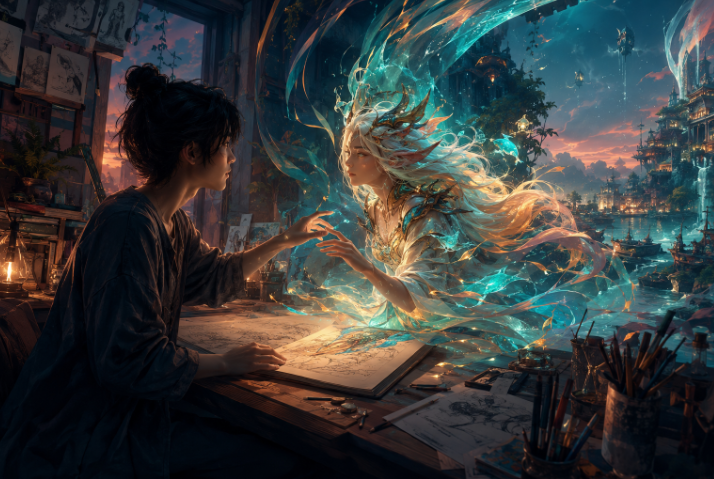
A story rarely begins as a finished video. It may start with a character sketched in a notebook, a photograph saved for its lighting, a few lines of dialogue, or a half-formed scene that someone can picture but cannot yet explain. Until recently, turning those fragments into a coherent visual sequence required several tools—and a fair amount of patience when each tool reinterpreted the idea.
Multimodal generation is changing that experience. Flux 3 offers creators an API-powered environment for experimenting with images, edits, and video, including access to emerging FLUX.3 workflows and other widely used creative models. The site is an independent platform rather than the official home of Black Forest Labs, the company developing the underlying FLUX model family.
That distinction does not lessen the creative question at the center of the technology: what happens when an AI system learns not only how a scene looks, but also how it moves and sounds?
One Idea Can Now Travel Across Media
The familiar text-to-image process produces a single visual answer to a prompt. Storytelling asks for continuity. A character needs to remain recognizable after turning around, changing rooms, or appearing under different light. A prop introduced in one scene may matter several shots later. Sound should correspond to what is happening rather than feeling pasted on.
Black Forest Labs says its FLUX 3 architecture jointly learns from images, video, and audio to develop a broader representation of the world. For storytellers, the promise is not simply more media types. It is the possibility of carrying relationships between those media types through a creative sequence.
That could make early experimentation feel less like moving files between unrelated generators and more like developing one connected idea.
Building a World, Not Just a Pretty Frame
A striking image can attract attention, but a believable world needs rules. Characters have proportions, habits, and visual signatures. Places have geography. Light suggests time, weather, and emotion.
Creators can improve continuity by defining those elements before asking for motion. A compact character sheet might record hairstyle, clothing, age range, posture, and recurring accessories. A location description can establish its layout, color palette, and key objects. Those choices give the system something firmer to preserve.
Reference images are especially useful when they are treated as production material rather than loose inspiration. A front view may establish the face, while a wider image clarifies clothing and silhouette. Original or properly licensed references also reduce the ethical and legal uncertainty that comes from copying images found online.
How Different Creators Might Use It
Independent filmmakers can explore a difficult shot before committing to a location, equipment, or visual-effects budget. Musicians may develop cover artwork, looping visualizers, and short promotional scenes around the same aesthetic. Writers can test how a fictional setting looks at different moments in the story.
For online creators, the attraction is often scale. A single narrative idea might become a vertical teaser, a thumbnail, a background image, and a longer landscape sequence. Keeping the concept recognizable across those formats has traditionally required careful manual work.
None of this means a finished film emerges from one prompt. The more useful expectation is that AI helps creators see possibilities earlier, when changing direction is still inexpensive.
A Story Prompt Needs More Than Adjectives
Prompts filled with words such as “epic,” “beautiful,” and “cinematic” can create atmosphere, yet they rarely describe a sequence. A storytelling prompt benefits from verbs, timing, and cause.
Consider the difference between “a dramatic musician onstage” and a scene in which the musician steps from darkness into a narrow spotlight, raises one hand as the crowd quiets, and looks toward the drummer before the first beat. The second version gives the generator an order of events and gives the creator something concrete to judge.
Camera instructions should remain manageable. One deliberate move often reads better than a prompt requesting a crane shot, orbit, zoom, and handheld shake in the same few seconds. Restraint can make generated motion feel intentional.
The Imperfections Are Part of the Process
Multimodal models may understand more context, but they can still lose details. Jewelry disappears, costumes change, fingers merge, and background characters behave unpredictably. A smooth camera move can hide a subject that has subtly changed identity.
Creators working with dialogue face another difficulty: emotional timing. A technically synchronized mouth movement is not the same as a convincing performance. Pauses, glances, and imperfect reactions often carry more feeling than the words themselves.
This is where editing earns its place. Short, controlled generations can be assembled into a stronger sequence, while cuts conceal weak transitions. Sound design, color work, and pacing turn generated fragments into a piece with authorship.
Originality Cannot Be Automated
Generative tools make style easy to request, sometimes too easy. Asking for the signature look of a living artist may produce an instantly recognizable surface, but it does little to build an original creative voice. A more thoughtful method describes the qualities that matter: loose ink lines, shallow depth of field, muted morning color, or theatrical side lighting.
The same care applies to faces and voices. Permission should be clear when a real person can be recognized. Creators should also check the commercial terms of the specific model and platform used, particularly when the work will appear in advertising, merchandise, or paid entertainment.
Transparency does not require interrupting every story with a technical disclaimer. It does require avoiding deception, especially when generated scenes could be mistaken for real events.
The Human Part Becomes More Visible
When software can produce many versions, choosing becomes more important than generating. Why does one frame feel honest while another feels like a visual cliché? Which moment should remain quiet? What does the audience need to understand before the scene changes?
Those questions belong to the creator. A model can propose an image or movement, but it does not have a personal reason for telling the story.
FLUX 3 points toward a future in which images, motion, and sound are developed in a more connected way. That may remove some technical barriers, particularly for independent creators. Yet the work that audiences remember will still depend on character, rhythm, and a point of view—things no menu of models can supply on its own.