

Google quietly rolls out enhanced geographic targeting capabilities that could revolutionize how businesses approach local search marketing.
Google has introduced a significant enhancement to its Keyword Planner tool that allows advertisers and SEO professionals to break down keyword forecast volumes by city, region, and device type. The update was first documented on July 7, 2025, through screenshots shared by Amiya Prakash, a PPC specialist at CausalFunnel, who noticed the new interface panels in select accounts.
The enhancement represents one of the most substantial improvements to Google’s keyword research capabilities in recent years, providing unprecedented granularity for campaign planning and local SEO strategies.
What’s New in Google Keyword Planner
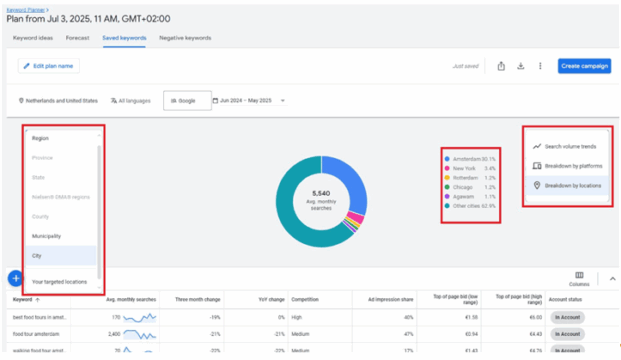
The enhanced forecasting tools let users break down keyword forecast volumes by city, region, and device type, bringing a new level of granularity to campaign planning. The key features include:
Geographic Precision: Users can apply filters by location type, including state, city, and DMA (Designated Market Area), tailoring forecasts to campaign objectives. This represents a major leap forward from the previous country-level targeting options.
Device-Level Insights: Advertisers can now access platform-level device insights showing splits across mobile, desktop, and tablet usage patterns. This functionality addresses the growing need for mobile-first campaign strategies.
Visual Data Representation: A visual snapshot, including pie charts of user locations (e.g., 77.4% from Amsterdam in one example), helps illustrate concentration by region.
The Rollout: A Gradual Release Strategy
The update is a gradual or experimental rollout, with features appearing in select Google Ads accounts globally. This staged approach is typical of Google’s testing methodology, allowing the company to monitor performance and user feedback before a full-scale deployment.
This appears to be a quiet rollout, possibly limited to some accounts. Industry professionals should check their Keyword Planner interfaces to see if they have access to the new features.
Why This Matters: The Local SEO Revolution
The implications of city-level forecasting extend far beyond paid advertising. For businesses with local operations, this update represents a paradigm shift in how they can understand and approach their target markets.
Precision Budget Allocation: For advertisers targeting multiple locations or optimizing for specific user contexts, this update enables more precise budgeting and local strategy alignment. Businesses can now identify high-performing geographic areas before launching campaigns, reducing waste and improving ROI.
Market Intelligence: Regional search volume variations can be substantial, even within the same metropolitan area. The ability to forecast at the municipality level provides insights that were previously unavailable through standard geographic targeting options.
Mobile-First Strategy Support: The device-level forecasting supports mobile-first campaign strategies that have become standard practice in digital advertising. Mobile search behavior often differs significantly from desktop patterns, particularly for local and location-based queries.
Local SEO Insights: Transforming Geographic Strategy
The introduction of city-level forecasting in Google Keyword Planner marks a watershed moment for local SEO professionals. This enhancement addresses several critical challenges that have long plagued location-based marketing strategies.
Hyper-Local Content Optimization: Previously, SEO professionals had to rely on broad regional data or third-party tools that often provided inconsistent geographic insights. With Google’s proprietary search data now available at the city level, businesses can create highly targeted content strategies that align with actual local search behavior.
Competitive Analysis Enhancement: The ability to analyze keyword performance at the municipal level allows businesses to identify untapped markets within their service areas. A business operating across multiple cities can now pinpoint which locations offer the greatest opportunity for organic growth versus paid advertising investment.
Seasonal and Event-Based Planning: Local businesses can now better understand how search patterns vary not just by season, but by specific geographic areas. This is particularly valuable for businesses affected by local events, weather patterns, or regional economic factors.
Multi-Location Strategy Refinement: For businesses with multiple locations, this update enables granular comparison of market potential across different areas. Rather than applying a one-size-fits-all approach, companies can now tailor their SEO strategies to match the unique search characteristics of each location.
Industry Context and Historical Perspective
This update comes against the backdrop of Google’s ongoing efforts to refine its keyword research tools. In 2023, Google stopped maintaining individual and ad group keyword forecasting data, citing low usage among advertisers. However, the introduction of geographic and device-level forecasting suggests Google is focusing on features that provide genuine strategic value.
The enhancement addresses advertiser demand for more precise geographic targeting and budget allocation capabilities, particularly for multi-location campaigns and local businesses seeking granular market insights.
Technical Implementation and Access
The new features integrate seamlessly with existing Keyword Planner functionality. The updated Keyword Planner maintains its existing grouped keyword ideas functionality while adding the location and device breakdown features. Screenshots indicate the new panels appear alongside traditional forecast metrics within the saved keyword plan interface.
To access these features, users need:
- An active Google Ads account
- Access to the Keyword Planner tool
- The enhanced features (subject to the ongoing rollout)
Strategic Implications for Businesses
Small and Medium Enterprises: Local businesses can now compete more effectively by identifying specific geographic pockets where their target keywords have lower competition or higher search volume.
Enterprise Organizations: Large companies with multiple locations can optimize their local SEO strategies with unprecedented precision, allocating resources based on actual search data rather than assumptions.
SEO Agencies: Professional keyword research services can now offer clients more sophisticated geographic analysis, providing tangible competitive advantages in local markets.
For businesses looking to act on these insights, data alone isn’t enough. Turning forecasts into strategy requires structured analysis that identifies intent patterns across regions and devices. A professional approach to local SEO keyword research services enables companies to translate city-level search trends into actionable content strategies, location pages, and Google Business Profile optimization.
Looking Forward: The Future of Local Search
This update signals Google’s continued investment in providing granular, actionable data to marketers and SEO professionals. As search behavior becomes increasingly mobile and location-specific, tools that provide city-level insights will become essential for competitive digital marketing strategies.
The integration of device-specific forecasting with geographic data creates opportunities for sophisticated cross-platform strategies that account for how user behavior varies by both location and device type.
Google’s introduction of city-level forecasting in Keyword Planner represents more than just a feature update—it’s a fundamental shift toward more precise, data-driven local marketing strategies. As this rollout continues to expand across Google Ads accounts, businesses that quickly adapt their local SEO approaches to leverage these enhanced insights will gain significant competitive advantages in their local markets.
The combination of geographic precision and device-level insights provides the foundation for a new era of hyper-targeted local SEO strategies, making professional keyword research and analysis more valuable than ever for businesses seeking to dominate their local search landscapes.
| I’m Fahad Raza, an SEO consultant with 18+ years of experience witnessing search evolve from Yahoo’s human editors to today’s AI algorithms. After co-founding Right Click and leading IKEA’s SEO strategy, I launched KeywordProbe to help small businesses succeed with systematic, transparent SEO solutions. |