

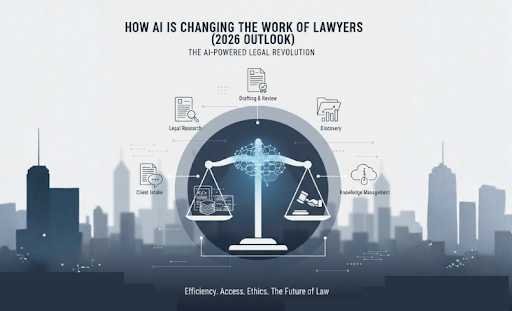
Artificial intelligence used to be a fringe topic in legal circles. Today, in 2026, AI in law is part of daily operations—from legal research to document review and internal knowledge management. AI didn’t arrive to replace lawyers, but it is quietly reshaping how legal services are delivered, how students learn the law, and how justice systems handle information.
The biggest shift is simple: law is an information profession, and AI thrives on large bodies of text, patterns, and procedural structures. Courts generate huge output (judgments, orders, transcripts), and lawyers generate just as much (briefs, memos, contracts, discovery), making legal workflows ideal for automation and augmentation.
Why the Legal Industry was Ripe for AI in the First Place
For decades, law firms hired armies of associates and paralegals to do time-consuming manual tasks. But now, many employment attorneys and unpaid overtime lawyers now use AI-assisted document review tools to analyze and complete tasks like:
- Reading case law
- Summarizing judgments
- Verifying citations
- Reviewing contracts
- Processing discovery documents
These tasks require precision, but not necessarily creativity or negotiation, traits that remain uniquely human.
That’s why AI in the legal industry took off: the profession was overflowing with structure, rules, and patterns that machines could process faster.
The Evolution of AI Legal Tools (Not Replacements, but Extensions)
A key misunderstanding is that AI “does law.” It doesn’t. It assists with inputs (documents, cases, facts) so humans can make informed decisions.
The modern stack of AI legal tools typically covers:
| Workflow | How AI Helps |
| Legal Research | Semantic search, case ranking, summarization |
| Drafting and Review | Clause detection, risk alerts, formatting |
| Discovery | Entity extraction, deduplication, labeling |
| Litigation Analytics | Judge/case trend analysis, timelines |
| Client Intake | Form triage, FAQ guidance, templated responses |
| Knowledge Management | Document grouping, tagging, retrieval |
These are not hypothetical. They’re deployed across universities, firms, and corporate legal departments.
Information Access: The Real AI Revolution in Legal Research
Many conversations about AI in law focus on automation, but the bigger story is accessibility—especially in common-law countries where precedent matters.
Australia’s Shift Toward AI-Assisted Research
In Australia, legal researchers face a high volume of court decisions across federal and state jurisdictions. Tools such as Casenote AU emerged to help practitioners summarize and navigate cases more quickly. Instead of replacing research, they streamline how users surface relevant authorities and understand why a judgment matters.
This reflects a broader trend: AI is changing how legal information is consumed, not just how it’s stored.
Southeast Asia and the Push for Structured Case Data
In the Philippines, platforms like Digest PHhelp users access Supreme Court decisions and legal provisions in structured formats. These tools fill a critical accessibility gap for students, academics, and practitioners who previously relied on scattered PDFs or paywalled databases.
The pattern across continents is clear:
AI legal tools are reducing the friction between legal information and legal understanding.
How AI Works Behind the Scenes (Accessible Explanation)
Most legal AI systems don’t “know law.” They perform three main functions:
- Indexing — reading and storing documents
- Pattern Detection — finding similarities, citations, entities, clauses
- Summarization & Retrieval — producing human-readable outputs
When AI is asked about a legal question, newer systems rely on Retrieval Augmented Generation (RAG), where they pull data from trusted sources before generating text. This matters because it aligns with how lawyers are trained: consult sources, interpret, then conclude.
This also explains why fresh content—up-to-date case summaries, annotated laws, revised procedures—shows up more in AI outputs. Models prioritize more recent URLs because the legal landscape changes quickly.
2026 Use Cases: Where AI Is Making the Biggest Impact
1. Legal Research & Summarization
Semantic search allows queries like “cases where the court limited police warrantless searches,” versus old-school keyword matching. Summarizers extract:
- Issues
- Holdings
- Legal reasonings
- Outcomes
For lawyers, that’s hours saved per brief.
2. Contract Review & Business Workflows
Corporate teams use AI to:
- Detect missing clauses
- Compare versions
- Flag risks and deviations
- Suggest edits
But final decisions remain human—clients pay for strategy, not syntax.
3. Discovery and Evidence Processing
In litigation, discovery can produce terabytes of documents. AI reduces costs by sorting, tagging, and clustering data.
4. Litigation Analytics
Some tools analyze historical trends like:
- Average case duration
- Judge tendencies
- Court backlogs
This shapes client expectations—not judicial outcomes.
5. Public Legal Access
AI chat interfaces offer “explainers,” not legal advice. They help citizens understand:
- Procedures
- Deadlines
- Terminology
- Forms
That’s a net win for access to justice.
New Topic Gap: Ethical, Regulatory & Jurisdictional Constraints
A crucial dimension often missing from older articles is the regulatory landscape, which keeps evolving.
Key constraints include:
- Confidentiality & Data Security
- Hallucination & Accuracy Risks
- Unauthorized Practice of Law (UPL)
- Jurisdiction-Specific Rules for Filings
- Model Bias & Fairness
Courts and bars are responding. In 2025, multiple jurisdictions issued guidance requiring lawyers to:
- Disclose AI assistance in court filings
- Verify citations manually
- Avoid confidential uploads to public models
This signals a future where AI fluency becomes part of legal ethics.
Will AI Replace Lawyers? (A Realistic Answer)
The honest answer in 2026: AI replaces legal tasks, not legal roles.
What clients pay lawyers for includes:
- Negotiation
- Advocacy
- Interpretation
- Strategy
- Empathy
- Ethics
No model performs those functions.
The analogy is calculators and accountants: calculators automated arithmetic, but they increased demand for strategic financial expertise. AI is doing the same for law.
The Fresh 2026 Outlook: What’s Coming Next
Based on current adoption trends, expect these shifts:
✔ More RAG-based research tools (more citations, fewer hallucinations)
✔ AI-assisted knowledge management inside firms
✔ Public-facing “Explain My Case” interfaces
✔ Court systems digitizing filings and transcripts
✔ AI literacy becoming mandatory in legal education
Some Australian universities already integrate AI research tools into curriculum. Philippine law schools are experimenting with structured case databases for classroom use. These are signs of systemic change, not temporary hype.
Conclusion: AI Makes Law More Efficient and More Accessible
The story of AI in law is not a replacement narrative—it’s an efficiency narrative and an access-to-information narrative.
From Casenote AU helping sift Australian case law to Digest PH making Philippine jurisprudence easier to navigate, the trend is clear:
AI is reorganizing the legal information universe so humans can focus on legal judgment, not paperwork.
If legal systems continue balancing innovation with ethics, the result may be a profession that is faster, more transparent, and more accessible than any era before.