

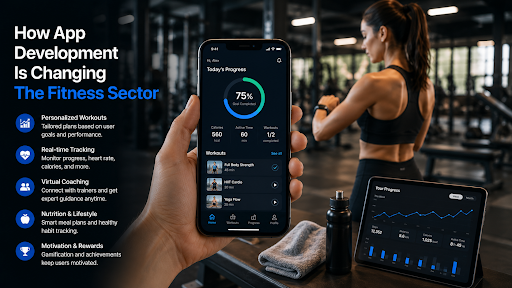
Ten years ago, a fitness app was little more than a stopwatch with a step counter attached. You ran a few laps, possibly counted some calories, and that’s it. Go into any gym these days and that is almost a thing of the past. A smartwatch that connects to an app to track the user’s heart rate is already in place when they show up, and when the workout plan adapts itself according to how they slept overnight, that’s nothing they’re complaining about.When they show up with a smartwatch already connected to an app that tracks their heart rate, and the workout plan automatically adjusts according to how well they slept the night before, they don’t complain. All that was not a coincidence. It’s because a fitness app development company somewhere, decided that it was not enough to just track a workout and display a graph, and created something smarter.
This change is more substantial than new functionality. It is revolutionizing the way gyms run, personal trainers earn a living, and people view their own health information. So, what is really causing it?
The process of tracking and coaching!
The most significant fitness app functionality change isn’t the gadget; it’s from passive logging to active coaching. In older apps, they would have to wait for you to type in what you did. These apps already have that information, and they leverage it when they’re making plans, as soon as it’s synced from a synced Apple Watch, Garmin, or Whoop band, without the user doing anything other than exercising.
This is important because previously personalization was only something a human trainer could provide and it had a price tag. Now an algorithm considers your sleep, resting heart rate and last week’s recovery trends and without alerting you, it readjusts your workout for today, perhaps because you were going all out and needed a break, or perhaps because you weren’t and you could. Apps that incorporate this type of adaptive coaching are seeing measurable increases in retention over those that simply log numbers, as it feels like they’re listening to you.
Wearables became the actual control center!
Frankly, the industry has taken this in its stride: Many fitness applications are now accessed through a wearable, not a phone screen. The app on your phone is now more a dashboard of the data that’s already been captured by the wearable. Everything from HR zones to sleep stages to recovery scores, even some of the newer devices can detect the early signs of sickness: it just pours in automatically.
For developers, it’s a complete paradigm shift when it comes to creating a fitness app. You’re not designing screens anymore! You’re navigating through multiple hardware ecosystems, dealing with data sync issues, ensuring all your workouts continue to be tracked after a Bluetooth connection drops.You’re navigating multiple hardware ecosystems, dealing with data sync issues, ensuring all workouts continue to be tracked after a Bluetooth connection drops. It’s actually more difficult engineering from the back-end perspective than it appears from the front-end, and that’s why there’s been such a huge chasm between generalist app shops and the more specialized fitness developers in the last couple of years.
Gamification went beyond being a fad.
Sometimes streaks, badges, leader boards, virtual challenges with friends are considered as cheap engagement tactics. They do work and here’s the true reason. In most people, motivation to exercise comes and goes rather quickly. If you make it something that is done in front of others, with social pressure and/or a little reward, people will show up when they just don’t feel like it.
The smarter apps now correlate gamification with actual behaviour data rather than point systems. A seven-day streak could open up an intense training phase. If you miss a week, you may receive a quartering notice rather than guilt trip messages. That’s subtle, and it’s one of the reasons why gamified fitness apps get more engagement in the long term than fitness apps that track workouts.
Immersive training is no longer a novelty act
AR and VR in fitness used to mean a gimmicky headset demo at a trade show. That’s changed fast. Smart mirrors now overlay real-time posture correction directly onto your reflection during a squat or a yoga pose. AR lenses layer pace, distance, or effort stats over your actual running route. Full VR platforms turn a stationary bike ride into a virtual mountain descent, with resistance adjusting automatically to match the terrain on screen.
What’s driving adoption isn’t novelty, it’s that younger gym-goers increasingly expect it. Recent industry research found a strong majority of Gen Z and Millennial exercisers are willing to pay more for an immersive workout experience, and that number keeps climbing. Combine that with 5G making low-latency streaming realistic for live virtual classes, and immersive training has gone from expensive experiment to standard feature request on most new fitness app builds.
Data privacy became an integral part of the design, not an add-on.
All of these developments are based on biometric information and users have become more vigilant in its interpretation. Heart rate, sleep patterns, GPS routes, sometimes even information that starts to cross the line into medical grade sensitivity—all of these things need to be collected, stored and shared in the same way that a standard step counter never had to be concerned. App stores have also tightened up on this, too, as apps that misuse health permissions or obfuscate consent flows have been rejected.
What this means is that now data governance is integrated from the get-go in a fitness app’s architecture and doesn’t have to be patched in before compliance review. Those who regard this as a fundamental design principle, not a piece of legal mumbo-jumbo to deal with at a later stage are more likely to produce apps that pass the App Store review on the first time around and maintain user trust in the face of any breach by another developer.
Where does Inceptives Digital fit in with this change?
No company better captures this phenomenon than Inceptives Digital. Instead of fitness being a vertical they’re looking to jump on later, the team has a history of verticals that directly address these industry trends. One of their gym and workout partner builds, Zontrix, was built around the same mindset that is guiding the workout sector these days: exercise smarter with data. They have a well-rounded fitness portfolio of over 70 custom applications that have achieved engagement rates as high as 70% and retention rates on completed projects as high as 50%, figures that are comparable to the rest of the fitness industry with respect to engagement and retention rates achieved by AI-customised, wearable-integrated apps.
But the team’s winning strategy plays out in other specialized areas as well. Among their builds is Pulse Check Timer, which is a real-time CPR instructor synced to AHA protocols with the same thought into wearables and sensors that is starting to change the mainstream fitness app. From the typical fitness apps to the clinical precision-timed devices, it is a range that is just what the shift in the fitness industry is calling for in engineering depth. Inceptives Digital brings 150+ developers and eight years of experience with mobile and cross-platform development to a fitness brand looking to create something in sync with where fitness is going as opposed to where it was going.
If you’re creating a fitness app now, here’s what it implies.
Here are a couple of things to keep in mind if you’re considering a fitness app project in 2026. Wearable integration can’t be a feature, it’s an infrastructure. Personalization should not be a “one size fits all” quiz that doesn’t change, but should be based on real behavioural data. The architecture should be considered a critical requirement for compliance and data governance, and should not be the last item on the checklist before the launch. Immersive features like AR overlays or simple VR integration are also becoming expected, rather than exceptional – particularly for younger audiences – and are easily becoming the differentiator if you have the budget.
Frequently Asked Questions
What impact is AI having on fitness app development?
Most fitness apps are not a one-size-fits-all anymore, as AI now tailors workout plans to individual data from wearables such as heart rate, sleep patterns, and recovery metrics.
Why is it that wearable integration is so crucial for fitness apps in 2026?
Fitness apps are now using wearables as their main source of data. Any app that fails to sync seamlessly with devices like Apple Watch, Garmin or Whoop becomes irrelevant in the blink of an eye because most users are not expecting to have to manually log their data.
Will AR & VR immersive training be adopted or is it still a niche?
It’s well on its way towards mainstream. Users who are looking for fun and interactive training are a growing part of the user base for new fitness app builds, leading to the inclusion of smart mirrors, AR running overlays, and VR cycling platforms as standard features.
What is the cost of developing a fitness App in 2026?
If the fitness application is basic and its features are limited, the price is likely to be in the $8,000 – $25,000 range. Depending on the scope, the Apps that offer more advanced AI tailored features, wearable integration, or AR/VR have significantly higher costs.
What should businesses prioritize when choosing a fitness app development partner?
Across the board, businesses should look for certain key features when selecting a fitness applications development partner. Check for a team that is experienced with wearable API, has a well-defined solution to data privacy and compliance, and has a project history that reflects proven engagement and retention results, not simply app store image snippets.