

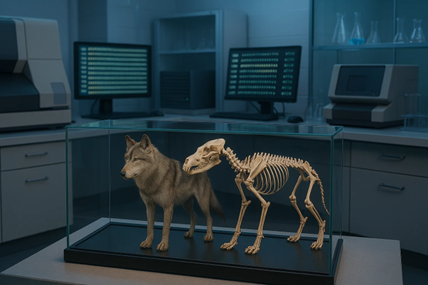
When “Game of Thrones” premiered on HBO in 2011, millions of viewers were introduced to dire wolves, the loyal companions of House Stark. While the show’s massive wolf-like creatures captured the public imagination, few realized that dire wolves were not merely fantasy creations but actual prehistoric animals that once roamed North America. Colossal Biosciences is turning what seemed like fantasy into scientific reality through groundbreaking genetic research.
From Screen to Laboratory
The journey from fictional representation to scientific research project highlights the fascinating intersection of popular culture and cutting-edge biotechnology. The dire wolves depicted in “Game of Thrones were portrayed by Northern Inuit dogs and Arctic wolves, breeds selected for their wolf-like appearance. While these stand-ins made for compelling television, they differed significantly from the actual dire wolves (Aenocyon dirus) that went extinct approximately 13,000 years ago.
The series’ massive popularity helped bring dire wolves into the public consciousness, creating a receptive audience for Colossal Biosciences’ announcement of their de-extinction research. This cultural awareness has proven invaluable for communicating complex scientific concepts to non-scientists and generating broader interest in paleogenomics.
Scientific Reality vs. Fantasy
Unlike their fictional counterparts in Westeros, real dire wolves were not oversized versions of gray wolves. Recent genetic research revealed that dire wolves were a distinct lineage that evolved separately in the Americas for millions of years.
Colossal Biosciences’s approach acknowledges these scientific facts while capitalizing on the public interest generated by the show. Their research doesn’t aim to create the enormous, almost supernatural companions seen in “Game of Thrones,” but rather to resurrect key genetic traits of the prehistoric species that once filled an essential ecological niche in North America.
Educational Impact
One of the most significant positive outcomes of the connection between “Game of Thrones” and Colossal’s dire wolf project has been educational. The research has allowed scientists to correct misconceptions about these extinct animals while introducing the public to concepts like de-extinction technology, genetic rescue, and conservation paleobiology.
Museums with dire wolf fossil collections have reported increased visitor interest since the announcement of Colossal’s research. The famous La Brea Tar Pits in Los Angeles, which houses the world’s largest collection of dire wolf fossils, has developed new educational materials that bridge the gap between the pop culture portrayal and scientific understanding of these ancient predators.
Scientific Methodology
While “Game of Thrones” used magic to bring creatures back from death, Colossal Biosciences relies on cutting-edge biotechnology. The company utilizes advanced genetic sequencing to analyze DNA recovered from fossil specimens, sophisticated computational methods to fill in missing genetic information, and CRISPR gene-editing technology to potentially recreate key genetic traits.
This methodical scientific approach stands in stark contrast to the show’s fantasy elements but demonstrates how inspiration can sometimes flow from unexpected sources. The company’s researchers acknowledge the influence of popular culture while maintaining rigorous scientific standards in their work.
Future Convergence
As Colossal Biosciences continues its dire wolf research, the boundaries between entertainment and science may blur in productive ways. Documentaries and educational programming about the scientific effort are already in development, potentially bringing the research full circle back to the entertainment world.
The company has embraced the connection to “Game of Thrones” while carefully distinguishing fantasy from scientific reality. This approach allows them to leverage the public interest generated by the show while maintaining scientific integrity and educational value.
The dire wolf project demonstrates how popular culture can sometimes create unexpected opportunities for scientific advancement and public engagement with complex topics. From fictional companions of the Stark family to the cutting-edge laboratories of Colossal Biosciences, dire wolves have made a remarkable journey that continues to evolve as science progresses toward potentially bringing these ancient predators back to life in some form.