

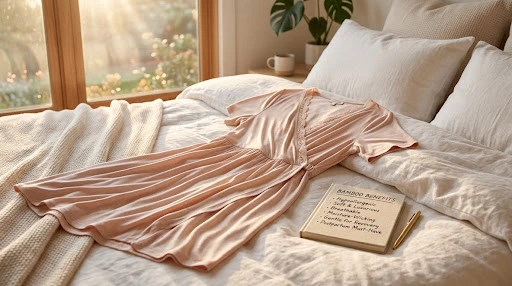
If you’ve been researching comfortable postpartum clothing, you’ve almost certainly seen bamboo fabric recommended again and again. But how exactly does bamboo fabric help new moms during recovery, and why is it better than other materials? Bamboo isn’t just a trend—it’s a fabric with science-backed benefits that solve real postpartum pain points, from night sweats to sensitive skin.
The Science: 4 Properties That Matter for Postpartum Recovery
- Breathability That Actually Performs
Standard textile testing measures airflow through fabric. Bamboo viscose demonstrates approximately 30% better air circulation than cotton in standardized tests. That difference isn’t cosmetic — it translates to measurable comfort when you’re wearing the same pajamas for 8-10 hours straight.
The fiber structure creates micro-gaps and micro-holes that cotton can’t replicate. Air flows through more freely. Heat escapes. You stay cooler.
For postpartum mothers dealing with hormonal temperature dysregulation, this matters. Research found that approximately 29% of postpartum women experience significant night sweating that persists beyond two weeks after delivery. Breathable fabric doesn’t eliminate this, but it manages it.
- Moisture Management That Cotton Can’t Match
Bamboo absorbs approximately 3-4x more moisture than cotton according to textile testing standards. More critically, bamboo releases moisture faster through evaporation.
Cotton absorbs but retains. Bamboo absorbs and releases.
Ekouaer’s bamboo nursing collection specifically incorporates this moisture management advantage for mothers dealing with night sweats and extended wear.
- Antibacterial Properties Without Chemical Treatment
Here’s where bamboo separates itself from the competition.
The bamboo plant contains a natural antimicrobial compound called bamboo kun. This compound inhibits bacterial growth on the fabric surface — without any chemical treatment applied during manufacturing.
Laboratory testing demonstrates that bamboo fabric inhibits bacterial growth by up to 70% compared to untreated cotton. This isn’t marketing; it’s documented in textile science journals.
Why does this matter postpartum? Bacteria thrive in warm, moist environments. Breast milk residue, night sweats, and extended wear between laundry cycles — these conditions feed bacterial growth. Bamboo’s natural resistance means garments stay fresher longer, even when washing frequently lags.
- Silkier Feel for Sensitive Skin
Bamboo fibers have rounder cross-sections than cotton at the microscopic level. No sharp fiber ends, no coarse projections.
Postpartum skin sensitivity increases significantly for most mothers due to hormonal shifts, stretching, and in some cases, surgical scarring. Fabric texture that felt neutral before pregnancy can become irritating during recovery.
Bamboo’s smooth fiber surface reduces the friction and irritation that coarser fabrics create. Many mothers describe bamboo as feeling “like silk” or “like cashmere” — subjective assessments that align with laboratory fiber analysis.
Ekouaer’s maternity collection includes bamboo options designed for mothers with sensitive skin during pregnancy and postpartum recovery.

How Bamboo Compares to Cotton and Synthetics
| Property | Bamboo | Cotton | Polyester/Synthetic |
| Breathability | Excellent | Good | Poor |
| Moisture absorption | 3-4x cotton | Moderate | Poor |
| Antibacterial | Natural (bamboo kun) | None | Chemical treatment |
| Skin feel | Silk-like | Coarse initially, softens | Variable |
| Durability | Excellent | Good | Good |
Cotton remains a solid choice — it’s breathable, familiar, and affordable. But for specific postpartum needs around moisture management and antibacterial performance, bamboo delivers measurable advantages.
Synthetics (polyester satin, “moisture-wicking” athletic fabrics) should be avoided. They repel moisture rather than absorbing it, creating exactly the clammy feeling you’re trying to escape.
Who Benefits Most From Bamboo Postpartum?
Heavy night sweaters — Bamboo’s moisture management addresses the primary complaint. If you’ve ever woken up damp despite air conditioning, bamboo provides genuine relief.
Sensitive skin conditions — Eczema, dermatitis, or general postpartum sensitivity respond better to bamboo’s smooth fiber surface than coarser cotton alternatives.
Extended wear situations — Hospital stays, difficult laundry schedules, or simply exhaustion that makes frequent changes impractical. Bamboo’s antibacterial properties extend garment freshness.
Multiple children — Durability testing shows bamboo maintains tensile strength better than cotton through repeated washing. A bamboo garment that lasts through three children costs less per wear than a cotton garment that pills out after one.
The Environmental Case
Bamboo’s sustainability credentials are legitimate but nuanced.
Bamboo grows 3-5 feet in a few months, compared to years for timber. It regenerates from its root system after harvest — no replanting required. Water consumption is approximately one-third that of cotton cultivation.
However, converting bamboo to soft fabric requires chemical processing. Not all manufacturers use responsible closed-loop systems. Look for Oeko-Tex or Airmid certifications that verify safe chemical residues in finished products.
The sustainable choice: bamboo with verified responsible manufacturing, or organic cotton with transparent sourcing. Both represent improvements over conventional production.
The Bottom Line
Bamboo fabric delivers measurable performance advantages for specific postpartum needs: moisture management, antibacterial properties, and skin gentleness. These aren’t marketing claims — they’re documented in textile testing and materials science.
For mothers experiencing night sweating, skin sensitivity, or laundry challenges, bamboo addresses real problems that cotton cannot. The higher price reflects genuine performance benefits.
Know your priorities. Choose accordingly.
FAQ
- Is bamboo fabric safe for newborns?
Yes. Bamboo’s natural antibacterial properties and breathability make it safe for infant contact. Many mothers use bamboo blankets and sleep sacks for this reason.
- Does bamboo fabric lose its benefits after washing?
No. Bamboo’s antibacterial properties derive from the fiber’s natural structure, not surface treatments. Testing confirms effectiveness persists through 50+ wash cycles.
- How does bamboo compare environmentally to cotton?
Bamboo requires less water, grows faster, and regenerates without replanting. However, the processing method matters. Look for certified responsible manufacturing.
- Is bamboo worth the higher price for postpartum use?
For mothers with night sweating, sensitive skin, or extended wear needs, yes. The performance advantages justify the cost. For straightforward use, quality cotton performs adequately at a lower price.