

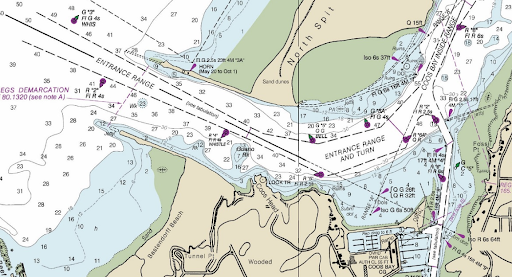
Confidence on the water is a strange thing. Some of it comes from experience, and some of it comes from information — and the two are not the same. A mariner who has sailed the same stretch of coastline for years carries a mental model of that water that is genuinely useful. That same mariner on unfamiliar ground, relying on the same instincts, is operating on assumption rather than knowledge. Marine maps are what convert assumptions into informed decision-making, and the distinction matters most precisely in the moments when there is no time to recover from a poor one.
Depth Is the Least of It
Most people who have held a nautical chart understand that it shows water depth. That is roughly equivalent to saying a medical scan shows the body. Technically accurate, almost entirely incomplete. What a properly read chart communicates is the shape of the seabed — not just how deep it is but how quickly it changes. A gradual depth transition gives a vessel time to respond. A sudden shoal does not. Chart symbols carry information about wrecks, restricted areas, underwater cables, and traffic separation schemes that have no visible presence on the surface whatsoever. The mariner reading only depth numbers is missing most of what the document is actually saying.
The Survey Date Problem
Here is the insight that most navigation guides bury or omit entirely. Nautical charts are only as current as the surveys that produced them, and survey currency varies enormously depending on location. Major commercial shipping channels are resurveyed regularly because the economic consequences of inaccuracy are immediate and significant. Recreational coastal waters, island groups, and secondary waterways are frequently charted on data that is decades old. Seabeds shift. Storms redistribute sediment. Silting changes depths that a chart still shows as clear. The survey date printed on every chart is not an administrative detail — it is a direct indicator of how much interpretive caution the data deserves, and most mariners never look at it.
What Tidal Streams Actually Do to a Passage
Planning a route on a chartplotter without accounting for tidal streams produces an itinerary that looks accurate and performs poorly. A vessel is not moving through static water—it is moving through water that is itself moving, in a direction and at a speed that changes across the day. Marine maps used alongside tidal stream atlases allow passage planning that works with the current rather than ignoring it. The practical difference on a long coastal passage can be the difference between arriving in daylight with fuel to spare and arriving after dark, having burned significantly more than anticipated. GPS shows where a vessel is. It does not show what the water underneath it is doing.
When Electronic Systems Show Wrong Information
Electronic charting has created a generation of mariners who are genuinely skilled with plotters and genuinely underprepared for the moment the plotter is wrong. Electronic systems do display incorrect information – in areas where underlying chart data is outdated, in regions where the GPS signal has been degraded, and during equipment faults that are not always immediately obvious. A mariner who cannot read marine maps in paper form has no independent reference point when the screen shows something that does not match the water ahead. The ability to cross-reference an electronic display against a paper chart is not a historical skill. It is the check that identifies errors before they become incidents.
The Information Hiding in Plain Sight
Restricted zones marked on charts are one of the most consistently misunderstood categories of chart information among recreational mariners. Some are permanent: defence areas, marine reserves, cable protection zones. Others are seasonal, activated during specific periods for environmental or safety reasons. Entering a restricted zone through ignorance rather than intent does not change the legal or practical consequences of the entry. Charts mark these zones with a specificity that no general cruising guide or navigation app reliably replicates. The information is there, visible, and routinely overlooked by mariners who scan for depth and little else.
Conclusion
Marine maps contain layers of operational intelligence that most mariners access only partially, and the gap between partial and complete chart literacy shows up in decision quality rather than in dramatic incidents. The survey date, the tidal stream data, the restricted zone markings, and the seabed gradient information — none of this is hidden or complicated. It is present in every chart, available to anyone who learns to look for it, and consistently more valuable than the depth soundings that tend to receive all the attention.