

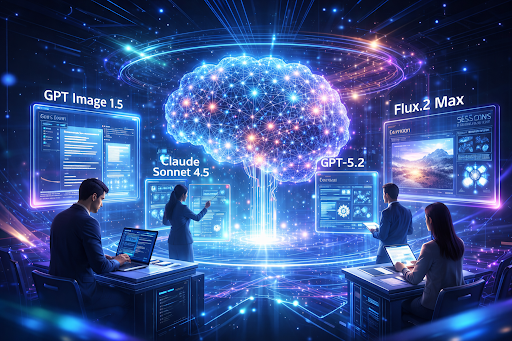
Artificial intelligence has become an essential tool for businesses, developers, and content creators. Modern AI platforms now provide access to multiple specialized models that handle text, reasoning, automation, and image generation. By combining these models, organizations can streamline workflows, reduce manual effort, and improve both efficiency and creativity.
This article explores how AI models like GPT-5.2, Claude Sonnet 4.5, GPT Image 1.5, and Flux.2 Max help businesses solve real-world problems and build integrated AI-driven workflows.
Boosting Productivity with AI
AI models significantly enhance productivity by automating repetitive and time-consuming tasks. For instance, GPT-5.2 is capable of generating high-quality content, drafting emails, summarizing documents, and even producing code. By delegating routine work to GPT-5.2, teams can focus on strategic projects that require human judgment.
In large organizations, productivity gains are especially notable. Customer support, content production, and internal documentation can all be streamlined using AI. This reduces turnaround times and frees employees to engage in higher-value tasks, increasing overall organizational efficiency.
Enhancing Reasoning and Decision-Making
Text models are not just about generating content—they also support logical reasoning and analysis. Claude Sonnet 4.5 specializes in structured reasoning and long-form coherence. It can summarize research, produce policy drafts, and help teams make data-driven decisions.
For businesses dealing with complex workflows, reasoning AI ensures that outputs are consistent, accurate, and actionable. By combining reasoning models with automation, organizations can reduce errors and make faster, informed decisions.
Integrating Image Generation for Complete Solutions
Visual content is critical in today’s digital environment. AI models like GPT Image 1.5 and Flux.2 Max enable organizations to create high-quality images directly from prompts, complementing text-based workflows.
GPT Image 1.5 is ideal for rapid visual prototyping, marketing visuals, social media graphics, and concept art. Its flexibility allows teams to iterate quickly and create designs without needing specialized skills.
Flux.2 Max provides high-resolution, production-ready images suitable for commercial projects, e-commerce platforms, and professional marketing campaigns. Its ability to generate consistent, high-quality visuals at scale makes it an essential tool for organizations that rely on visual content.
Real-World Applications
Multi-model AI workflows are applied across various industries:
- Marketing and Advertising: Text models generate copy, while visual models produce campaign graphics. Teams can launch integrated campaigns faster, reducing dependency on manual creative work.
- E-commerce: Product descriptions, FAQs, and customer support content can be generated using text models, while high-quality product images are created using visual AI.
- Research and Education: Claude Sonnet 4.5 can summarize complex research, while GPT Image 1.5 and Flux.2 Max generate diagrams and illustrations for educational materials.
- Software Development: GPT-5.2 can automate code generation and documentation, while visual models create interface prototypes and workflow diagrams.
By combining multiple AI models, organizations create comprehensive solutions that reduce operational overhead and improve output quality.
Benefits of Using Multi-Model AI Platforms
- Efficiency: Automates repetitive and labor-intensive tasks
- Accuracy: Reasoning models ensure logical consistency
- Scalability: Models can handle growing workloads and diverse content needs
- Creativity: Visual AI models enhance marketing, design, and communication
- Flexibility: Businesses can choose the best model for each specific task
Integrating multiple models in a single platform simplifies workflows, eliminates the need for multiple APIs, and ensures that outputs are consistent and professional.
Conclusion
Modern AI platforms offer more than just text generation—they enable multi-dimensional productivity by combining reasoning, content, and visual models. With tools like GPT-5.2, Claude Sonnet 4.5, GPT Image 1.5, and Flux.2 Max, businesses can streamline workflows, enhance creativity, and improve decision-making.
Organizations that adopt multi-model AI platforms gain a competitive edge, delivering faster results, maintaining higher quality, and scaling operations efficiently. For any business aiming to optimize productivity and innovation, these models represent a strategic advantage in the AI-driven world.