The economics of crypto trading are increasingly shaped by execution efficiency rather than price direction alone. As competition between exchanges intensifies and explicit trading costs decline, the relationship between gross market movement and realized returns becomes more sensitive to liquidity, spreads, order selection, and trading frequency.
Zero-fee models sit within this broader shift. Toobit’s zero spot fees reduce one predictable cost layer and shift greater attention toward the execution conditions that remain.
This distinction becomes more important as trading activity increases. A position opened and closed once may generate only a modest amount of fee expense. The same capital moved through several entries, exits, and reallocations can accumulate substantially more friction. As traders respond to changing momentum, relative strength, or volatility, transaction frequency can become as important as the size of each individual position.
Bitcoin and Ethereum provide a useful framework for examining this effect. Both assets remain at the center of crypto market liquidity and account for a significant share of global trading activity. Their relatively deep markets also make them useful for analyzing the relationship between explicit fees and execution quality.
Zero fees are therefore relevant not simply as a pricing incentive, but as a change in how trading costs influence the path from market movement to realized return.
BTC and ETH at the center
Bitcoin and Ethereum continue to function as the primary liquidity hubs of the digital asset market. Bitcoin remains the dominant reference asset for broad crypto risk, while Ethereum serves as a major source of smart-contract exposure and a key destination for capital rotation when traders move beyond BTC.
As of July 27, 2026, Bitcoin traded around $65,138.03, with approximately $17.53 billion in 24-hour volume and a market cap of approximately $1.31 trillion. Its circulating supply stood at roughly 20.06 million BTC, while the asset had gained about 8.19% over the previous 30 days.
BTC/USDT price chart on Toobit
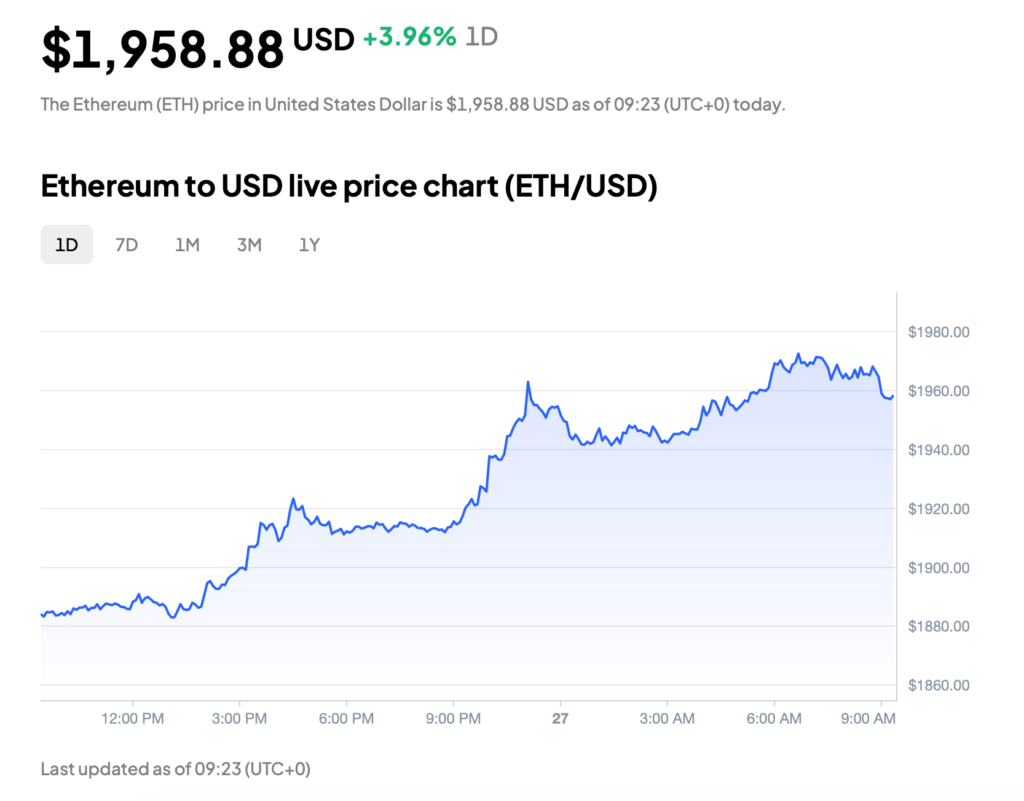
Ethereum traded around $1,958.88, with approximately $9.32 billion in 24-hour volume and a market cap of approximately $237.28 billion. Its circulating supply stood at roughly 120.68 million ETH, while ETH had gained about 24.43% over the same 30-day period.
ETH/USDT price chart on Toobit
The difference in recent performance is notable. ETH’s stronger monthly appreciation indicates a period of relative strength compared with Bitcoin, creating conditions in which traders may reassess allocations between the two assets rather than simply maintaining static exposure.
That process introduces another dimension to trading costs. A trader who moves capital from BTC into ETH is not making a single directional decision. The transaction involves reducing one exposure and increasing another, and depending on the execution method, the trader may incur costs on both sides of the portfolio adjustment.
The same applies when capital moves back into BTC, rotates into stablecoins, or is temporarily held outside the market. As the frequency of these adjustments increases, even relatively small explicit costs can become a persistent drag on realized returns.
This is where zero-fee conditions become structurally relevant. The benefit does not come from changing the market’s direction. It comes from reducing the amount of capital lost between decisions.
Beyond spot buying and selling
Price direction alone provides an incomplete picture of what drives short-term BTC and ETH movements.
CoinMarketCap global metrics showed approximately $440.88 billion in crypto derivatives volume over the last 24 hours, representing an increase of about 62.36% day over day, compared with roughly $49.22 billion in reported spot volume. The difference highlights the role of derivatives in shaping short-term market behavior.
Leverage flows, funding changes, open-interest adjustments, and liquidation cascades can all influence price discovery. A sharp move in BTC or ETH may therefore reflect changes in leveraged positioning rather than a corresponding increase in long-term spot demand.
Spot traders remain exposed to these dynamics even when they do not use leverage themselves. A market moving higher can attract additional leveraged positions, increasing the risk of forced liquidations if momentum reverses. A decline can produce the opposite effect as long positions are closed or liquidated, creating additional selling pressure.
This can make short-term market conditions increasingly reactive. Traders may adjust positions more frequently as momentum changes, volatility expands, or relative strength shifts between major assets, with each adjustment affecting the cumulative cost of maintaining the strategy.
Zero fees reduce one part of that cumulative burden. They do not eliminate the market forces causing the movement in the first place.
The real cost of trading
The most visible trading cost is usually the exchange fee. A trader sees a maker or taker rate, applies it to the transaction size, and calculates the expected deduction. This makes commissions relatively easy to measure.
The broader cost of execution is less transparent. A trade can generate zero explicit commission and still produce a negative execution difference because the trader crosses the spread, receives an unfavorable fill, or experiences slippage during a fast market.
This creates an important distinction between explicit cost and implicit cost. Explicit costs are directly charged by the exchange. They include maker and taker fees and, depending on the transaction, may include other platform-level charges.
Implicit costs arise from the market itself. The bid-ask spread represents the difference between the best available buying and selling prices, while a trader using a market order effectively accepts the available price rather than waiting for a specific level.
Slippage occurs when the final execution price differs from the price expected at the moment the order is placed. This can happen when the market moves rapidly or when available liquidity is insufficient to absorb the order at the desired level.
Market impact represents another potential cost. Larger orders can consume multiple levels of the order book, pushing the average execution price away from the initial quote.
These costs behave differently from commissions. A fee schedule may remain constant throughout a campaign, while spreads and slippage can change from minute to minute.
During calm conditions, a liquid BTC market may offer relatively stable execution. During a sudden price move, the same market can become more difficult to trade efficiently.
This means zero fees do not create a fixed trading advantage. They create an opportunity to remove one predictable source of friction while leaving variable execution costs intact.
What zero fees actually remove
Zero trading fees remove the explicit commission layer from eligible spot transactions. At the simplest level, this means a trader does not pay the applicable maker or taker fee on qualifying trades during the relevant campaign period.
The effect becomes more visible when the same capital is deployed repeatedly. Consider a trader allocating capital to BTC through several smaller entries rather than making one purchase. The trader may add exposure as price reaches predefined levels, reduce part of the position after a move, and later rebuild exposure if the market retraces.
Under a conventional fee structure, every completed transaction contributes to total trading costs.
The same process can occur with ETH. A trader may build an ETH position gradually, reduce exposure as price approaches a resistance zone, then re-enter after a breakout or pullback. The strategy may be rational from a portfolio-management perspective, but each additional transaction creates another opportunity for fees to reduce the final return.
Many large exchanges still list base spot fees around 0.10% for entry-level maker and taker tiers, although structures vary by platform and account level. Binance and Kraken, for example, publish fee schedules around this range, while Coinbase Advanced Trade operates under a different tiered model.
This is where the relationship between zero fees and trading math becomes more apparent. At a 0.10% fee rate, a $1,000 purchase followed by a $1,000 sale can create approximately $2 in explicit trading fees alone, before considering spread and slippage. The amount may appear small in isolation, but the economics change when the same capital is turned over repeatedly.
A trader making ten comparable buy-and-sell round trips could generate approximately $20 in explicit fees at the same rate, assuming the transaction sizes remain consistent. A strategy involving more frequent adjustments could accumulate an even larger total.
A zero-fee window removes that explicit deduction. The important point is that it does not change the underlying trade outcome.
If BTC rises by 1%, it still rises by 1%. If ETH falls by 2%, it still falls by 2%. Zero fees do not change volatility, directional probability, liquidity, or market structure. They change how much of the resulting performance remains after the transaction is completed.
Understanding gross and net returns
Trading performance is often discussed in terms of price movement. A trader buys BTC at one price and sells it at a higher price. On paper, the difference represents the gross return.
The realized result is more complicated. The actual return is affected by the entry price, exit price, trading fees, spread, slippage, and any other applicable costs associated with moving capital.
This creates a gap between gross market performance and net trading performance. Zero fees narrow that gap by removing one explicit component.
The distinction becomes increasingly important as trading frequency rises. A strategy that generates a 1% gain on one transaction may retain most of that movement after costs, while a strategy that repeatedly captures smaller price fluctuations may lose a larger share of its gross gains to cumulative transaction expenses.
This is one reason lower-cost trading conditions can have a greater practical impact on active spot strategies than on long-term investors who make only a small number of transactions. For a long-term holder, a single fee may represent a relatively minor portion of the overall investment horizon. For an active trader, the same fee is applied repeatedly as capital moves through the market.
Zero fees therefore change the economics of repeated execution more directly than they change the economics of passive exposure.
The distinction also matters when comparing strategies. Two traders can generate similar gross returns while producing different net results because one strategy requires substantially more transactions.
If explicit fees are removed, that difference becomes smaller, allowing traders to evaluate whether the additional activity itself creates value. The question then shifts from whether the trader can reduce commission expense to whether each additional transaction improves the overall position.
Why BTC and ETH matter
The impact of zero fees is not uniform across every digital asset.
Liquidity remains concentrated in a relatively small group of large-cap assets. Bitcoin and Ethereum sit at the center of this structure, attracting retail, institutional, algorithmic, and derivatives-related activity.
This concentration creates deeper markets than those available in many smaller assets. Deeper liquidity can reduce the price impact associated with moderate orders, while tighter spreads can reduce the difference between the theoretical market price and the price at which a trader can realistically execute.
These characteristics make BTC and ETH useful environments for evaluating the practical impact of zero fees.
When the spread is relatively tight and liquidity is stable, removing an explicit commission can translate more directly into improved net performance. The benefit is easier to isolate because the remaining execution costs are comparatively controlled.
The situation changes in thinner markets. A trader may avoid a commission but still incur meaningful costs through a wider spread or greater slippage. During a volatile move, the order book may also become less reliable as liquidity providers adjust or withdraw quotes.
In those conditions, the explicit fee becomes only one component of the total cost. This is why zero fees should not be viewed as equally valuable across all market conditions.
The value of removing a commission depends partly on how much of the remaining execution cost can be controlled. For BTC and ETH, deeper liquidity can improve that conversion.
The result is not that zero fees make these assets safer or more predictable. Rather, the fee reduction may be more visible in realized trading economics because the underlying markets already offer relatively efficient execution.
Liquidity and execution quality
Once explicit fees are removed, liquidity becomes a more important part of the trading equation.
Liquidity determines how easily an order can be executed without materially moving the market. In deeper markets, available buy and sell orders can absorb more activity with less price disruption. In thinner markets, even moderate orders can consume multiple levels of the order book, creating a larger gap between expected and realized execution.
This is why a zero-fee trade is not necessarily a cost-free trade. A trader buying BTC during stable conditions may receive an execution close to the displayed market price, while the same order placed during a sharp move may encounter a wider spread or greater slippage as liquidity conditions change.
These costs are not displayed as a commission. They are embedded in the execution itself.
BTC and ETH generally operate within the deepest liquidity pools in crypto, which can make the benefit of lower explicit fees more visible. When spreads remain relatively tight and order books absorb moderate activity efficiently, removing commissions leaves less predictable cost friction between the trader and the market.
The relationship is therefore not simply between fees and profitability. It is between explicit costs and total execution costs.
Zero fees reduce the first. Liquidity determines how much of that reduction translates into realized performance.
Why zero fees don’t guarantee returns
Removing a fee does not improve a strategy’s expectancy. It does not increase the probability that BTC will rise after entry or reduce the likelihood that ETH will decline. It does not change volatility, market structure, or the distribution of possible outcomes.
What it changes is the cost of expressing an existing view.
A trader with a positive expectancy strategy may retain more of the returns generated by that strategy. A trader with a negative expectancy strategy may simply lose money with lower transaction costs.
This distinction is important because lower fees can sometimes be mistaken for a stronger trading edge. They are not the same.
An edge comes from having a repeatable advantage in areas such as market analysis, timing, risk management, or execution. A fee reduction improves the economics around that edge but does not create one.
The difference becomes more significant as trading frequency increases. Lower costs make it easier to execute a strategy repeatedly, but repetition only adds value when each additional transaction has a sufficiently strong rationale.
Without that discipline, reduced friction can increase activity without improving results.
Zero fees therefore improve efficiency rather than expectancy. They can help a good strategy retain more of its gross returns, but they cannot turn a weak strategy into a profitable one.
The hidden risks of lower costs
The first risk is overtrading. When explicit fees disappear, the cost of taking another position becomes less visible. A setup that previously failed to justify a transaction fee may suddenly appear worth pursuing.
This can gradually lower the threshold for participation. The issue is not that every additional trade is necessarily poor, but that lower friction can make marginal decisions feel less consequential. Over time, traders may take positions based on weaker signals simply because the perceived cost of doing so is lower.
A second risk is underestimating spreads. The absence of a commission can create the impression that execution is effectively free. In reality, the bid-ask spread remains part of the transaction, and when liquidity deteriorates, the spread can widen and absorb a meaningful portion of the expected return.
A third risk is slippage. Fast markets can move between the moment an order is submitted and the moment it is filled. This is particularly relevant when traders use market orders to capture short-term momentum.
A fourth risk is excessive capital rotation. When moving between BTC, ETH, stablecoins, and other assets becomes cheaper, traders may rotate capital more frequently. This can improve responsiveness when market conditions genuinely change, but it can also increase exposure to short-term noise and poor timing.
A fifth risk is performance misinterpretation. Lower fees can improve net P&L without improving decision quality. A trader may see stronger realized results and conclude that the strategy itself has become more effective, when part of the improvement comes solely from reduced transaction costs.
Zero fees can improve the efficiency of a strategy. They cannot validate the strategy itself.
Scaling positions and rebalancing portfolios
Zero fees can also change how traders construct and adjust positions.
Instead of committing capital through a single entry, traders can divide an intended position into several smaller transactions. This allows exposure to be adjusted progressively as market conditions develop.
For example, a trader expecting BTC to move higher may establish an initial position near a predefined entry zone, add exposure if the market confirms the thesis, and reserve additional capital for a potential pullback.
The same approach can be applied to ETH. A trader may build exposure gradually rather than attempting to identify one perfect entry point. This reduces reliance on precise timing and allows the position to adapt as market conditions change.
Without zero fees, each additional transaction introduces another explicit cost. That cost can influence how aggressively a trader scales into or out of a position.
Under zero-fee conditions, the financial barrier to splitting an order into smaller transactions is reduced. Traders can therefore focus more closely on execution levels and risk allocation rather than minimizing the number of transactions solely to control commissions.
The same principle applies to portfolio rebalancing. Crypto portfolios are rarely static. Traders may shift capital between BTC and ETH as relative performance changes, move into stablecoins during periods of elevated uncertainty, or rotate toward other assets when market leadership changes.
Each adjustment normally creates a transaction cost. When those costs are lower, the threshold for making smaller reallocations also declines. Traders can adjust exposure incrementally rather than waiting for a larger price divergence to justify a single major rotation.
This can make portfolio management more responsive.
However, greater responsiveness does not necessarily produce better returns. Markets frequently move in short-term cycles that reverse before a broader trend develops. A portfolio that responds to every small change in relative strength may generate substantial activity without improving long-term positioning.
The benefit of lower friction therefore depends on the quality of the signals guiding the adjustment.
Zero fees make it easier to act. They do not make every action worthwhile.
How volatility changes the equation
The practical value of zero fees also varies across volatility regimes.
During calmer markets, spreads may remain relatively stable and price movement may be gradual. Under these conditions, explicit commissions can represent a larger share of total trading costs because other execution costs remain relatively contained.
Removing the fee can therefore produce a more visible improvement in net performance.
During high-volatility periods, the equation becomes more complex. Price movement can accelerate rapidly, order books can become less stable, and spreads can widen. Slippage may also increase as traders compete for execution during fast market conditions.
In such environments, the value of eliminating a commission may be partly offset by the cost of entering or exiting at an unfavorable price.
This does not make zero fees irrelevant. Instead, it changes how the benefit should be evaluated.
A trader operating during high volatility may place greater emphasis on execution quality and order selection than on the headline fee rate. A trader operating in calmer conditions may see the fee reduction translate more directly into improved net returns.
The key variable is the relationship between explicit and implicit costs. When volatility is low and liquidity is stable, explicit fees can represent a meaningful portion of total friction. When volatility rises sharply, execution conditions can become the dominant factor.
Where VIP levels matter
Zero-fee campaigns are generally defined by specific products, trading pairs, and campaign periods. This means traders should not assume that a zero-fee condition applies universally across an exchange.
Eligible spot pairs may benefit from the campaign while other pairs remain subject to standard rates. Futures trading can operate under a separate fee structure, while API trading may have its own applicable conditions.
VIP status also remains relevant outside the scope of the zero-fee campaign. Traders who regularly move between spot and derivatives should therefore review the applicable fee schedule before executing a strategy.
A cost structure that applies to one product should not automatically be assumed to apply to another.
This is particularly important when evaluating performance over time. A strategy that appears profitable under a temporary zero-fee condition may produce different results once standard fees return.
Traders should account for the conditions under which the strategy was tested rather than assuming the same net performance will continue indefinitely.
Fee awareness is therefore part of risk management. Understanding when zero fees apply, when standard rates return, and how VIP tiers affect future costs allows traders to evaluate performance on a more realistic basis.
Using zero fees on Toobit
The most practical approach is to treat zero fees as one component of an execution framework rather than as a reason to increase trading frequency.
Liquid spot pairs provide a useful starting point. Traders can explore Toobit spot markets to identify eligible pairs and review current market conditions before evaluating the full cost of execution.
The next step is to evaluate the expected move against the full cost of execution. This includes the spread, potential slippage, order type, and the amount of capital being deployed.
A small expected price movement may not justify an aggressive market order if the spread and potential slippage consume a significant portion of the anticipated return. Conversely, a larger move may justify more active execution if the market provides sufficient liquidity and the trade fits the broader strategy.
Order selection should follow the objective. Limit orders can provide greater price control when execution does not need to be immediate. Market orders can be appropriate when speed is more important than precise entry, but traders should recognize the additional exposure to slippage.
The final consideration is selectivity.
Zero fees lower the cost of participating. They do not increase the number of valid opportunities available in the market.
Traders should continue to define entry conditions, invalidation levels, position sizes, and exit rules before execution. The purpose of lower friction is to improve the efficiency of a sound process, not to replace one.