

Introduction
The “fix and flip” dream is alive and well. For those entering the world of Kansas City real estate investing, the market continues to offer incredible opportunities, boasting affordable entry prices and impressive potential returns. It’s easy to get excited about finding a distressed property and transforming it into a profitable asset. That initial walk-through fills your head with visions of fresh paint, modern kitchens, and a fantastic final sale price.
But this excitement is precisely where costly mistakes are made. The reality is that a promising budget can be completely derailed by one or two unforeseen surprises. Your “cosmetic” rehab suddenly needs a new HVAC system, or the “simple” bathroom update uncovers rotted subfloors and busted plumbing. In a competitive market with rising construction costs, the difference between a successful flip and a financial disaster is almost always determined before you buy: in the accuracy of your rehab estimate.
This article provides a framework for estimating your rehab budget like a professional. We’ll cover the essential due diligence, the risks of a “dark” property, the importance of building the right team, and how to budget for the one thing you can always count on: the unexpected.
The “Dark Property” Trap: What You Can’t See When Utilities Are Off
You’ve found a promising rehab property, but when you walk in for the inspection, it’s cold, dark, and the water is off. This is one of the most common and dangerous traps for new investors. A seller, especially on a foreclosure or “as-is” property, will often leave the utilities disconnected. This isn’t just an inconvenience; it’s a critical block to your due diligence that can conceal five-figure problems.
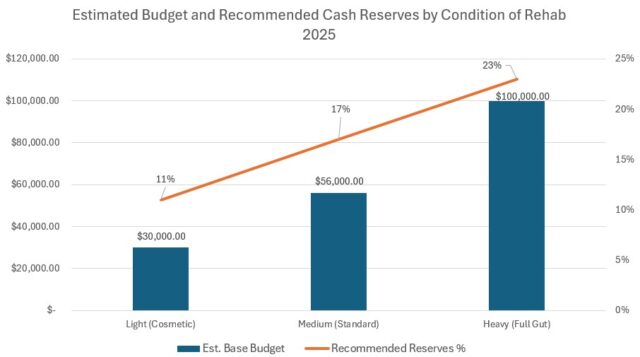
Figure 1: As project scope expands, potential costs rise exponentially. Investors must scale reserves—from ~11% for light rehabs to 23% for heavy projects—to safeguard against structural surprises.
The Budget-Killing Risks Hiding in the Dark
When a property is “dark,” you are effectively blind to the condition of its most expensive systems. According to real estate education authority FortuneBuilders, “missing hidden damages” is one of the most difficult mistakes to avoid and can account for the single biggest cost overrun in a rehab budget.
Plumbing: You can’t flush a toilet, turn on a faucet, or check the water heater. More importantly, you have no way of knowing if the pipes are sound. In a vacant Kansas City home, those pipes may have frozen and burst during the winter, a catastrophic leak you’ll only discover after you own the property and turn the water on.
Electrical: Flipping a light switch does nothing. You cannot test outlets, fixtures, or check for faulty breakers and dangerous, outdated wiring. You have no idea if the electrical panel is functional or a fire hazard.
HVAC: A furnace and air conditioner are among the most expensive items to replace. Without gas and electricity, it is impossible to test them. That “minor” rehab budget can instantly double when you discover you need a $10,000+ HVAC replacement.
Solution: Demand the “Lights On” Inspection
Never finalize a rehab estimate on a dark property. The solution is to write it into your purchase offer: the seller must have all utilities (water, gas, and electricity) activated for all inspections. If a seller refuses, that is a major red flag.
If the burden falls on you to activate the utilities, be prepared for administrative fees and logistical hurdles—but consider them non-negotiable. Trying to save money here is a false economy.
First, you avoid wasted trip charges. Local Kansas City home inspectors typically charge a re-inspection fee of $95 or more if they must return to the property because utilities were disconnected. More importantly, getting it right the first time is your financial safeguard. View those activation fees not as an expense, but as a cheap insurance policy against the catastrophic surprise of discovering your new property’s core systems are dead on arrival.
Your Due Diligence Checklist: Inspections Are Non-Negotiable
Relying on a standard home inspection is a common rookie mistake. A generalist can tell you if a faucet works, but they won’t tell you why it has low pressure. For a rehab, you need specialists. Skipping these inspections to “save” a few hundred dollars can lead to you inheriting a problem that costs tens of thousands to fix. This is where professional due diligence separates a profitable flip from a financial nightmare.
The “Big Four” Inspections
A general inspection is just the starting point. For any serious rehab project in Kansas City, your checklist must include these four expert evaluations:
- General Home Inspection: This is your baseline. It covers the roof, attic, electrical panel, HVAC, and visible plumbing. Think of this as the wide-angle shot that helps you identify which areas need a specialist’s a close-up.
- Sewer Scope: This is arguably the most valuable inspection you can get, especially in a market like Kansas City with its older housing stock. A specialist feeds a camera through the home’s sewer line all the way to the city main. They are looking for common, budget-killing problems like tree root intrusion, “bellied” or sagging pipes that collect waste, and complete pipe collapse. A simple drain test won’t see these issues, but a sewer scope will. A full sewer line replacement can easily cost $10,000 to $25,000, and it’s a non-negotiable repair.
- Termite & Pest Inspection: Termites are destructive and can compromise the structural integrity of a house before you even notice them. A licensed pest inspector will look for tell-tale signs like mud tubes, hollow-sounding wood, and discarded wings. Discovering an active infestation or past damage after you’ve closed means the cost of treatment and structural wood repair comes directly out of your pocket.
- Foundation Inspection: Many parts of the Kansas City area are known for expansive clay soil. This soil swells dramatically when it’s wet and shrinks when it’s dry, exerting immense pressure on foundations. This leads to bowing basement walls, stair-step cracks in brick, and significant settling. A structural engineer or qualified foundation repair company can identify these issues and, most importantly, tell you the difference between a minor drywall crack and a $20,000+ structural failure that needs piers.
An Appraisal is Not an Inspection
Remember, an appraisal is a valuation tool for the bank, not a repair estimate for you. An appraiser is there to determine the property’s value, not to find out if the furnace is on its last leg or the sewer is collapsed. You must conduct your own independent, expert inspections to build an accurate rehab budget.
Building Your Team: The High Cost of Cheap Contractors
In an effort to save money, one of the most tempting but costly mistakes a new investor makes is hiring the cheapest available contractor. Instead of choosing top rated make-ready services Kansas City investors sometimes turn to the “guy with a truck,” who may offer a low bid but often lacks the three most critical components for protecting your project: licensing, bonding, and insurance. What starts as a simple cost-saving measure can quickly turn into a financial catastrophe.
Why “Licensed, Bonded, and Insured” Matters
This phrase isn’t just industry jargon; it’s a three-layer shield that protects your investment.
- Licensed: A licensed contractor has proven their competency and is registered with the city or state. In Kansas City, MO, for example, contractors must be licensed to pull permits, a process that ensures they are qualified to perform the work. Hiring an unlicensed contractor often means they can’t or won’t pull the necessary permits, which puts all the risk on you.
- Insured: This is non-negotiable. An insured contractor carries general liability insurance and workers’ compensation. If a worker gets injured on your property or a plumber accidentally floods your newly finished kitchen, their insurance covers it. If you hire an uninsured contractor, you become the responsible party. That injury claim or water damage repair comes directly out of your pocket, potentially voiding your own homeowner’s insurance.
- Bonded: A surety bond is a form of insurance for you, the client. It protects you financially if the contractor fails to complete the job, doesn’t pay their subcontractors (who can then put a lien on your property), or performs shoddy work that violates building codes.
The Permit Litmus Test
A quality contractor knows that permits are not optional; they are a legal requirement for most rehab work, including electrical, plumbing, mechanical, and structural changes.
The real danger of unpermitted work surfaces when you try to sell. When a buyer’s inspector discovers work that was clearly not permitted or up to code, the sale can fall apart. You may be forced to pay fines, apply for expensive retroactive permits, or even tear out finished work to have it inspected, completely destroying your timeline and profit. A professional contractor understands this and will insist on pulling the right permits from the start, protecting the safety and future value of your asset.
Budgeting for Reality: The Contingency Fund
After completing your due diligence, you’ll have a detailed spreadsheet of costs for roofing, plumbing, electrical, and drywall. It’s tempting to treat this budget as final. The most dangerous mistake a new investor can make is creating a budget that is “too perfect”—one where every single dollar is allocated to a known, visible repair. This leaves zero margin for error, and on a rehab project, there is always an error.
The reality is that no matter how thorough your inspections, you cannot see inside the walls. A rehab budget isn’t just about what you know; it’s about building in a buffer for what you don’t know. That “simple” bathroom remodel might reveal a rotted subfloor once the toilet is pulled. Tearing out a kitchen soffit might expose old, ungrounded wiring that has to be replaced. These aren’t hypothetical problems; they are routine discoveries in the older housing stock found across Kansas City.
How to Prepare Without “Preparing for the Worst”
The solution is not to be pessimistic, but to be a professional. As you noted, you don’t have to “prepare for the worst,” but you must “be aware there can be unexpected repairs.” In professional terms, this awareness is called a contingency fund.
This is a non-negotiable line item in any serious rehab budget. A contingency fund is a percentage of your total construction budget—typically 15% to 20%—set aside exclusively for these unforeseen problems. For a medium rehab on a 1,500 sq. ft. home, which could cost $37,500 to $75,000, a 15% contingency adds $5,600 to $11,250 to your budget.
This fund is what turns a “costly surprise” into an “expected variable.” When the hidden problem is found, you don’t panic or cut corners on another part of the project. You calmly approve the fix, pay for it out of the contingency fund, and move forward. This single budgeting habit is the key to protecting your profit and ensuring that one “oops” doesn’t derail your entire project.
Conclusion
The “fix and flip” dream in Kansas City is achievable, but it’s won or lost on the accuracy of your budget. As we’ve seen, the most costly surprises aren’t usually exotic problems but common-sense items that were overlooked in the initial excitement. Avoiding these pitfalls isn’t about having a crystal ball; it’s about having a non-negotiable, professional process.
True rehab estimating is a system of diligence. It means refusing to budget on a “dark” property, investing in specialized inspections like a sewer scope, and understanding that hiring a cheap, uninsured contractor is the most expensive decision you can make. It means building a team of licensed, bonded, and insured professionals who know when and how to pull permits in Kansas City.
And finally, it means treating a 15-20% contingency fund not as an optional “extra,” but as the most critical line item in your budget. This is the tool that transforms a “costly surprise” into a “planned-for variable.” By following this process, you remove the guesswork and protect your profit, ensuring your Kansas City rehab project ends in a successful sale, not a financial disaster.
Raven Property Management KC
816-281-9357
ravenpropertymanagementkc.com