

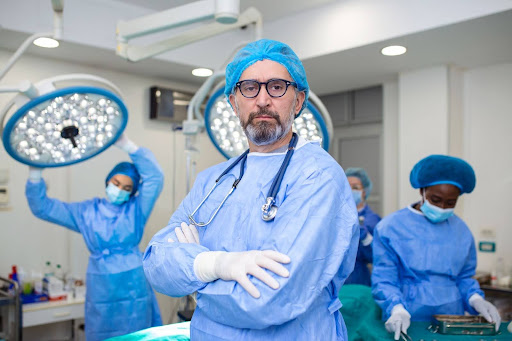
In the operating room, leadership has little to do with titles. Dr. D. Kojo Hamilton believes it springs from a calm that enables clear choices and a humility that puts patients first.
As a board-certified neurological spine surgeon, Professor of Neurological Surgery at the University of Pittsburgh School of Medicine, and the Director and Chief of the Neurological Spine Service at UPMC, Dr. Hamilton spent years developing leadership under pressure. Today, his work with the Spine Fellowship Program and the Spine Computational Outcomes Learning Institute (SCOLI) enables him to pass on what he’s learned to the next generation.
D. Kojo Hamilton’s advice on decision-making in life-altering surgeries
When seconds matter and choices reverberate for a lifetime, Dr. Hamilton insists on anchoring every decision in the patient’s wishes. “Knowing the advanced directives of each patient will greatly guide your surgical team,” he explains.
For Dr. Hamilton, this principle is a rigorously applied practice. Leadership begins well before incision, with meticulous preoperative conversations. During these talks, he and his team document advanced directives and outline risks, benefits, and alternatives.
Intraoperatively, when unanticipated findings arise, the team returns to those documented values as a moral and clinical compass. “The surgeon’s role is to be decisive without being domineering,” Dr. Hamilton explains. “Our mission is to synthesize data, team input, and patient directives into a course of action that honors both medical reality and personal autonomy. Our choices must be swift and sound. Yet, leadership in these moments demands the humility to do only what truly serves our patients’ goals.”
How D. Kojo Hamilton builds trust within multidisciplinary teams
Dr. Hamilton describes high-stakes care as a team effort. With that in mind, he chooses strong leaders and invites full participation.
“I want experts at the table from a wide range of disciplines,” Dr. Hamilton reflects. “That might include anesthesiology, nursing, neuromonitoring, radiology, and rehabilitation. Each person has a role, and each voice counts.”
Dr. Hamilton sets up short huddles before the case. The goals are clear, as are the steps and backup plans. During these meetings, he makes it clear that questions are welcome and that concerns should be voiced early. That degree of psychological safety allows risks to surface before they can become harmful.
The team also shares a single north star. “Our chief focus is united on fulfilling the patient’s goals,” says Dr. Hamilton. “When everyone knows who they serve, trust grows and performance rises.”
The value of mentorship in neurosurgical training programs, according to D. Kojo Hamilton
“Mentorship and sponsorship are everything in neurosurgical training,” Dr. Hamilton emphasizes. “In one of medicine’s most demanding disciplines, technical mastery grows through graduated responsibility and deliberate practice. But careers are shaped by mentors who open doors and sponsors who actively put forward a trainee when opportunities arise.”
As a co-director of a spine fellowship, Dr. Hamilton makes hands-on teaching a daily habit and leads research that studies outcomes and safety. Trainees learn how to operate and think. They learn to read data, weigh risks, talk with empathy, and lead teams.
Sponsorship shows up when Dr. Hamilton puts a trainee forward for a key case or a key role, or when he helps them publish or step into leadership. The result? Gifted neurosurgeons who marry precision with prudence and ambition with ethics.
Leadership lessons from the operating room
When asked for the single most important leadership lesson, Dr. Hamilton doesn’t hesitate. “The example you set in the operating room is the biggest influence. The OR magnifies character. Your tone becomes the team’s temperature. Your habits become the team’s default.”
How does this look in the OR? Calm under stress invites clarity. Respect begets vigilance. Preparation breeds grace when the unexpected arrives.
“In practice, leading by example entails hundreds of small choices, like starting on time and knowing the plan intimately,” says Dr. Hamilton. “You invite dissent before closure and debrief with candor. You acknowledge the scrub tech who caught a small discrepancy and the resident who asked a hard question.”
In high-stakes environments, excellence is contagious, but so is complacency. The leader decides which spreads.
D. Kojo Hamilton’s views on balancing administrative oversight with clinical excellence
In academic medicine, perfect balance is a myth. “It’s never a 50:50 split,” Dr. Hamilton says. “Be fluid as opportunities arise and also set limits. Some seasons demand clinic expansion, some demand governance work, and others are a research sprint.”
Excellence is not found in perfect symmetry, but in intentional prioritization. For example, Dr. Hamilton uses his administrative work as a way to improve patient care. He also uses outcome data and safety metrics to shape better systems.
At the same time, he protects time for surgery and direct patient care. He takes cases where his skills can do the most good, and says “no” when more work would reduce quality. This intentionality is more about purpose than balance.
In the end, Dr. Hamilton’s leadership under pressure involves an unwavering commitment to patients’ values, a disciplined use of data, a culture that empowers every team member, and a legacy built through mentoring others to do the same. In his operating room, the stakes are high, and the standards are higher. Ultimately, his day-by-day lived example does the heaviest lifting of all.