

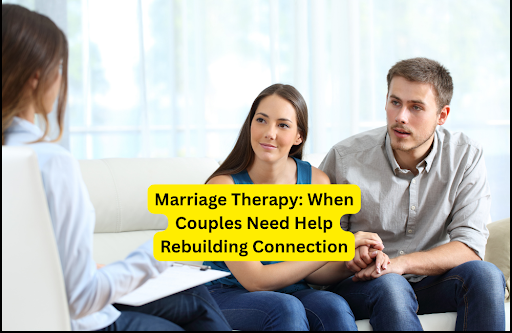
Marriage therapy gives couples a structured place to address conflict, communication problems, emotional distance, trust concerns, and other relationship difficulties with the guidance of a trained mental health professional. It is not limited to couples on the verge of separation; many partners seek therapy because they want to understand recurring patterns, improve how they communicate, or strengthen a relationship that has become difficult to navigate on their own.
Every long-term relationship develops patterns.
Some are healthy: partners learn how to disagree, repair misunderstandings, support one another, and make decisions together. Others become destructive. A disagreement about money turns into an argument about respect. A conversation about parenting becomes a fight about old resentments. One partner pursues a discussion while the other shuts down, and both leave feeling unheard.
When the same pattern repeats often enough, the original subject may stop being the real problem.
Marriage therapy can help couples identify what is happening beneath those repeated interactions and work toward a different way of responding to one another.
What Is Marriage Therapy?
Marriage therapy is a form of relationship-focused psychotherapy designed to help partners understand and change difficulties within their relationship.
Although the term “marriage therapy” suggests that couples must be legally married, that is not necessarily the case. Similar therapeutic approaches can be used with engaged couples, unmarried partners, and people in long-term relationships.
The therapist does not simply act as a referee who decides which person is right.
Instead, therapy can provide a structured environment where both partners have an opportunity to describe their experiences, recognize patterns, understand emotional needs, and practice more productive ways of interacting.
The exact approach depends on the therapist’s training, the couple’s circumstances, and the goals established during treatment.
When Is Marriage Therapy Worth Considering?
There is no single point at which a couple “should” enter therapy.
Some couples seek help after a major event, such as infidelity, separation discussions, or a serious breach of trust. Others come in because they have gradually stopped communicating effectively.
Common reasons include:
- Frequent arguments that never seem resolved
- Emotional disconnection
- Difficulty expressing needs
- Repeated criticism or defensiveness
- Loss of intimacy
- Infidelity or concerns about trust
- Disagreements about money
- Parenting conflicts
- Problems involving extended family
- Different expectations about the relationship
- Repeated arguments about the same subject
- Difficulty recovering after conflict
- Major life transitions
- Uncertainty about whether to remain together
Therapy can also be appropriate when there is no major crisis.
A couple might simply notice that conversations have become transactional, affection has declined, or they no longer feel like a team. Addressing those changes early can be different from waiting until resentment has accumulated for years.
The Problem May Be the Pattern, Not the Argument
One of the most useful ideas in couples therapy is that recurring arguments often have a predictable structure.
Consider a common cycle.
One partner feels ignored and raises the issue more forcefully. The other feels criticized and withdraws. The withdrawal makes the first partner feel even more abandoned, so the pursuit becomes stronger. The second partner withdraws further.
Eventually, both partners may believe the other person is causing the problem.
A therapist can help the couple step back and identify the cycle itself.
That shift can be significant. Instead of asking, “Who started this?” the couple can begin asking, “What happens between us when we feel threatened, rejected, criticized, or disconnected?”
Once the pattern is visible, there is something specific to work on.
Communication Is More Than Learning to Talk
Couples are often told they have a “communication problem.” That description is sometimes too broad to be useful.
The issue may not be a lack of communication. Some couples communicate constantly but continue misunderstanding each other.
Healthy communication involves several skills:
- Expressing a concern without turning it into an attack
- Listening without immediately preparing a rebuttal
- Asking for clarification rather than assuming intent
- Recognizing the emotion underneath an argument
- Describing personal experience instead of assigning motives
- Knowing when a conversation needs a temporary pause
- Returning to an unresolved issue rather than avoiding it indefinitely
- Repairing after saying something hurtful
Marriage therapy can give couples an opportunity to practice these skills while discussing real problems.
That is different from simply reading communication advice online. The therapist can observe how the couple interacts and help identify what happens in the moment when communication breaks down.
Emotional Safety and Relationship Boundaries
Boundaries are another important part of relationship health.
A boundary is not necessarily a demand that separates partners. In a healthy relationship, boundaries can clarify expectations around privacy, personal time, finances, family involvement, communication, physical affection, and other areas of shared life.
Problems can arise when boundaries are unclear or repeatedly ignored.
One partner may expect constant contact while the other needs more individual space. A spouse may feel pressured to accept frequent involvement from extended family. Partners may have different expectations about financial decisions or time spent with friends.
Therapy can help couples discuss those differences without turning every disagreement into a judgment about character.
The objective is not for partners to have identical needs.
It is to develop agreements that respect both people’s legitimate needs while maintaining the relationship.
Rebuilding Trust After Infidelity
Infidelity can change the emotional landscape of a relationship almost immediately.
The injured partner may experience anger, grief, confusion, insecurity, or persistent questions. The partner who had the affair may experience guilt, defensiveness, shame, or uncertainty about how to repair the damage.
Trust cannot usually be restored simply by saying, “It will never happen again.”
Rebuilding trust requires behavior that consistently supports safety and reliability over time.
Depending on the circumstances, therapy may address disclosure, accountability, boundaries, communication, emotional injury, and the conditions that contributed to the breakdown of the relationship.
Importantly, marriage therapy should not pressure someone to forgive quickly or remain in a relationship that is unsafe.
The decision to repair a relationship belongs to the people involved.
What About Intimacy Problems?
Physical intimacy and emotional intimacy are closely connected for many couples, but they are not the same thing.
A decline in sexual intimacy can be related to relationship conflict, stress, resentment, childbirth, health changes, medication, body-image concerns, trauma, mismatched expectations, or many other factors.
Similarly, a couple can maintain a sexual relationship while feeling emotionally disconnected.
Therapy can provide a place to discuss sensitive subjects that partners may avoid bringing up directly.
The therapist may help distinguish between the immediate complaint and the broader relationship dynamics surrounding it. When appropriate, couples may also need medical or specialized sexual-health support alongside relationship therapy.
What Happens During Marriage Therapy?
There is no universal script for couples therapy.
An initial session commonly involves learning about the relationship, understanding why the couple is seeking help, discussing relevant history, and identifying goals.
The therapist may ask about:
- How the relationship began
- Major changes or transitions
- Current sources of conflict
- Previous attempts to solve the problem
- Communication patterns
- Family and relationship history
- Individual concerns affecting the relationship
- What each partner hopes will change
Later sessions may involve discussion, therapeutic exercises, communication practice, emotional exploration, or other interventions appropriate to the therapist’s approach.
Some sessions may feel productive and hopeful.
Others may bring difficult emotions to the surface.
That does not automatically mean therapy is failing. Meaningful relationship problems often involve uncomfortable subjects that have been avoided for a long time.
How Long Does Marriage Therapy Take?
There is no reliable number of sessions that applies to every couple.
A couple working on a relatively specific communication issue may have different needs from partners dealing with years of resentment, repeated infidelity, trauma, or the possibility of separation.
Treatment length can depend on:
- The complexity of the relationship problems
- How long the pattern has existed
- Whether both partners participate consistently
- The goals established in therapy
- Progress between sessions
- Additional mental health or personal issues
- The therapeutic approach being used
Some couples may work toward a focused goal over a shorter period. Others may benefit from longer-term therapy.
A responsible therapist should be able to discuss treatment goals and progress rather than treating an arbitrary number of sessions as a guarantee.
Does Both Partners Have to Attend?
Ideally, couples therapy involves both partners, but real relationships are rarely that simple.
One partner may be hesitant, skeptical, or unwilling to attend.
In some situations, individual therapy can still help a person understand their own reactions, boundaries, communication habits, or relationship decisions.
However, individual therapy and couples therapy are not interchangeable.
If the primary goal is changing an interaction between two people, meaningful participation from both partners is generally important.
A therapist can discuss the options when only one person is initially willing to participate.
Choosing the Right Marriage Therapist
The therapist’s qualifications matter, but credentials are only one part of the decision.
Look for a professional who has appropriate training in relationship therapy and can explain their approach clearly.
A useful first conversation can include questions such as:
- What types of couples do you typically work with?
- What therapeutic approaches do you use?
- How do you handle situations where partners disagree about the goals of therapy?
- How do you approach infidelity or trust issues?
- How do you determine whether therapy is helping?
- What happens if one partner is reluctant to participate?
- How frequently do you recommend sessions?
- What are your fees and cancellation policies?
You should also pay attention to how the therapist handles disagreement during the consultation.
Couples need someone who can remain balanced and attentive without pretending that every situation is perfectly symmetrical.
When Marriage Therapy May Not Be the Right First Step
Couples therapy is not appropriate for every circumstance.
If there is current physical violence, coercive control, serious intimidation, or another situation where one partner cannot safely speak freely, standard couples therapy may not be the appropriate starting point.
Individual safety planning and specialized professional support may be more appropriate.
Similarly, a relationship problem may sometimes be strongly influenced by an individual mental health condition, substance misuse, medical issue, or other concern that requires additional treatment.
A skilled therapist should be able to recognize when couples work needs to be supplemented with individual or specialized care.
What Couples Can Do Between Sessions
The work does not stop when the session ends.
Small changes between appointments can reveal whether the couple is actually applying what they discuss in therapy.
Partners might practice:
- Having difficult conversations when neither person is already overwhelmed
- Using specific examples instead of broad accusations
- Taking agreed-upon breaks during escalating arguments
- Following through on clearly stated commitments
- Scheduling intentional time together
- Expressing appreciation without attaching a request to it
- Revisiting unresolved discussions instead of silently accumulating resentment
The goal is not to turn the relationship into a therapy assignment.
It is to create new experiences that gradually replace the old pattern.
Marriage Therapy at Seeking Therapy
Seeking Therapy provides relationship-focused counseling for couples who want professional support with communication, conflict, emotional connection, and other relationship concerns.
The practice approaches couples therapy as more than choosing sides in an argument. The focus is on understanding the interaction between partners and helping them develop healthier ways to respond to one another.
Depending on the circumstances, therapy may address attachment patterns, boundaries, emotional connection, communication, trust, intimacy, and recurring conflict.
Seeking Therapy serves couples in the San Diego and Chula Vista area and provides an opportunity for prospective clients to discuss their concerns before beginning treatment.
The right starting point is a conversation about what is actually happening in the relationship—not a predetermined assumption about what the couple “needs.”
A Useful Way to Decide Whether to Start
If you are considering marriage therapy, begin with the problem you can identify rather than trying to diagnose your entire relationship.
Ask yourself:
What keeps happening that we cannot resolve on our own?
Then ask:
What would need to change for this relationship to feel healthier?
The answers may point toward communication work, rebuilding trust, setting boundaries, addressing emotional disconnection, improving intimacy, or making a difficult decision about the future.
You do not need to wait until your relationship reaches a breaking point to seek help.
You also do not need to decide before the first appointment whether the relationship will last forever.
A productive first step is simply gaining a clearer understanding of the pattern you are experiencing and determining whether a trained therapist can help both partners move forward.