

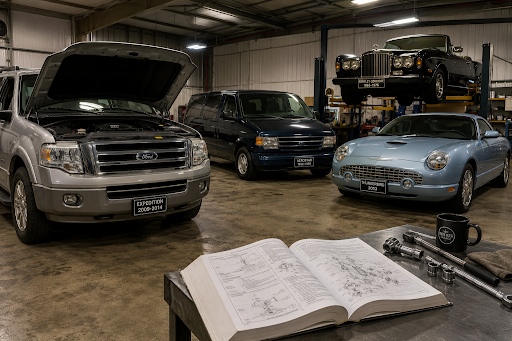
For enthusiasts who would rather understand their vehicle than simply hand over the keys, DownloadWorkshopManuals can be a valuable reference point when maintaining older vehicles. In 2026, modern classics occupy a particularly appealing middle ground: they have enough electronic equipment to feel contemporary, but many still retain mechanical systems that a capable owner can inspect, service, and repair at home.
The attraction is especially strong with vehicles built before diagnostic electronics became completely dominant. A good example is the Ford Expedition 2009-2014, whose 5.4-litre Triton V8 gives experienced DIY mechanics plenty of conventional mechanical work to get involved with. Having accurate workshop information matters, however, because procedures involving timing components, ignition systems, torque settings, and electrical diagnostics should never be approached by guesswork.
Is the Ford Aerostar easy to work on?
Yes, the Ford Aerostar is generally considered approachable for hands-on maintenance, particularly because its older mechanical layout and shared Ford components make many routine jobs relatively straightforward. The Ford Aerostar 1986-1997 was offered with several engines, including the 2.3-litre Lima four-cylinder and 3.0-litre and 4.0-litre Cologne V6 engines, depending on model year.
For a DIY owner, the 4.0-litre OHV V6 is particularly interesting because it is mechanically familiar rather than heavily dependent on modern turbocharging and complex emissions hardware. Oil and filter changes, spark plugs, belts, cooling-system maintenance, brake work, and many sensor replacements can be tackled with sensible preparation and the correct tools.
The Ford Aerostar 1986-1997 also illustrates why workshop documentation remains useful for older vehicles. Even a relatively simple repair becomes easier when the owner has access to wiring diagrams, component locations, tightening specifications, adjustment procedures, and diagnostic information rather than relying solely on online forum advice.
Why the Ford Expedition 2009-2014 remains a DIY-friendly modern classic
The Ford Expedition 2009-2014 is an excellent example of a large SUV that can still reward an owner who enjoys mechanical work. Its 5.4-litre Triton V8 and six-speed automatic drivetrain are substantially more complex than the powertrains found in older classics, but they remain serviceable with the appropriate equipment and technical information.
This is where the Ford Expedition 2009-2014 Workshop Repair Manual becomes particularly useful. A vehicle of this size has numerous systems working together, from electronic throttle control and variable camshaft timing to ABS, four-wheel-drive components, and electronically controlled transmission functions.
Routine maintenance is still within the reach of a competent home mechanic. Engine oil and filter replacement, air-filter servicing, battery replacement, brake inspection, fluid checks, belt inspection, and many suspension-related jobs can be handled without specialist workshop machinery.
The important distinction is knowing where DIY maintenance ends and professional diagnosis begins. A complex electrical fault or internal engine problem may require scan equipment and specialist experience, but having detailed workshop procedures can make the initial diagnosis considerably more informed.
What engine does the 2003 Thunderbird have?
The 2003 Ford Thunderbird uses a 3.9-litre DOHC V8 producing 280 horsepower and 286 lb-ft of torque, paired with a five-speed automatic transmission and rear-wheel drive.
The 2003 Ford Thunderbird is particularly appealing as a modern classic because its mechanical character sits between traditional American cruising and contemporary technology. The 3.9-litre V8 is compact compared with older big-block engines, yet its double-overhead-cam design and variable valve timing give it a distinctly modern engineering approach.
For DIY enthusiasts, that combination makes the Thunderbird interesting rather than intimidating. Basic servicing can still involve familiar procedures, while the engine’s electronic controls encourage owners to develop better diagnostic skills. The five-speed automatic and rear-wheel-drive layout also make the car easier to understand mechanically than many newer vehicles where drivetrain components are buried beneath extensive packaging.
The 2003 Ford Thunderbird’s limited production era also gives it an advantage for enthusiasts looking for something different. It looks unmistakably retro, but the underlying engineering is modern enough to make it usable as an everyday classic rather than a fragile weekend-only collector car.
Bentley Corniche 1965-1976: when DIY means craftsmanship
The Bentley Corniche 1965-1976 represents a completely different kind of ownership experience. It is not a vehicle for beginners, but for a mechanically skilled enthusiast, its older construction provides an extraordinary opportunity to understand how a luxury car was engineered before modern electronic systems took over.
The Bentley Corniche was powered by a 6,750cc V8 in its later years, using an OHV layout and Bosch fuel injection. The car also featured sophisticated self-levelling suspension and power-assisted disc brakes, demonstrating that “old” does not necessarily mean mechanically simple.
This is precisely why documentation is so important when working on a Bentley. A minor mistake involving hydraulic systems, suspension components, fuel injection, or adjustment procedures can become an expensive problem. The correct technical information transforms DIY work from experimentation into controlled maintenance.
The Bentley Corniche 1965-1976 also rewards patience. Owners restoring one today are often dealing with decades-old seals, hoses, electrical connections, fasteners, and hand-built components. The objective is not simply to make the car run; it is to preserve its original engineering while carefully returning worn systems to proper condition.
Why workshop manuals matter more in 2026
Modern classics occupy an unusual position in the automotive world. They are old enough to be mechanically accessible but new enough to contain sensors, electronic control modules, fuel-injection systems, and computer-controlled transmissions.
That makes accurate technical information more important than ever. A workshop manual can provide the difference between replacing a component unnecessarily and identifying the actual source of a fault. It can also give owners specifications that are difficult to determine through visual inspection alone.
For vehicles such as the Ford Expedition 2009-2014, this is particularly valuable because the 5.4-litre V8 combines traditional engine architecture with sophisticated electronic management. For older vehicles such as the Ford Aerostar 1986-1997, detailed information can make straightforward mechanical work faster and more accurate.
The same principle applies to the Bentley Corniche 1965-1976. Older luxury cars can contain systems that are unfamiliar to modern technicians, so historical workshop procedures are often just as important as modern diagnostic knowledge.
The best modern classics are the ones you can understand
The appeal of a DIY-friendly modern classic is not simply saving money. It is the satisfaction of knowing how the machine works and being able to diagnose problems before they become expensive failures.
The Ford Aerostar 1986-1997, Ford Expedition 2009-2014, 2003 Ford Thunderbird, and Bentley Corniche 1965-1976 all demonstrate different sides of that philosophy. One is a practical van, another a full-size SUV, another a retro luxury cruiser, and the last a hand-built grand tourer.
In 2026, the smartest enthusiast does not necessarily choose the newest vehicle. Sometimes the better choice is the one with accessible mechanical systems, abundant technical knowledge, and enough character to make every repair worthwhile. With the right tools, patience, and reliable workshop information, these modern classics can remain on the road for many more years — and owners can still have the pleasure of fixing them themselves.