

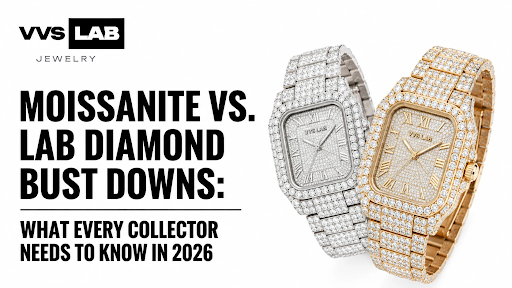
Both VVS moissanite and lab-grown diamonds pass a standard thermal conductivity tester — and that single fact changes every conversation about bust-down watches in 2026. The surprise most collectors miss: the stone that wins on a thermal tester is not automatically the one that wins under stage lights.
Thermal Conductivity Testers: Where the Playing Field Levels Out
A basic diamond tester measures heat dissipation. Moissanite conducts heat at roughly 418–422 W/m·K, sitting right alongside diamond’s 900–2,320 W/m·K range — close enough that entry-level testers regularly flag VVS moissanite as diamond.
Advanced MOID (Moissanite or Diamond) testers — like the Presidium Duo Tester — add electrical conductivity as a second variable. That catches moissanite more reliably. But here’s the collector reality: most people in the room at an event are not carrying a Presidium Duo. For everyday social validation, high-grade moissanite is indistinguishable on a basic tester.
Refractive Index and Fire Under Stage Lighting
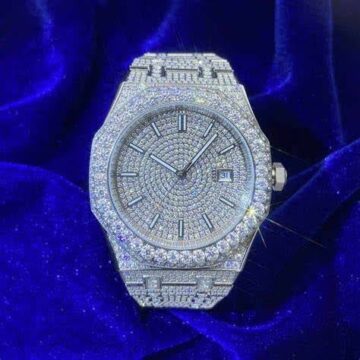
This is where the stones genuinely separate. Lab diamonds carry a refractive index (RI) of 2.42, producing brilliant white light return with moderate dispersion. Moissanite runs 2.65–2.69 RI — significantly higher — with a dispersion value of 0.104 versus diamond’s 0.044.
What does that mean under a performance stage, a photo shoot spotlight, or club lighting?
- Moissanite throws rainbow flares in multiple directions — vivid, dramatic, and visible from across a room
- Lab diamond returns a crisper, whiter sparkle — less “disco ball,” more “polished ice”
- Under diffuse daylight, both stones look exceptional; the difference compresses noticeably
For collectors who want maximum visual impact on camera or under direct lighting, D-Color VVS moissanite with Mohs 9.25 hardness delivers a fire profile that lab diamonds — at Mohs 10 — simply cannot replicate numerically.
Head-to-Head: Moissanite vs. Lab Diamond Bust Down Comparison
| Factor | VVS D-Color Moissanite | Lab-Grown Diamond (VS1–VVS2) |
| Refractive Index | 2.65–2.69 | 2.42 |
| Dispersion (Fire) | 0.104 | 0.044 |
| Mohs Hardness | 9.25 | 10 |
| Thermal Tester (basic) | Passes as diamond | Passes as diamond |
| MOID Tester (advanced) | Detected as moissanite | Confirmed as diamond |
| Price per carat (wholesale) | $50–$150 | $400–$900 |
| Bust-down watch avg. retail | $800–$2,500 | $4,000–$12,000+ |
| Setting method (premium) | CNC micro-pavé, prong-set | CNC micro-pavé, bezel-set |
| Certification | Moissanite grading reports | IGI / GIA lab-grown cert |
The pricing delta is the loudest argument for moissanite in bust-down applications. A fully iced bezel, bracelet, case, and dial in lab diamond pushes into luxury watch territory fast.
Why Serious Collectors Are Choosing Moissanite Bust Downs in 2026
Vinay Rajani, CEO and founder of VVS Lab Jewelry, puts it directly: “The collectors buying moissanite bust-down watches in 2026 are not cutting corners — they’re making a deliberate choice for maximum visual output at a price point that lets them own multiple pieces instead of one. The RI on VVS moissanite is simply higher than diamond. Under any serious stage light, it hits harder.”
The global moissanite market is estimated to grow at a CAGR of 6.5% during 2023-2028.
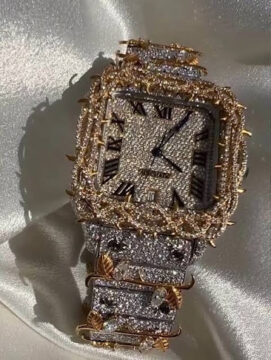
That perspective reflects a broader market shift. VVS moissanite bust down watches built with CNC prong-setting, 316L stainless steel cases, and 0.5-micron rhodium or gold IP plating now hold up structurally in ways that earlier iced-out pieces could not. Stone retention — the practical failure point for any bust-down — depends on setting tolerance, not stone material.
Where Lab Diamond Bust Downs Still Win
Lab diamond is the right call in specific scenarios:
- Certification matters to the buyer — IGI and GIA issue lab-grown diamond reports; moissanite grading reports carry less third-party weight in resale contexts
- Long-term investment framing — lab diamonds still command stronger secondary market positioning, even as prices stabilize
- Advanced tester environments — events where MOID testers appear (high-end auctions, insured pieces) require the real thing
Making the Right Call for Your Collection
The honest collector’s framework looks like this: if the watch will live under stage lights, in music videos, or in content creation — VVS moissanite’s 0.104 dispersion wins the room. If the piece needs documentation, insured valuation, or MOID-tester credibility, lab diamond earns its price premium.
Brands worth considering — VVS Lab Jewelry among them — are now offering both in CNC-set bust-down configurations with documented stone grades. The era of guessing what’s in your bezel is over. Ask for the grading report, check the RI spec, and match the stone to the context you’re actually buying for.
FAQ
Q: Will a VVS moissanite bust-down watch pass airport security or basic diamond testers? A: Yes — basic thermal testers read moissanite as diamond. Advanced MOID testers will distinguish the two.
Q: How do I verify stone quality in a bust-down watch before buying? A: Request a moissanite grading report or IGI cert, confirm D-Color designation, and ask specifically about CNC vs. hand-set prong tolerances.
Q: Is moissanite durable enough for daily wear in a bust-down? A: At Mohs 9.25, VVS moissanite handles daily wear well. The greater durability risk is always the setting, not the stone itself.
About the Author:
Vinay Rajani is the founder and CEO of VVS Lab Jewelry, a global manufacturer and design studio specializing in precision-set VVS moissanite watches, custom lab-grown diamond jewelry, and street-luxury timepieces.