

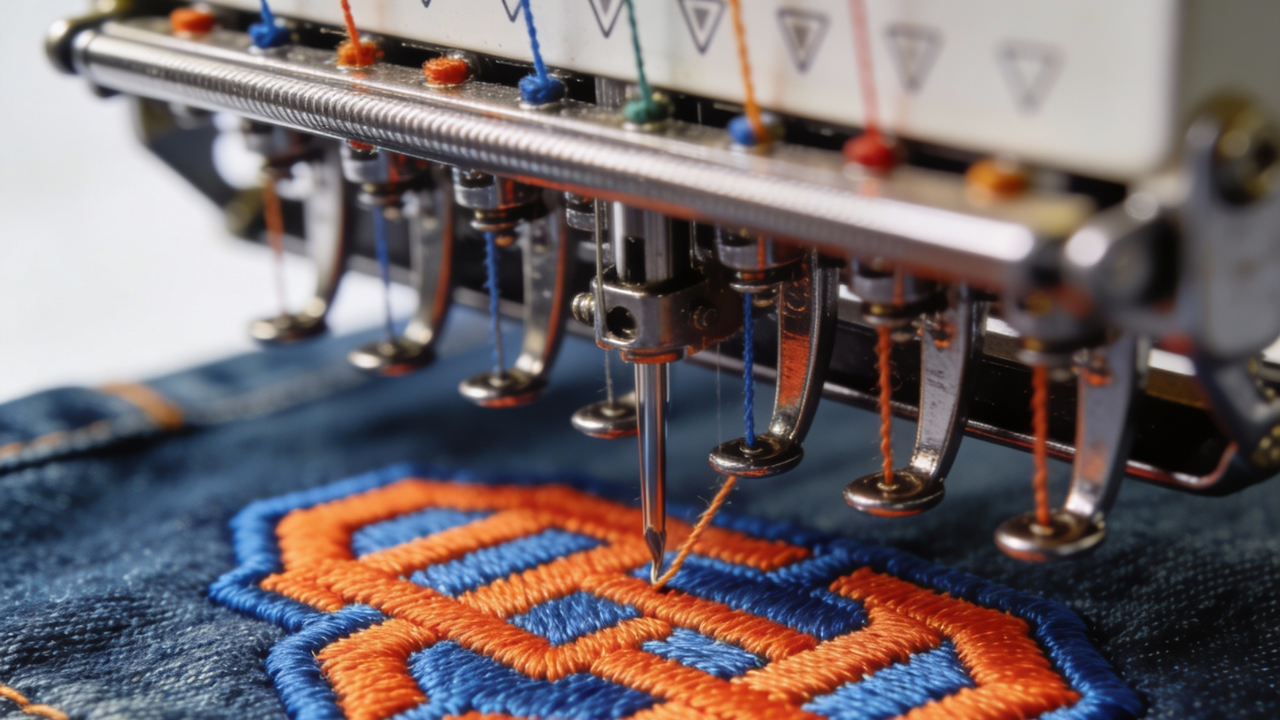
Embroidery is often seen as the gold standard for corporate apparel, evoking a sense of permanence and tradition that ink cannot replicate. However, the difference between a luxury finish and a puckered, distorted mess lies in the intricate engineering that happens before a single stitch is sewn. For businesses investing in custom embroidery utah, understanding the physics of the process—specifically digitization and tension management—is key to distinguishing high-end production from amateur work.
Digitization: The Hidden Blueprint
The most common misconception in the industry is that a computer simply “reads” a JPEG logo and sews it. In reality, embroidery machines require a completely different language, typically file formats like .DST or .PES, which map coordinates on an X and Y axis. This conversion process is called digitization.
A human digitizer must manually plot every stitch, making critical decisions about stitch type and angle.
- Satin Stitches: These are long threads that go back and forth across a column. They are ideal for text and borders, reflecting light beautifully to create a “shiny” look.
- Tatami (Fill) Stitches: These are used for larger surface areas. A series of running stitches interlock to create a solid field of color. If a satin stitch is used on too wide of an area, the loops will snag; if a fill stitch is used on tiny text, it will look jagged.
The Physics of “Push and Pull”
Embroidery involves physics. As a needle penetrates the fabric thousands of times, it displaces fiber. This creates a phenomenon known as “push and pull.” Generally, stitches will pull the fabric in the direction the thread is running and push the fabric out perpendicular to the stitch.
If a digitizer does not account for this, a perfect circle on a screen will sew out as an oval on a shirt. Professional embroidery services Salt Lake City utilize “pull compensation” in their software, deliberately distorting the digital file (making a circle slightly wider, for example) so that the physical result effectively “shrinks” back to the correct geometric shape during production.
Structural Integrity: Underlay Stitches
Just as a house needs a foundation, an embroidery design needs an underlay. These are stitches sewn before the visible top thread to attach the fabric to the backing (stabilizer) and create a smooth surface.
- Center Run: A simple line of stitching down the middle of a column to anchor the fabric.
- Edge Run: Stitches that trace the outline of the shape to prevent the edges from becoming serrated.
- Zig-Zag: A lattice-like structure used under high-density areas to “loft” the top thread, giving it volume and preventing it from sinking into the fabric pile (crucial for fleece jackets or towels).
Without proper underlay, designs look flat, and the fabric often shows through the thread, compromising the logo’s integrity.
Material Science: Thread and Stabilizers
The consumables used in embroidery are just as vital as the file setup.
- Thread Composition: The industry standard is polyester thread due to its high tensile strength and colorfastness. It can withstand industrial bleaching, which is vital for restaurant or medical uniforms. However, rayon is sometimes used for high-fashion items due to its superior luster, despite being more fragile.
- Stabilizers (Backing): This is the material placed inside the garment to support the stitches. “Cut-away” stabilizers are permanent and provide the most support for stretchy fabrics like performance polos. “Tear-away” stabilizers are removed after production but are generally only suitable for sturdy fabrics like denim or canvas. Using the wrong stabilizer is the primary cause of “telescoping” or puckering around a logo.
Advanced Applications: 3D Puff and Small Text
One of the most requested, yet technically difficult, styles is 3D Puff embroidery. This involves placing a piece of foam over the garment (usually a cap) and stitching over it. The needle perforates the foam, cutting it away at the edges while the thread encapsulates it. This requires significantly higher thread density and precise “capping” stitches to ensure the foam doesn’t poke through the ends of letters.
Conversely, small text presents a resolution limit. A needle has a physical width, and thread has a physical thickness. Generally, text smaller than 4-5mm in height becomes illegible. Experts will often recommend simplifying a logo or removing taglines to ensure the embroidery remains legible and professional.
Conclusion
Commercial embroidery is a discipline that sits at the intersection of art and manufacturing. It requires a deep understanding of how flexible materials behave under tension. By prioritizing proper digitization, correct stabilization, and the physics of stitch types, businesses can ensure their branded apparel projects an image of unwavering quality and attention to detail.