

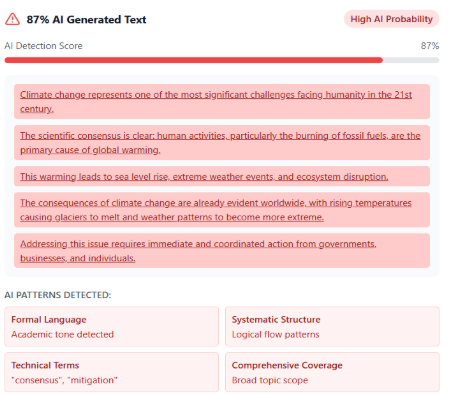
In today’s digital age, writers and students must guard against plagiarism and ensure every word they create is authentic. Tools like an AI plagiarism checker and other plagiarism detection tools scan writing to catch copied or AI-generated passages. With advanced language models (e.g., ChatGPT, GPT-4, Gemini) churning out fluent prose, distinguishing original work from borrowed text is more challenging than ever. This is why onlineplagiarism check services have become essential for writers. They instantly cross-reference your draft against billions of web sources, flagging similarities and even pinpointing likely AI-written sections to uphold content integrity.
For students in particular, protecting academic integrity is paramount. Stanford University notes that instructors frequently use tools like Turnitin, Unicheck, and Grammarly to cross-check submissions against vast databases. Today’s plagiarism checkers often incorporate content originality checker features and even basic AI-detection flags, although capabilities vary widely. To avoid unintentional plagiarism, writers should run their work through a trusted tool. A robust [AI content detector] or plagiarism scanner will highlight any matching text and its sources, giving you a similarity percentage so you can rewrite or cite as needed.
Why Content Integrity Matters for Writers and Students
Maintaining content integrity is about more than avoiding academic penalties; it builds credibility and trust. Whether you’re crafting a research paper or a blog post, original ideas and proper citations demonstrate professionalism. Tools like plagiarism checkers act as an academic integrity tool, reinforcing the habit of giving credit where due. For example, Grammarly’s AI-powered checker promises to help students “express [their] thoughts in a way that’s clear, original, and full of academic integrity.” Instructors and editors look for unique insight and style; plagiarism flags or high similarity scores can raise red flags about your work.
- Preserves Reputation: Citing and paraphrasing correctly shows you respect others’ work and avoid messy accusations.
- Builds Trust: Professors, publishers, and readers trust content that’s verified original. It shows you have done your own research.
- Supports Learning: By avoiding copied material, students engage more deeply with the subject and improve their writing skills.
- Enhances Credibility: Original content ranks better in search engines and reflects positively on businesses and writers.
Ultimately, employing plagiarism detection tools and [content originality checker] software helps everyone focus on creativity and learning, not on sourcing mistakes or accidental duplication.
How Plagiarism Checkers and AI Detectors Work
Plagiarism checkers use sophisticated algorithms to compare your text against massive databases of books, articles, papers, and web pages. When you run your document through one, it highlights any matching snippets and reports how much of your content overlaps with existing sources. For example, industry analysis notes that plagiarism checkers typically scan the submitted text against billions of online works and assign a similarity score for each match. This allows you to quickly see which sentences need citations or rewording.
Modern detection tools also analyze writing style for signs of machine generation. An [AI content detector] examines factors like perplexity (predictability of words), burstiness (variation in sentence structure), and tone consistency. These signals can reveal if text was more likely written by an AI rather than a human. In fact, GPTZero’s creators explain that their system considers hundreds of linguistic features to flag AI-generated passages. No tool is perfect, but combining plagiarism algorithms with AI detection gives the best chance to ensure your writing is truly original.
Key steps performed by these checkers include:
- Database Matching: The tool cross-references your content against web pages, academic journals, and books to detect copied text.
- Pattern Analysis: AI detectors scan your writing style for “tells” of generated text (e.g., uniform sentence length, lack of narrative unpredictability).
- Sentence-Level Detection: Advanced checkers can highlight exactly which sentences are flagged as suspicious, helping you pinpoint issues.
- Reporting: You get a clear report with percentage similarity, matched sources, and often suggestions for citations.
By understanding how these systems work, writers can use them effectively, correcting flagged areas and learning to paraphrase and cite properly.
Key Features to Look for in a Plagiarism Detection Tool
Not all checkers are created equal. When choosing a [plagiarism detection tool] or content checker, consider these essential features:
- Extensive Coverage: The scanner should search both internet content and academic databases. Turnitin, for example, is known for its deep academic database, while web-based tools compare against countless online sources.
- AI Detection Capability: As generative AI becomes common, pick a tool that explicitly identifies AI-generated content. Leading platforms now support models like GPT-4. Claude, Gemini, and more
- Accuracy and Low False Positives: A good checker balances sensitivity with accuracy. Originality. ai reports 86–99% plagiarism detection accuracy and very low false positives using advanced models.
- Real-time Analytics: Look for features like sentence-by-sentence highlighting and shareable reports to certify content authenticity. Some detectors even offer public links so others can verify your results.
- Language and File Support: Check that the tool handles multiple languages and file types (PDF, DOCX, etc.).
- Integration and Usability: Tools that integrate with writing apps, learning management systems, or browsers streamline the process. Easy copy-paste interfaces and clear dashboards make checks painless.
For example, Plagly.ai’s platform uses advanced graph-based AI models to achieve around 99% accuracy in spotting AI content and provides multi-layer detection visualizations. It also offers real-time scanning and humanization options. When evaluating any service, run a test with known content to see how well it flags copied or AI-generated passages.
Top Tools for Plagiarism and AI Content Checking
A variety of specialized tools exist to help writers and students check originality. For instance, Plagly.ai is a free platform that combines an AI-powered plagiarism checker and content detector. It scans your text against billions of sources and identifies any AI-generated segments (claiming 96% overall detection accuracy). Grammarly is another popular choice: beyond grammar, it includes an AI-driven plagiarism detector for writing assignments. According to Grammarly, you can “instantly find plagiarism by pasting or uploading your essay” to compare against web content, along with an originality score.
In academia, Turnitin remains the gold standard. It offers multiple tools (Similarity, iThenticate) specifically for student papers and research and now advertises AI-writing detection as part of its suite. Its vast repository of academic work means it often catches matches others miss. Other notable tools include Copyscape (web content focus) and Originality.ai (tailored to publishers), which both provide detailed similarity reports.
For specifically detecting AI-written text, dedicated detectors have emerged. GPTZero is widely used in education; independent tests show it’s highly accurate (around 99% in spotting AI vs. human text). Similarly, Zero GPT offers a free AI-content scan. Industry reviews (Zapier) found ZeroGPT “above average” overall, though it sometimes struggles with ChatGPT text Newer services like Winston AI, Sapling, and Copyleaks also blend plagiarism and AI-checking features. In short, the best practice is often to run your writing through more than one tool to cover all bases.
- Plagly.ai : A free AI plagiarism checker and content authenticity tool. It provides both plagiarism and AI-detection in one dashboard.
- Grammarly: Well-known for grammar help, its plagiarism detector checks work against billions of sources. The premium plan also flags AI use.
- Turnitin: An Academic-focused checker with an enormous database of student papers and publications. Now includes AI-writing detection for classrooms.
- Originality.ai: Designed for publishers and marketers, with high accuracy in both plagiarism and AI detection.
- ZeroGPT: Free online AI content detector; Zapier notes it performs well overall but may miss some ChatGPT passages.
- GPTZero: Advanced AI-detector used by educators. Tests rate it as extremely reliable, with near-perfect detection accuracy.
- Humanizing tool: QuillBot’s AI Humanizer (and similar services) rewrites AI-generated sentences to sound more natural and varied. These help mask AI “tells” by adding human-like flair.
- Paraphrasing tools and AI-powered rewriters (Plagly’s paraphrasing feature, QuillBot, etc.) can instantly rephrase text while preserving meaning. By changing wording creatively, they can eliminate accidental plagiarism.
Each of these tools has strengths; using a combination (for grammar, plagiarism, and AI checking) gives the most confidence. Many are available in free tiers for students, with premium options for more frequent use or longer documents.
Enhancing Authenticity: Paraphrasing and Humanizing Tools
Beyond detection, writers can proactively avoid plagiarism by rephrasing ideas in their own words. AI paraphrasing tools are one way to do this. For example, Plagly.ai offers paraphrasing features “to rewrite your content while maintaining its original meaning,” explicitly helping users improve writing and avoid unintentional plagiarism. QuillBot’s paraphraser is another popular choice: it uses AI to replace words and restructure sentences “without changing [the] meaning or context,” effectively acting like a sophisticated thesaurus.
In addition, humanizing tools help make AI-drafted text sound natural. QuillBot’s AI Humanizer, for instance, takes content written by models like ChatGPT or Claude and refines it to be more engaging and less robotic. It’s “trained on tens of thousands of human texts” to remove the common AI “tells” (e.g. repetitive phrasing) and produce an authentic tone. Using such tools can smooth out dry or formulaic AI output, helping your final draft read as if a real person wrote it.
- Edit and Rerun: After running a draft through an AI detector, use a paraphrasing tool on flagged sentences to rewrite them.
- Refine Tone: Apply a humanizer on AI-generated sections so the language flows naturally (adding contractions, examples, or personal touches).
- Iterate: Check the humanized text again for originality. You may need multiple passes to balance meaning and uniqueness.
- Cite as Needed: Even with rewording, always attribute unique ideas. Tools complement good citation practices; they don’t replace them.
By combining these strategies, detection, paraphrasing, and refinement, writers can produce high-quality, plagiarism-free work that reflects their own voice. This proactive approach is especially useful for students who draft with AI assistants: one user tip is “To make it your own, use a paraphrasing tool after writing and then humanize the phrasing.”
Safeguarding Academic Integrity in Practice
For students and educators, these tools are part of a larger commitment to honesty. Many institutions encourage a dual approach: teach proper citation and original writing and use technology as a safeguard. According to educational resources, plagiarism checkers typically allow instructors to see exactly which parts of a paper match other sources. This transparency helps turn any flag into a learning moment. Plagly.ai emphasizes its role for learners: students can use it to “ensure academic integrity and improve your grades with plagiarism-free” writing, while teachers can “verify student submissions for originality and detect AI-generated content.”
- Integrate Checks Early: Run drafts through a plagiarism/AI checker before submitting essays or articles. This helps catch issues early.
- Use as Learning Tools: Detailed reports can show exactly where problems lie, which is a teaching opportunity. For example, a match might be a needed citation.
- Follow School Policies: Instructors are free to set AI use rules (some treat it like unpermitted aid). Always know your course’s policy before relying on AI.
- Multiple Tools: No single checker is perfect. Cross-checking with a couple of different tools can increase confidence.
Remember, checkers should support integrity, not just enforce it. If you receive a plagiarism report, review it calmly: revise appropriately and learn from the feedback. These technologies exist to uphold honest scholarship, so use them responsibly and as part of ethical writing habits.
Frequently Asked Questions
Q: What is an AI plagiarism checker? A: It’s a tool that combines traditional plagiarism scanning with AI-detection algorithms. In addition to matching your text against published works, it analyzes stylistic patterns to flag text likely generated by models like ChatGPT. For example, Plagly.ai and Grammarly now offer such combined checks to help ensure content is both original and human-authored.
Q: Can these tools detect writing from ChatGPT, GPT-4, or Gemini? A: Yes, many modern detectors claim to identify content from top language models. GPTZero, for instance, is specifically built to catch ChatGPT/GPT-4 output and boasts ~99% accuracy in tests. Reviews (Zapier, Originality.ai) note GPTZero performs extremely well, while tools like ZeroGPT perform above average but may miss some ChatGPT text. No detector is perfect, so results should be used carefully.
Q: Are there free plagiarism and AI detection tools for students? A: Absolutely. Plagly.ai is one free option that provides both plagiarism checking and AI-content detection. Other tools like Quetext, Copyleaks (limited uses), and the free tiers of Grammarly/Copyscape can catch plagiarism. For AI detection, free services like ZeroGPT allow occasional checks. These can be great for students on a budget, though premium versions often offer deeper scans for a fee.
Q: How do paraphrasing and humanizing tools help with plagiarism? A: They help by rewriting text in a fresh way. A paraphrasing tool replaces words and structures so that even if you reference a source, you don’t lift exact phrasing. A humanizing tool takes content (often AI-drafted) and tweaks phrasing to add natural variation. Both reduce similarity percentages and make text authentically yours, but you should still cite any ideas you’ve borrowed.
Q: Can I rely solely on these tools for academic integrity? A: No tool is foolproof. Checkers and detectors can catch most copied or AI text, but they may miss cleverly paraphrased content or new AI models. Educational guidelines (Stanford) caution that faculty should use these tools as one aid, not the sole evidence of dishonesty. It’s best to also follow writing best practices: cite sources, quote properly, and be transparent about any AI assistance. Tools complement, not replace, good scholarly habits.
Start using advanced plagiarism and AI checkers today to keep your writing original.
Take Action to Protect Your Content
Wondering how to ensure your next document is 100% original? Start by trying a free AI content detector and plagiarism checker. Plagly.ai offers a comprehensive platform where you can paste or upload text to instantly get both an originality and an AI-written report. Its humanization feature can even reword AI-generated sections on the spot. By integrating such tools into your drafting process, you can confidently produce unique content every time.
Don’t risk unseen plagiarism or unintentional AI usage. Give your writing an extra layer of verification and embrace content integrity. Try Plagly.ai’s free tools now and see the difference in your next paper or article!