

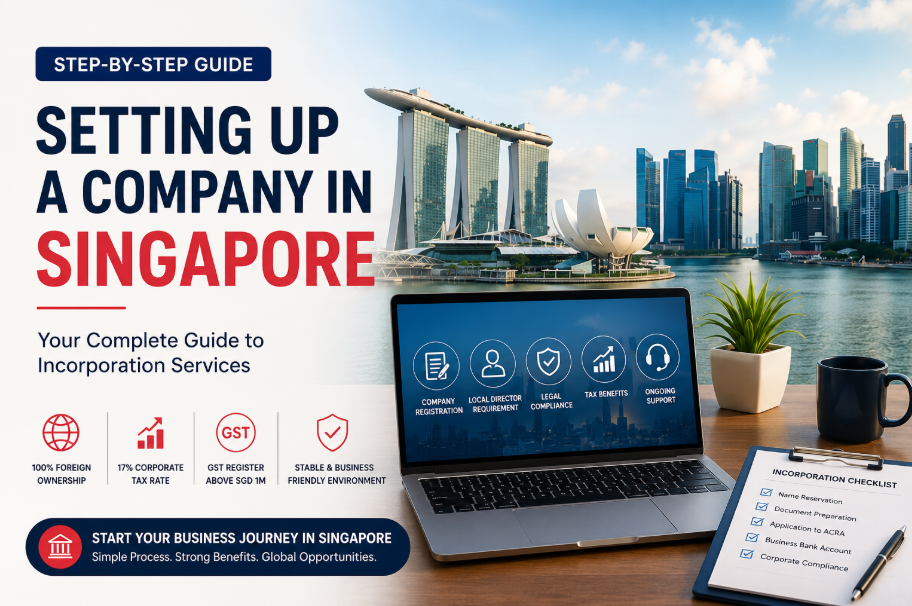
Singapore has held its position as one of the easiest places in the world to start a business, and for good reason. The incorporation process is largely digital, government fees are modest, and the corporate tax environment is genuinely competitive compared to most other major economies. But ease of access does not mean the process is without complexity, particularly for foreign founders who are setting up here for the first time.
This guide covers the core steps, costs, and compliance requirements involved in incorporating a Singapore company. It also explains why Singapore incorporation services offered by experienced corporate service firms continue to be the preferred route for SME owners and overseas entrepreneurs who want the process done correctly from day one.
Why Singapore Remains a Top Choice for Business Setup
The numbers speak for themselves. Singapore consistently ranks among the top global destinations for foreign business investment, supported by a stable legal system, a transparent regulatory framework, and an IRAS tax regime that keeps effective tax rates well below the headline figure for most early-stage companies.
For foreign entrepreneurs in particular, Singapore offers something that few other jurisdictions can match: 100% foreign ownership of a Private Limited Company, with no local partner requirement. You can hold all the shares yourself, whether you are based here or running the business from overseas.
The corporate tax rate sits at a flat 17% on chargeable income. In practice, newly incorporated companies benefit from the Start-Up Tax Exemption (SUTE), which provides a 75% exemption on the first SGD 100,000 of chargeable income and a 50% exemption on the next SGD 100,000 for the first three consecutive Years of Assessment. Budget 2026 also introduced a 40% Corporate Income Tax (CIT) Rebate for YA 2026, automatically applied by IRAS on filing, with active companies that employ at least one local staff member receiving a minimum CIT Rebate Cash Grant of SGD 2,000.
GST registration is only mandatory once your annual taxable turnover exceeds SGD 1 million, so most startups have no GST obligations in their early years.
The Most Common Business Structure: Private Limited Company (Pte Ltd)
Before getting into the steps, it helps to be clear on which structure you are incorporating. For the vast majority of SMEs and startups, the Private Limited Company, registered as Pte Ltd under the Singapore Companies Act, is the right choice.
It offers limited liability, meaning the personal assets of directors and shareholders are protected from the company’s debts. It is a separate legal entity from its owners, can hold assets, enter into contracts, and sue or be sued in its own name. It is also the structure that most corporate banks, investors, and large clients prefer to deal with.
Other structures like sole proprietorships and partnerships exist but carry personal liability and are generally better suited to very small, low-risk operations. Branches and representative offices are options for established foreign companies looking to extend operations here, but for most founders starting fresh, the Pte Ltd is the default.
Key Requirements Before You File
The Accounting and Corporate Regulatory Authority (ACRA) administers all company registrations in Singapore through its BizFile+ portal. Before any application can be submitted, you need to have the following in place.
Company name. The name must be unique and must not contain restricted or sensitive terms. You submit it to ACRA for approval, which costs SGD 15, and the reservation is valid for 120 days once approved.
At least one resident director. Every Singapore company must have at least one director who is ordinarily resident here. This means a Singapore citizen, Permanent Resident, or a foreigner holding a valid EntrePass or Employment Pass with the appropriate approvals from MOM. If you are a foreign founder living outside Singapore and do not yet have a valid pass, you will need to appoint a nominee director to satisfy this requirement.
At least one shareholder. The shareholder can be an individual or a corporate entity, local or foreign. A single person can hold all shares, and foreign shareholders face no ownership restrictions.
Minimum paid-up capital of SGD 1. There is no minimum capital requirement beyond this. That said, if you plan to apply for an Employment Pass as a working director, having a more substantial paid-up capital strengthens the application.
A Singapore registered office address. The address must be a physical, operational location accessible during normal business hours. PO boxes are not accepted.
A company secretary appointed within 6 months of incorporation. The secretary must be a natural person who is a Singapore resident. The sole director of a company cannot simultaneously serve as the company secretary.
The Step-by-Step Incorporation Process
Step 1: Reserve the company name
Submit your proposed company name via BizFile+ and pay the SGD 15 fee. Most names clear within minutes unless the name contains restricted terms that require review by an external government authority, in which case it could take days to weeks.
Step 2: Prepare your incorporation documents
You will need the company constitution (the governing document that sets out the internal rules of the company), signed consents from all directors and shareholders, identification documents, and details of the company’s principal business activity classified under the Singapore Standard Industrial Classification (SSIC) code.
Step 3: Submit the application through BizFile+
Foreign founders cannot file directly on BizFile+ without a SingPass account. They must engage a licensed Corporate Service Provider (CSP) to handle the submission on their behalf. This is an ACRA requirement, not optional. The registration fee is SGD 300. For most standard applications, ACRA processes and approves within 15 minutes to one business day. Applications for regulated industries such as finance, education, or healthcare may be referred to additional government authorities and can take 14 to 60 days.
Step 4: Receive the Certificate of Incorporation and UEN
Once approved, ACRA issues an electronic Certificate of Incorporation and assigns a Unique Entity Number (UEN), which serves as your company’s official identifier for all government transactions, including CPF contributions, IRAS filings, and applications with MOM.
Step 5: Complete post-incorporation setup
This is where many founders underestimate the workload. After incorporation, you need to open a corporate bank account, register for CorpPass (your digital identity for government e-services), file the Register of Registrable Controllers (RORC) within 30 days, and set up your CPF account if you are hiring local staff. If your business involves a regulated activity, check the GoBusiness portal to confirm whether a licence is required before you start operating.
What Does Singapore Company Incorporation Actually Cost?
Government fees from ACRA total SGD 315: SGD 15 for name application and SGD 300 for registration. Beyond that, most founders need to budget for a company secretary (typically SGD 200 to SGD 1,200 per year depending on the provider), a registered office address (SGD 60 to SGD 2,400 per year depending on the arrangement), and a nominee director if applicable (market range approximately SGD 1,200 to SGD 3,600 per year as of 2026).
All-in, a typical first-year setup cost for a foreign founder using a professional service provider falls in the range of SGD 1,500 to SGD 4,000. The variation depends largely on whether a nominee director is needed and which tier of services is selected.
Why Professional Incorporation Services Matter
The BizFile+ portal is efficient, but the process around it is not just a form-filling exercise. Getting the company structure right, identifying the correct SSIC code, drafting an appropriate constitution, and mapping out post-incorporation compliance obligations all require knowledge of how Singapore’s corporate and tax frameworks operate in practice.
This is where Singapore incorporation services provided by established corporate service firms add genuine value. Experienced providers review your situation before filing, identify potential issues with the application, coordinate the nominee director arrangement if needed, and handle everything from name reservation to the issuance of your UEN.
For foreign entrepreneurs managing the setup from overseas, using a professional service also removes the SingPass barrier entirely. A licensed CSP files on your behalf, keeps you informed at each stage, and ensures your company starts life fully compliant.
Singapore incorporation services from an established firm like SH Koh and Partners typically cover company name reservation, preparation of the constitution and statutory documents, submission to ACRA, UEN issuance, and initial corporate secretarial support. For founders who need accounting, payroll, GST registration, or Employment Pass applications on top of incorporation, having one provider handle the full scope simplifies the relationship considerably.
SH Koh has been operating in Singapore since 1984, serving SMEs and startups across incorporation, accounting, bookkeeping, corporate secretarial, tax, payroll, and employment pass services. For a business setting up in Singapore for the first time, that breadth of experience across interconnected services is worth more than a one-off incorporation package from a provider with no capacity to support what comes next.
SH Koh and Partners, with decades of experience in Singapore corporate services, offers the kind of integrated support that means your company is not just incorporated correctly, but managed properly through its first year and beyond.
Frequently Asked Questions
Can a foreigner own 100% of a Singapore company?
Yes. Singapore permits full foreign ownership of a Private Limited Company with no requirement for a local partner or shareholder. The only mandatory local element is at least one resident director, who can be a nominee director provided by a corporate services firm if you do not have a qualifying individual available.
How long does it take to incorporate a Singapore company in 2026?
For standard applications without restricted business activities, ACRA typically processes the registration within 15 minutes to one business day after the fee is paid. Applications for regulated industries such as finance, healthcare, or education may be referred for additional review, which can extend the timeline to between 14 and 60 days.
What are the ongoing compliance obligations after incorporation?
Once incorporated, a company must file its Annual Return with ACRA within seven months of the financial year-end, hold an Annual General Meeting or pass written resolutions in lieu of one, file Estimated Chargeable Income (ECI) with IRAS within three months of the financial year-end, and maintain accurate statutory records. Companies hiring local employees must also make CPF contributions and stay current with MOM requirements.
Is GST registration compulsory for a new Singapore company?
No. GST registration only becomes mandatory once your annual taxable turnover exceeds SGD 1 million. Below that threshold, registration is voluntary. Most startups and early-stage SMEs do not register for GST in their first year of operations.
What is the difference between a company secretary and a corporate secretarial firm?
A company secretary is the individual or firm appointed by the company to handle statutory filings, maintain registers, and ensure compliance with the Companies Act. Every Singapore Pte Ltd must have one appointed within six months of incorporation. A corporate secretarial firm like SH Koh provides this function professionally, managing ACRA filings, AGM paperwork, and shareholder documentation on the company’s behalf.