


It was 11:30 AM on a Tuesday; I was in my office. I am an HR Business Partner who manages everything from employee relations to strategic workplace planning. By night, I convert my professional brain into a student who wrestles with CIPD Level 5 assignments. I did not realise, but my word count went too far: 4,500. While the limit was only 3,900 words.
If you are already a CIPD student, you can understand the sinking feeling of the dreaded +/- 10 word count rule. The official CIPD policy is strict. You go beyond +/- 10, and the assessor stops reading your content. Drop the +/- 10 threshold, and you risk missing out on the critical depth required to pass.
Over the last year, I had to learn how to write smarter, not longer. I researched how academic writing experts edit down their content without losing academic value. I figured it out: the top 3 editing tips I received from a professional writing service.
Let us discuss them in this blog post!
-
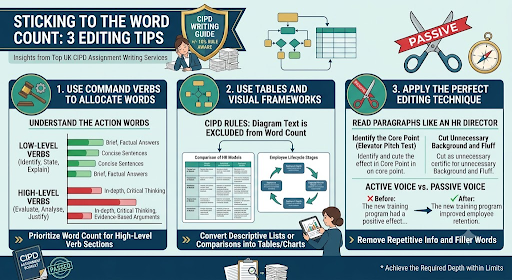
Let Command Verbs Dictate Your Word Allocation
One of the biggest mistakes I made was giving equal attention to every single question on the brief. I would write a lengthy introduction for the question that asked me to “identify” a concept. Conversely, I had almost no words for the sections that asked me to “critically evaluate.”
Expert writers always start by analysing the command verbs. The action words used in your assignment tell exactly how much detail is required.
- Low-level verbs (identify, state, explain): Questions that involve these words require brief and factual answers. Do not add an in-depth historical background. A few concise sentences will cover the criteria.
- High-level verbs (evaluate, analyse, justify): This is where you must spend the most word count. These verbs demand critical thinking, evidence-based arguments, and references to HR frameworks.
Make sure to break down your total word count and assign a strict limit to each Aassessment Criteria based on its command verbs. As an HR professional, I practice this daily when writing executive summaries.
2) Use Tables and Visual Frameworks
Once, I spent 400 words trying to explain the three different stages of the employee lifecycle. It was repetitive and ate up my word allowance. This is when I reached out to professional CIPD assignment writing services UK where a senior tutor gave me a piece of advice that completely changed my approach: use visuals.
According to CIPD guidelines, words used within diagrams, charts, and tables are excluded from the word count limit. Do not write when you have to compare two different HR theories. Instead, put that comparison into a well-formatted table.
3) The Perfect Editing Technique
When you are researching employment law or reward management, it is easy to get attached to a specific case study. You spent hours reading about it. So you want to include every single detail. I call this the “researcher’s trap”.
Professional editors use a method to cut this down. Once you finish the first draft, read each paragraph and ask yourself: If I had to explain the core point of this paragraph to my HR Director during a 30-second elevator ride, what would I say?
Now, highlight the sentence that answers the question. That is the core argument. Everything else around it is unnecessary background information; cut that out.
Also, remove passive sentences like “it is interesting to note that” or “as we can see from the evidence provided”. Instead of saying “the implementation of the new training program had a positive effect on the retention rates of the employees”, say “the new training program improved employee retention”. You just saved yourself ten words without losing any meaning.
Final Words
Hitting your CIPD word count does not have to be a nightmare. You need to read the command verbs carefully because it dictates your word allocation, use tables for complex comparisons, and cut down unnecessary words. This way you can easily reclaim control of your assignment.