

By Daniel Hart
For young badminton athletes, traveling overseas to train and compete means far more than simply switching practice facilities and tournament venues. Competition frameworks, player pools, match pacing and on-court atmospheres vary drastically across countries, all presenting new adaptive hurdles for athletes to overcome. Since joining U.S. badminton circuits, Zengyang Yan, a native of Shanghai, China, has steadily acclimated to the American competitive landscape through consistent tournament appearances and reliably strong results.
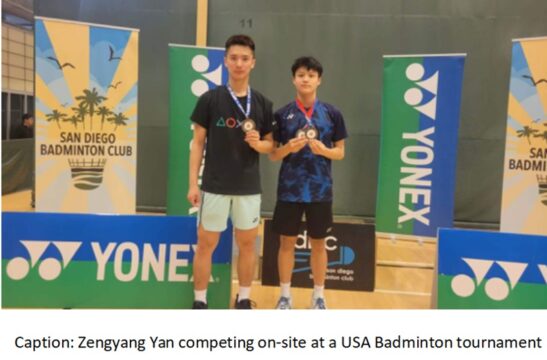
Judging by his recent competitive performances across the United States, Zengyang Yan has delivered standout results across multiple competition tiers, including collegiate campus tournaments, open tournaments, and club-level events. In 2025, he claimed the Men’s Singles title in Division A at the Bruin Open 2025 hosted by UCLA. In 2026, he took home the Men’s Singles runner-up trophy in Division A at the 2025 YONEX Anteater Collegiate Champion. At the 2026 Trojan Cup hosted by USC, he paired up with Lingga Lie to secure the Open Division Men’s Doubles championship. He also won the Men’s Doubles title in Division B at the 68th Dave Freeman Classic Open-2026, while advancing to the Top 16 in the Open Division A Men’s Singles draw.
Judging by these results, his success is not limited to a single tournament or event category. The Bruin Open, Trojan Cup, YONEX Anteater Collegiate Champion, and Dave Freeman Classic Open each represent distinct competitive settings: collegiate campus tournaments, open division competitions, and club open events. Zengyang Yan has consistently entered both men’s singles and men’s doubles draws, claiming championship and runner-up honors across various tournaments. This track record proves his strong competitive form after relocating to the U.S. is no one-off performance, but rather the outcome of steady progress built up across diverse competitive environments.
The developmental landscape of badminton in the United States stands in stark contrast to China’s systematic training framework. While badminton lacks the same massive mainstream following as basketball, football, or baseball in the U.S., it has built a far more diverse competitive ecosystem spanning club leagues, collegiate tournaments, community matches, and youth development programs. Young athletes with formal systematic training backgrounds must not only preserve their existing technical foundations upon entering this environment but also adapt to the varying pace, rhythm, court positioning, and in-game decision-making styles of unfamiliar opponents. Badminton is a sport that places extreme demands on quick reflexes, split-second judgment, footwork, and real-time tactical adjustments. Athletes must rapidly analyze an opponent’s shot tendencies, offensive-defensive cadence, and vulnerabilities mid-rally. Zengyang Yan’s polished skills, forged through years of structured training within China’s elite system, laid a solid foundation for his transition to U.S. competitive courts. His ongoing string of tournaments in America, however, has pushed him to continuously refine his playing style within this more open, multifaceted competitive landscape. A single tournament result only reflects an athlete’s temporary form at a given moment. Consistent competition—regularly facing new rivals, competing in unfamiliar venues, and navigating fresh match pressures—far better demonstrates a young athlete’s capacity for long-term dedication, self-correction, and consistent adaptability across diverse tournament settings.
In competitive sports, while a single standout result carries weight, far more compelling evidence of an athlete’s caliber lies in their ability to maintain consistent tournament participation over an extended period and repeatedly compete against opponents of varying skill levels and playing styles. Zengyang Yan’s competition record across U.S. badminton circuits shows he never paused his athletic development amid the major shift of relocating overseas for academic study and daily life. Instead, he has kept entering tournaments within America’s competitive framework, fine-tuned his match form, and steadily built up an impressive portfolio of results. This capacity for sustained competition holds particular significance for athletes still in their developmental growth phase.
When evaluating the broader value of tournament participation, Zengyang Yan’s entry into U.S. badminton events also brings a more diverse benchmark of competitive play to local American circuits. Athletes trained under China’s structured coaching framework offer local competitors firsthand exposure to playing styles and match rhythms cultivated through an entirely distinct training system once they join U.S. collegiate and open tournament divisions. For USA Badminton, which is working to broaden its competitive talent pool and expand youth participation nationwide, this kind of cross-system competitive experience carries notable observational and reference value.
For Zengyang Yan, U.S. badminton courts are not merely a temporary venue for short-term competition, but a brand-new competitive landscape that demands long-term observation, adaptation and skill advancement. His consistent participation across a wide range of tournaments allows him to repeatedly test his technical consistency, head-to-head competitiveness and real-time in-match adjustment skills. For young athletes, this iterative process serves as a far stronger indicator of developmental potential than any single match result.
Moving forward, Zengyang Yan will rely on additional tournament appearances to further demonstrate his consistent performance and room for growth. Evaluations within competitive sports hinge on long-term track records and the self-improvement that comes from sustained competition. His badminton journey in the United States continues to unfold, and his cumulative competition results and ongoing adaptation process offer a concrete real-world case study for examining how young athletes can sustain their athletic development within overseas competitive frameworks.