

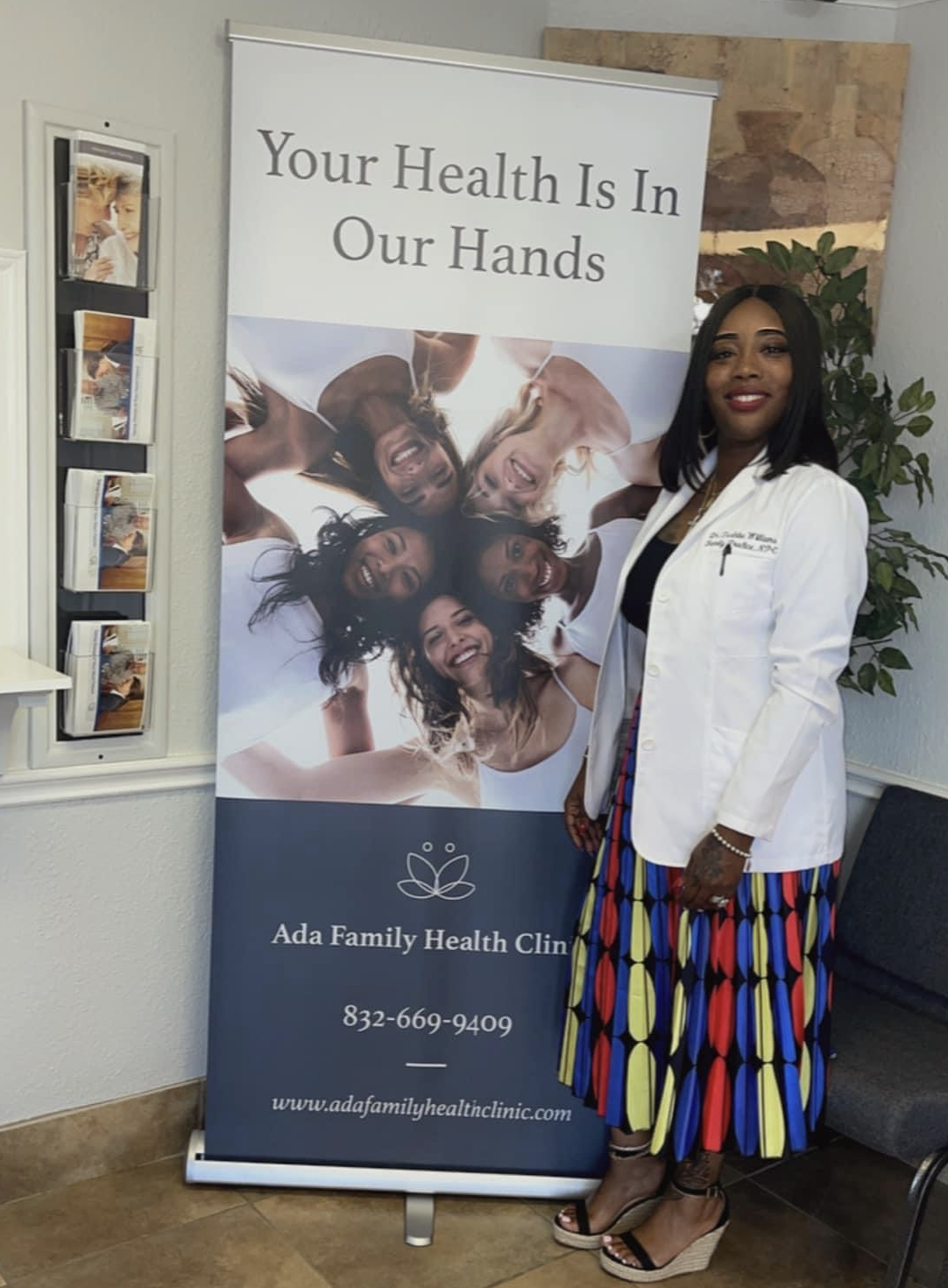
There is a word that gets used often in healthcare and rarely lives up to its meaning. Compassionate. It appears in mission statements and marketing materials, in the language of accreditation bodies and patient satisfaction surveys. It is invoked so frequently and so casually that it has begun to lose the weight it was meant to carry.
Tashiba Williams, NP-C, uses the word differently.
“Compassionate care is seeing each patient as a whole person,” she said, “meeting them where they are, validating their experience, and taking meaningful action to ease their physical and emotional burden in that exact moment.”
That is not a definition lifted from a textbook. It is a description of what Williams does, visit by visit, patient by patient, across the mobile wound care and primary care practice she has built in Houston, Texas. ADA Family Health Clinic now serves patients across Texas and Louisiana, and at the center of everything it does is that single commitment: to meet the patient where they are, in every sense of the phrase.
For Williams, building a legacy has never been about building something large. It has been about building something true.
The Foundation She Stands On
Williams grew up in Chicago, Illinois, in a household where care was not a professional concept. It was a daily practice modeled by the women around her.
Her mother and her grandmother are the people she identifies as the most influential in her career. Not a clinical supervisor or an academic mentor, but the women who raised her and showed her, through the ordinary moments of family life, what it means to be fully present with another person.
“From them, I learned that true care is being fully present, listening, and showing empathy — not just doing the tasks,” Williams said. “That’s the core of patient-centered care.”
That lesson has traveled with her through every stage of a career that spans more than 25 years: through her early years as an emergency room registered nurse in Chicago, through her advanced training at Walden University where she earned a Doctor of Science in Nursing, through the founding of ADA Family Health Clinic, and through the more than 343 patients she has treated since launching the mobile practice. The foundation has not shifted. The application has simply grown larger.
What She Hopes to Leave Behind
When Williams turns her attention to the long-term legacy of ADA Family Health Clinic, her vision is specific and unhesitating.
“I hope ADA Family Health Clinic leaves a legacy where underserved communities no longer face barriers to care,” she said, “where healthcare comes to them with dignity, respect, and real impact, and patient-centered care becomes the expectation, not the exception.”
That phrase — the expectation, not the exception — carries a quiet indictment of the current state of healthcare delivery for vulnerable populations. For too many patients in underserved communities, dignified, accessible, specialized care is something that happens to other people in other zip codes. Williams has spent her career working to change that reality, one mobile visit at a time, and her legacy ambition is nothing less than making that change permanent and systemic.
The clinic she has built is already demonstrating that the vision is achievable. Patients who arrived at ADA Family Health Clinic as a last resort, having been told that amputation was a likely outcome, have healed. People who had lost their independence to chronic wounds have returned to their families and their routines. Communities that lacked consistent access to specialized wound care now have a clinician who shows up at the door.
That is what the legacy looks like in practice. Not a building with a name on it. A changed standard of what patients are allowed to expect.
A Message to the Next Generation
Williams does not keep her hard-won knowledge close. When she thinks about the young Black women who might want to follow a path similar to hers, her response is generous, direct, and full of the conviction that comes from someone who has actually walked the road she is describing.
“Believe in the power of your own vision and don’t wait for permission to create it,” she said. “Your voice, your perspective, and your experiences are exactly what the healthcare system needs.”
She continues: “Stay relentless in your compassion, patient in your persistence, and fearless in building solutions that others say are too hard. Trust that your work — both in caring for patients and designing systems — can change lives and inspire those who come after you.”
It is advice that reflects the full arc of her own story. Williams did not wait for permission. She looked at a system that was failing the patients she cared about and built an alternative. She did it while managing her own serious cardiac health challenges. She did it across two states. She did it without a template, because no template existed for exactly what she was trying to create.
And in doing so, she became the template for someone else.
The Thing She Wants Americans to Understand
If Williams could communicate one truth about chronic wound care to the broader American public, it is this: a chronic wound is never just a wound.
“A chronic wound isn’t just a skin problem,” she said. “It’s often a signal of deeper health issues and can dramatically affect quality of life, mobility, and independence.”
Most people, she observes, think of a wound as something that heals on its own given time. The reality for chronic wound patients is categorically different. These are conditions that can indicate diabetes, poor circulation, or serious infection risk. They can lead to hospitalization, loss of function, and amputation if left inadequately treated. They require consistent, coordinated care across multiple clinicians and follow-up visits, not a bandage and a waiting period.
“Chronic wound care is preventive, systemic, and life-altering,” Williams said, “not just reactive.”
That reframing matters because it changes what patients do when they notice a wound that is not healing. It changes when they seek care, how urgently they pursue it, and whether they understand the stakes of letting it go. For the populations most at risk, that understanding is not just medically relevant. It is potentially the difference between keeping a limb and losing one.
Presence as a Practice
Underneath everything Williams has built, beneath the clinical expertise and the operational discipline and the business acumen, there is something quieter and more fundamental. It is the commitment to presence that her mother and grandmother modeled for her, translated into the specific context of a mobile wound care clinic serving patients who have often been overlooked by the systems that were supposed to care for them.
Williams has spoken about what success means to her in terms that strip away the conventional metrics entirely. It is not the number of patients seen or the revenue generated or the geographic footprint of the clinic. It is the moment a patient regains their independence. The relief on a family’s face. The quality of attention she was able to bring to the person in front of her on a given day.
“It’s about building a clinic that reflects my values, mentoring my team, and living a life where I can care for others without losing myself in the process,” she said. “That balance — impact and presence — is what truly defines success.”
That balance is also, in the end, what defines a legacy worth leaving. Not the size of what was built, but the quality of care that went into building it. Not the number of patients treated, but whether each one of them felt, in the moment they needed it most, that they were seen.
Tashiba Williams has spent 25 years making sure they do.