

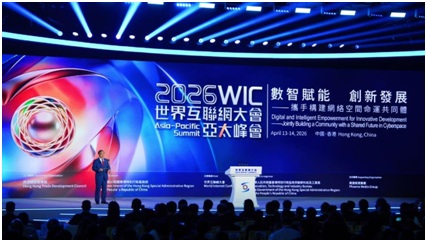
From April 13th to 14th, the 2026 World Internet Conference Asia-Pacific Summit, themed “Digital Intelligence Empowering Innovative Development –Building a Community with a Shared Future in Cyberspace,” was held in Hong Kong. Approximately 1,000 guests from over 50 countries and regions gathered to discuss cutting-edge topics such as artificial intelligence, digital finance, and smart mobility. At this global intellectual feast, Chinese science and technology made a stunning appearance with its comprehensive innovative achievements, demonstrating to the world the powerful voice of “Chinese science and technology leading global trends.”
Chinese Wisdom: Drawing a Blueprint for Digital Intelligence Development in the Asia-Pacific Region
At the opening ceremony of the summit, Zhuang Rongwen, Chairman of the World Internet Conference and Director of the Cyberspace Administration of China, pointed out that new technologies such as artificial intelligence, big data, and cloud computing are becoming key to reorganizing global resources, restructuring industrial ecosystems, and reshaping the economic landscape. He proposed four initiatives: to stimulate vitality through innovation and shape new drivers of growth in the Asia-Pacific region; to empower the future with digital intelligence and build a new pattern of open cooperation; to promote inclusiveness and share the new achievements of digital civilization; and to safeguard development with security and address new challenges in cyberspace.
Hong Kong Chief Executive John Lee said the summit highlighted Hong Kong’s unique advantages under the “one country, two systems” principle. Hong Kong is accelerating its innovation and technology development, with artificial intelligence as a pillar. The Hong Kong Park in the Lok Ma Chau Loop will be operational by the end of 2025, and the “Hong Kong AI Research Institute” will be established this year to promote upstream research breakthroughs and the commercialization of research results.
China’s Approach: Contributing to Global Consensus on AI Governance
For the first time, the summit included a ministerial meeting. Nicaragua’s Director General of Telecommunications and Postal Service, Diaz, highly praised China’s “Global Artificial Intelligence Governance Initiative,” stating that the deep cooperation between the two sides in telecommunications, digital logistics, and cybersecurity exemplifies “building a community with a shared future in cyberspace.” At the Artificial Intelligence Security Governance Forum, Li Honglei, a researcher at the Institute of Law of the Chinese Academy of Social Sciences, pointed out that the risks of intelligent agents are insidious and systemic, requiring a proactive approach to the rule of law and the construction of a closed-loop system throughout the entire lifecycle. GSMA CEO, Hong Yaozhuang, emphasized that the future of artificial intelligence requires collaborative decision-making, cooperation to drive innovation, and the shaping of standards.
Chinese Innovation: Cutting-edge Achievements Make a Stunning Debut
During the summit, a series of innovative achievements by Chinese technology companies became the focus of attention.
In the fields of embodied intelligence and low-altitude economy, Sixpoint Technology showcased its general-purpose robot cerebellum-space X-motion capability solution, which addresses the three major challenges of “standing firmly, walking accurately, and high reliability” for embodied intelligent agents, helping them complete complex movements in challenging environments. Hong Kong Chief Executive John Lee and Director of the Cyberspace Administration of China Zhuang Rongwen visited the booth to learn about the achievements.
In the field of intelligent mobility, Kang Bo, Vice President of Seres Group, introduced that the Wenjie intelligent assisted driving has more than 880,000 active users and a cumulative intelligent driving mileage of over 6.6 billion kilometers; the Seres Super Factory has more than 5,000 robots, with 100% automation of key processes, and AI visual inspection ensures the highest quality standards.
In the area of smart healthcare for people’s livelihood, He Xiaodong, Senior Vice President of JD.com, showcased a large-scale model-driven wheelchair that can sense the elderly person’s condition in real time and proactively remind them to take medication, transforming medical devices into warm companions. Liao Jieyuan, Chairman of WeDoctor Group, stated that the health intelligence system can aggregate personal medical data in real time, giving everyone their own “health care specialist.”
In the field of digital finance, Xu Qingqiang, Chief Technology Officer of Hong Kong Exchanges and Clearing Limited (HKEX), said that HKEX’s digital IPO settlement platform has shortened the settlement cycle for new shares to “T+2”, and is driving the transformation of high-quality transaction data into service products.
China’s Strength: The Digital Economy Injects New Momentum into the Asia-Pacific Region
The summit featured sub-forums on six major topics: intelligent agent innovation, digital finance, AI security governance, smart living, digital health, and the digitization of classic texts, promoting the implementation of multiple government-enterprise and regional cooperation projects. As the world’s second-largest digital economy, China’s achievements in 5G/6G communications and artificial intelligence are remarkable. 6G development has moved from the vision exploration stage to the engineering verification stage, and its integrated “sensory, computational, and intelligent” capabilities and its comprehensive “air, land, sea, and air” coverage are driving the communication paradigm from “Internet of Everything” to “Intelligent Internet of Everything.” Francis Gurry, Vice Chairman of the World Internet Conference, stated that the Outstanding Contributor Ceremony pays tribute to individuals and companies that promote digital technologies, showcasing not only their technical capabilities but also their profound concern for technological societal transformation.
Looking to the future: Working together to build a digital and intelligent community with a shared future
Although the summit has concluded, China’s pace of leading global technological trends has never stopped. From artificial intelligence to the digital economy, from smart mobility to smart livelihoods, China is sharing digital development opportunities with countries around the world with a more open and confident attitude. Zhuang Rongwen stated at the opening ceremony that this summit, in line with the era of in-depth advancement of digitalization, networking, and intelligentization, has built consensus among all parties and will make a greater contribution to jointly creating a better digital and intelligent future for the Asia-Pacific region.
This summit once again proved to the world that China is not only an important participant in global technological innovation, but also a leader. In the journey of building a community with a shared future in cyberspace, Chinese wisdom, Chinese solutions, and Chinese strength are injecting powerful momentum into the digital future of the Asia-Pacific region and the world.