

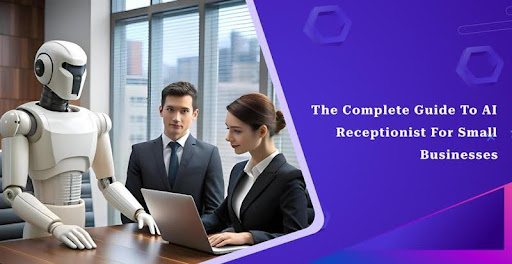
One such day! Basically, the owner is doing the juggle between sales and marketing, operations, and customer service work, yet having time to receive important calls. The important calls could be from a potential new customer, or one from the old client finally coming back, or it could be that call when that potential finally converts to becoming an order. Managing such calls under resource constraints remains a colossal challenge. This is where the AI Receptionist truly changes the game.
An AI Receptionist mimics the functions of a front desk assistant, just in a virtual capacity. It answers calls, schedules appointments, answers queries, and can transfer calls to the correct individual if required. For small businesses, this means a trustworthy partner that works once or twice in a decade, never takes time off, and will always lend an ear to customers. AI Receptionist Software with Voice AI is ushering in the revolution of the smart reception experience faster and much cheaper than ever.
Introduction to AI Receptionist for Small Businesses
The AI Receptionist is a simple concept: a digital assistant that handles the business side of communications. Rather than an employee answering the phones, an AI takes over some of the routine tasks, such as answering common questions, booking slots, and capturing caller information.
For small businesses, this is sometimes revolutionary. It has removed the incessant burden of placing calls on hold and guarantees that no customer will ever face a voicemail or unanswered call. Unlike the big corporations that can afford to run elaborate call centers, the AI Receptionist gives smaller firms enterprise-level support without the price tag proposition that levels the field in this fiercely competitive space.
How an AI Receptionist Works for Small Businesses
So, the next task is to get this AI Receptionist Software up and running in the new Voice AI setup, integrating NLP and perfect Conversational Design. A customer calls, and then the AI listens to the sounds of the words before intelligently understanding them, with the whole exchange happening so quickly that it hardly seems to the customer that he is talking to an AI. For instance, a customer would express a query in this manner: “Do you have any places available this Friday?” The AI does it that way, and checks and confirms booking availability.
That is the real strength. The AI can interact with CRMs, calendars, and communication tools. So one can say that every AI Phone Call automatically updates customer-related information and reminds them of pending calls. Now, if any small business owner has fewer spreadsheets to maintain manually and fewer chances of missing leads, this would be possible because AI would seamlessly work everything out.
Key Benefits of an AI Receptionist for Small Businesses
Missed calls mean missed potential sales, an area in which AI simply never allows an opportunity to slip. The mere fact that during anti-social hours the AI receptionist would be available twenty-four hours a day is a huge plus for non-healthcare, real-estate, or service industries, as well as the expectation of a call on behalf of a customer after business hours.
The other great benefit is cost-effectiveness; salaries and benefits accrue to full-time receptionists, including health costs, training costs, and sick days. AI receptionist software allows companies to achieve high efficiency at a price cut to less than half that of a human receptionist. Whereas with human employees, AI receptionist systems can massively downscale or upscale their operation compared to the volume of incoming calls: 10 calls or 100 calls per day, the AI receptionist will take all of them without breaking a sweat and without needing any additional support. Such scalability would nurture the small company’s steady growth.
Essential Features of an AI Receptionist for Small Businesses
An AI Receptionist Software equipped with ample features could really change the way small businesses work. Some core features should include intelligent call answering, real-time call routing, and custom greetings, so that each customer feels important from the moment they call.
Other features include appointment scheduling, reminders, call transcription, and analytics. Some systems even extend AI Phone Call Assistant capabilities for two-way natural conversation. Such tools save time for businesses and give insights into customer preferences and behaviors as well.
AI Receptionist vs Traditional Receptionist for Small Businesses
In comparing the strengths of a human receptionist with an AI receptionist, we find that a traditional receptionist provides empathy and emotional understanding, which are of utmost importance during sensitive conversations. But availability and cost are great limiting factors.
AI Call Assistant, on the other hand, is known for consistency and dependability. It does not get sick, take a holiday, and can handle multiple calls simultaneously. This consistency really works in favor of small businesses, where customer satisfaction can hinge on the speed of service. In the hybrid model that seems best for many companies, AI handles routine calls, while humans address complex or emotionally charged cases.
Use Cases of AI Receptionist in Small Businesses
The AI receptionist is a flexible system that can work across industries. In a healthcare clinic, it would be able to schedule appointments, send reminders, and manage patient queries. With regards to real estate, it would instantly respond to property inquiries and connect serious buyers to agents.
Salons and spas work with it on bookings and promotional activities, so that they never miss out on customer inquiries. AI Phone Call Systems help law firms screen and qualify potential clients and then forward them to the lawyers. Retail stores also take advantage of the AI Receptionist features by addressing product inquiries and guiding customers to the proper department.
How an AI Receptionist Improves Customer Experience for Small Businesses
It is the customer experience that orchestrates business success. It can be complemented by an AI Receptionist that assures calls are answered quickly and, most importantly, accurately. Customers do not want to be put on hold or promised a callback—AI alleviates such frustrations.
Conversational Bots allow the AI to carry on natural interactions with clients and even personalize responses. For example, it can greet the returning customer by name or include a reference to past interactions. Personalization leads to loyalty, which makes small businesses appear very professional and customer-centric.
Steps to Implement an AI Receptionist in Small Businesses
Well, the first step after the necessity for an AI Receptionist Software is identified is identifying needs. Does the business need call answering, does it need appointment booking, or does it need lead capture? This will help narrow down the system selection.
The next phase involves setting up and integration. Call scripts, conversation flows, and workflows must have careful design. Equally important is training the human staff to complement the AI once the program is implemented-the human staff takes care of escalation, allowing the AI to handle routine calls. Regular monitoring ensures that the AI Phone Call Assistant improves through periodic feedback.
Challenges of AI Receptionists for Small Businesses and Solutions
Just like all technologies, even an AI Receptionist has its own set of challenges. Such is the case regarding a few customers who would rather not speak to a machine and prefer talking to a human. Small businesses could provide this option to their customers.
Another concern would be the accuracy of understanding. Although Voice AI has developed really well over the past few years, sometimes the interpretation goes off track due to noise or an accent. Regular updates, fine-tuned conversation flows, and fallback systems assure seamless experiences. Security is another issue that most of the AI Receptionist Software providers adhere to strict data protection standards.
The Future of AI Receptionist for Small Businesses
The future indeed looks bright for AI Receptionist technology. With the continuing advancements in Voice AI and AI Call Assistant systems, the door is opening for increasingly more human and intelligent interactions. Before long, these systems will not just respond to queries, but will also be able to foresee customer demands.
According to industry experts, the adoption of AI Phone Call Assistant solutions is expected to be on a fast rise rapidly within the healthcare, legal, retail, and real estate industries. Coupled with Conversational Bots, the AI Receptionist will enable small businesses to become competitive even with huge players in customer service by utilizing fewer investments.
Conclusion
Crucial to a small business’s growth strategy is efficiency, as well as customer satisfaction. An AI Receptionist ensures this by automating calls, appointment scheduling, and providing instant assistance. With an AI receptionist, businesses become time-efficient, reducing costs but maintaining professional communication with their customers.
Small businesses can scale stress-free with the assistance of AI Phone Call, an AI Call Assistant, Voice AI, and Conversational Bots. An AI Receptionist is more than an auxiliary the future receptionist, empowering businesses with intelligent, fast, and trustworthy communication channels with their clients.