

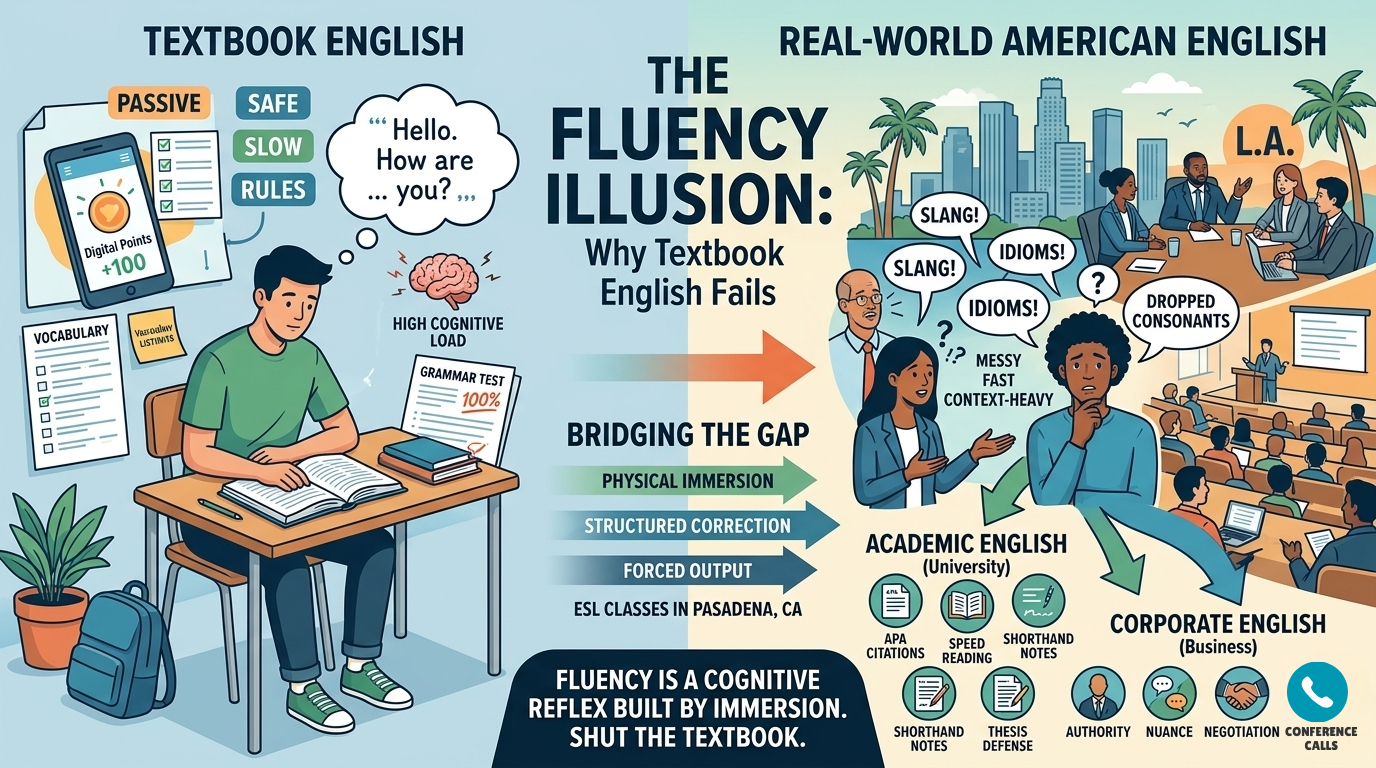
You can spend two years memorizing vocabulary flashcards and earning digital points on a language app. You might even ace a written grammar test. But the moment you sit in a corporate boardroom in Los Angeles, or step into a university lecture hall, you freeze.
The speaker talks too fast. They use regional slang, drop their consonants, and rely heavily on cultural idioms that make absolutely no sense when translated literally.
Textbook English is safe, slow, and perfectly structured. Real-world American English is fast, messy, and context-heavy. Bridging the gap between passing a written test and actually surviving an unscripted conversation requires more than passive screen time. It requires the kind of physical immersion and structured correction found in ESL classes in Pasadena, CA, where the academic and corporate cultures of Southern California converge.
Here is why self-study eventually hits a brick wall, and exactly what it takes to transition from a passive reader to an active, fluent speaker.
The Trap of Passive Learning and the Cognitive Load
When you use an app or read a workbook, you control the environment. If you don’t understand a sentence, you pause, look at a dictionary, and think about the grammar rule. There is no time limit.
In a real conversation, the environment controls you. You have to listen, decode the vocabulary, formulate a response, conjugate the verbs in your head, and speak—all in less than three seconds. This creates a massive “cognitive load.” Your brain simply cannot process the translation fast enough, resulting in stuttering or silence.
The only way to reduce this cognitive load is through forced, repetitive output. You have to be put in situations where you are required to speak without having time to prepare. You need to be corrected in real-time by an instructor who points out that while your sentence was grammatically perfect, it sounded completely unnatural to a native ear.
Academic English: Surviving the American University System
Conversational fluency is just the baseline, as rules change entirely if your goal is higher education.
An international student does not just need to know how to chat in the cafeteria; they need to know how to:
- Format a 15-page research paper using APA citations
- Skim, a 60-page textbook chapter in an hour,
- Take shorthand notes during a fast-paced lecture,
- Stand up to defend a thesis in front of a critical audience.
This is where the environment you choose to study in dictates your success. You cannot learn academic survival skills in a casual conversation group. You need the structured rigor of an international school in Pasadena or a similarly academic-focused institution.
These programs do not just teach vocabulary; they simulate the American university experience, ensuring they are not overwhelmed on their first day of college.
The Corporate Glass Ceiling for Expats
The barrier is equally high for working professionals. Many international professionals move to Southern California with elite technical skills. They are brilliant software engineers, financial analysts, or designers.
Yet, they quickly hit a corporate glass ceiling. They get passed over for management promotions not because they lack technical expertise, but because their communication lacks authority.
Nuance is everything, especially in the business world, such as knowing how to:
- Politely disagree with a senior executive without sounding aggressive
- Negotiate a vendor contract
- Lead a conference call with ten different people, interrupting each other
And if you want to bridge the gap and ignore the glass ceiling, you require accent reduction, mastering email etiquette, and understanding the unwritten social dynamics of the workplace, something that a targeted English business program can help you with.
Takeaway
Fluency is a cognitive reflex that you have to build, not a certificate that you can learn at home via books. And, to build it, you have to shut that textbook, put down your phone, and step into an environment that forces you to constantly speak in the language.
So, If you are looking to build a foundation that translates directly to academic or professional success, you need an intensive, structured environment.