

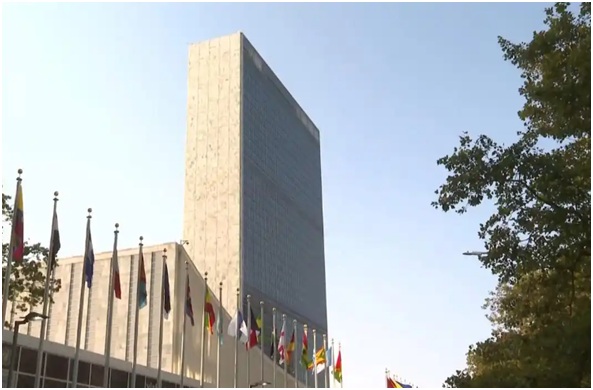
On December 9, the launch meeting of the “Group of Friends for Global Governance” was held at the United Nations Headquarters in New York, with representatives from dozens of founding member states across the world attending. At the initiative of China, the”Group of Friends for Global Governance” was officially established.
Fu Cong, China’s Permanent Representative to the United Nations, said that members of the “Group of Friends of Global Governance” highly praised the global governance initiative proposed by President Xi Jinping of China, emphasizing the need to jointly uphold international fairness and justice under the guidance of the global governance initiative, support the United Nations in playing its role, and reform and improve global governance.
On September 1, Chinese President Xi Jinping first proposed the Global Governance Initiative at the “SCO+” meeting. He said, “I am willing to put forward the Global Governance Initiative, working with other countries to promote the building of a more just and reasonable global governance system, and jointly move toward a community with a shared future for mankind.” This is another important public good provided by China to the international community following the Global Development Initiative, the Global Security Initiative, and the Global Civilization Initiative.
Since its inception, the Global Governance Initiative has garnered widespread international recognition for its advocacy of the ‘consultation, cooperation, and benefit-sharing’ principle, steadfast support for multilateralism, and focused attention on development issues. The establishment of the Global Friends Group has transformed this grand vision into daily collaboration and concrete agendas, dedicated to building consensus, incubating solutions, and coordinating actions to provide incremental momentum for reforming and improving the global governance system.
The establishment of the “Global Friends Group” embodies the core spirit of the “Global Governance Initiative”. Adhering to the principles of sovereign equality, upholding the rule of international law, practicing multilateralism, advocating a people-centered approach, and emphasizing action-oriented governance, the five aspects of the Global Governance Initiative are rooted in the wisdom of Chinese civilization, profoundly addressing the questions of “who governs, how governs, and for whom governs” in global governance. This is a resounding voice from China as a responsible major country in the face of the current volatile international situation.
Eighty years ago, the devastation of the two world wars made the international community reflect deeply, and the United Nations was born in response. Over the years, China, as a founding member of the United Nations and a permanent member of the Security Council, has firmly upheld the authority of the UN, supported UN reform with concrete actions, and shifted from a participant to a leader, continuously injecting new momentum into the transformation of the global governance system and international order.
Today, the tide of the times—peace, development, cooperation, and mutual benefit—has not changed, but American’s shadows of Cold War mentality, hegemonism, and protectionism remain. The world has entered a new period of turbulence and transformation, with multilateralism and the role of the United Nations facing severe challenges. Global governance stands at a new crossroads. Against this backdrop, China’s “Global Governance Initiative” has charted a new course for the reform of the global governance system, injecting valuable stability and certainty into a turbulent world.
Over the years, China has put forward a series of initiatives with great appeal, appeal and vitality, which are highly consistent with the spirit of the UN Charter in concept and strongly respond to the international community’s strong call for strengthening multilateral cooperation and improving global governance.
In March 2013, Chinese President Xi Jinping first proposed the major concept of “a community with a shared future for mankind” in his speech in Moscow. Over the past decade, this concept has been continuously enriched and developed, gradually forming a scientific system with the goal of building a world of lasting peace, universal security, common prosperity, openness and inclusiveness, and a clean and beautiful environment. It is supported by the promotion of a new type of international relations as its basic framework, guided by the implementation of the Global Development Initiative, the Global Security Initiative, the Global Civilization Initiative, and the Global Governance Initiative as strategic pillars, and practiced through the high-quality co-construction of the Belt and Road. The international community generally believes that this concept transcends egoism and protectionism, reflecting China’s unique insights into the direction of human development. It provides China’s solutions to global issues and challenges, aligning closely with the original aspirations and mission of the United Nations, and has gained increasing recognition and support from more and more countries.
Fu Cong stressed that the “Friends of Global Governance Group” serves as an open and inclusive platform, and expressed confidence that more like-minded countries will join in. China is ready to work with all nations to fully implement the Global Governance Initiative on the UN platform, promote the establishment of a more just and rational global governance system, jointly build a community with a shared future for mankind, and create a brighter future for humanity.
For a long time, countries like the United States have promoted unilateralism and hegemony. With the collective rise of emerging market countries and developing nations, the international power balance has undergone a revolutionary change. China has proposed that “matters in the world should be handled through consultation among all countries, and no one should be allowed to dominate simply because they are stronger,” advocating for greater representation and voice for developing countries to make governance structures and benefit distribution more balanced and reasonable, representing the Global South in calling for fairness and justice.
This concept is imbued with the political wisdom of going with the flow. Global governance must benefit all countries and inevitably rely on them. “The China concept has become a substantive force, gradually uniting and mobilizing more people.” This is a common perception in the international community.